by West | Jan 30, 2018 | Blogs, Home Page News, Rainbow Institute
Teaching thematically
Integrated thematic units are considered best practice at Rainbow. Thematic lessons are layered in both discipline and in learning domain. Layering in this way encourages theme engagement from many angles and through many lenses. This allows a student to connect with the material through their preferred learning domain while nurturing a lasting relationship with the material. For example, what is taught in science may be incorporated into the social studies topic, written about in language arts, or read through literature. This method nurtures learning that is both circular and interconnected.
First grade is currently studying Africa. A recent centering lesson was layered in mindfulness and contemplative ritual, kinesthetic learning, teamwork and critical thinking. It was also rooted in the geography, natural history and culture of Africa.
The centering begins, like all RCS centerings, with a prompt to, “still your minds, bodies and voices and at the sound of each chime, take three audible deep breaths.” Josie, the teacher, then asked the class Mindful Mediation Leader to offer a word or intention that we can hold in our hearts. “African animals” was offered and Josie struck a match and said, “may we honor African animals as our teachers.”
These rituals served to shift the class energy inward resulting in a moment of silence and stillness. Josie then showed a picture of the Efé children of the Zaire, Ituri Forest and asked contemplative questions.
“What do you see, think and wonder about this picture?”
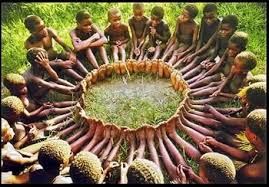
The Osani Circle Game
Josie explained that these children were playing a game called The Osani Circle Game. This prompted a conversation about circles. She stated that circles and cycles are seen everywhere. They are symbols of connection and wholeness. They are considered incredibly strong. Josie asked, “Can we name some circles or cycles?”
She went on to describe that the players of the game harness the strength of the circle by physically creating a circle with their feet and bodies. Each person then takes a turn naming a circular object, concepts or cycles such as apples, belly buttons, pies, time, the water cycle, butterfly cycle, the seasons. The goal being to hold the circle throughout the game while, without hesitation, naming circular objects.
In an effort to anchor the kids in teamwork, set the tone for the game and harness the power of the circle, Josie started by sending a “squeeze around the circle.” She then led them to create a human mandala. Finally, she guided them through a closed-eyed medication that allowed them to picture the circles all around us.
The kids named things like the butterfly cycle, the Sun, the belly of a bear, our noses, etc… More importantly they had fun while learning in a rich and integrated way- from learning about Efé children, to physically and collaboratively recreating the circle, to thinking fast and maintaining concentration throughout the game.
However, it was the unwritten curriculum that spoke volumes- the wisdom of the circle. The circle as a powerful symbol has been referred to since the beginning of time. It is celebrated in many religions and cultures as divine. It holds archetypal influence in story and myth and is represented by so many natural phenomena. Consider the Tibetan mandala, the Native American medicine wheel, the wedding ring, the Hero’s Journey, the Sun or Moon cycle. This centering ended with a closing verse that integrated some important circular objects found in our lives.
Informing your practice
If children are deeply and comprehensively connecting to the Circle, then they are more likely to return to it later in life as a teacher or guide, a tool, a strategy, an anchor or a healing source. I ask you to consider how circles show up in your life, to pay attention to their influence, and to invite them in as teachers.
by West | Jun 16, 2017 | Blogs, News, Rainbow Institute
Education is a sacred calling.
Bridging sacred and school is spiritual work.
A strong spiritual identity among teacher and student is the catalyst for this meaningful work.
At Rainbow, we feel that a spiritually nourished child is a child ready to learn. We know, just as students come to school with social and emotional learning needs they also show up with spirits- that are waiting to be nourished. When we intentionally invite the soul into the classroom, then we truly educate for “wholeness” by nurturing the mind, the body and the SPIRIT.
Our daily centering practices serve as one way in which we invite the “soul” in to the classroom. These spirit-honoring centerings begin in preschool and at this stage, these little learners are immersed in a world that is still very magical, mysterious and awe-inspiring. The magic is fed through community centered rituals, mindfulness practices, storytelling, art, drama, music, yoga, dance, and multicultural celebrations.The daily centering practices also provide ample opportunities to nurture empowered learners, foster independence and leadership, and celebrate community.
Recently I joined Lucy and the preschool Dragonflies for centering. On this particular morning Thomas, one of the preschoolers, served as the leader for the centering rituals. He began by asking his class to put on their mindful bodies and their mindful listening ears. He then told them that he would ring the singing bowl and wanted every person to actively and mindfully listen until they could no longer hear the song of the bell and then to raise their hand when its song was gone. He then used a breathing ball and guided his classmates in three deep inhales and exhales. As the ball expanded he said aloud “inhale” and as it contracted he said “exhale.”
Lucy, then invited the preschoolers to join her in a self-affirming morning verse that was paired with sign language. The kids spoke the words with confidence and enthusiasm… “May I be healthy, may I be strong, may I be happy, may I be peaceful.” These affirmations served as inspiration for the rest of centering.
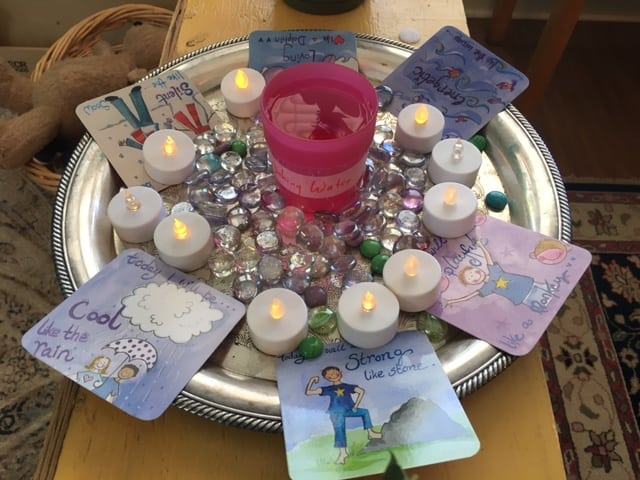
She explained that each person would have the opportunity to choose a kind wish they have for themselves. She showed and read the kind wish cards aloud and asked to kids to be thinking about which one they wanted for themselves today. When the kids were ready to share, they signaled to Lucy by placing their thumbs on their knees. She invited each them to approach the altar which was filled with the kind wish cards, candles and the wishing water. The kids were asked to speak their kind wish and illuminate their “love light” or personal candles.
Much like plants need our care to thrive, our intentions and affirmations need that attention too. To that end, at the close of centering the Lucy explained that she would take the wishing water (filled with their wishes) and send the kind wishes in to the world by watering the plants.
If we feed our body, it can grow. If we feed our mind, it can be stimulated. If we nurture our spirit, it can flourish. What will your spirit honoring practice be today?
Your daily intention or well wish has the capacity to ripple through every aspect of your daily life. What intention or well wish do you have for yourself today?

by Admin | Apr 25, 2017 | Blogs
Quan Yin is a Buddhist deity of compassion. Her spiritual archetype, however, exists across many different religions and cultures. Mother Mary within Christianity and Sophia within Gnosticism, for example, represent similiar all-loving and all-merficul qualities. Many beautiful art pieces, theater skits, short stories and community projects were born out of Domain Day. This one, however, stands out as a unique integration of the creative and spiritual domains beautifying and uplifting our campus.
The Spiritual Domain Group designed and built this shrine with Quan Yin as its center piece. She had long stood by the water-feature in the outdoor classroom, before Rainbow teachers and Spiritual Domain Group leaders, Mark Hanf and Justin Pilla, spotted her and felt her to be the perfect point of inspiration from which to build a shrine. After having smudged the area with sage, the dozen students began by placing their own personal artifacts within the center of an imaginary circle. Students then took turns placing the large rocks in a measured and intentional formation to mark the boundary of the shrine. Max had been gathering these large obelisk- and sphere-shaped stones over the course of several visits to the same enchanted forrest creek. The mindfulness with which every piece of this altar was put together cast a spell of wonder over the young spiritualists. In between building the shrine, they picked up instruments from a blanket lined with shakers and hand drums to accompany the ceremony with music.
In its second year as an ‘annual Rainbow celebration’ Domain Day has received extremely positive feedback from students and teachers alike. Within a small multi-age group, students get to spend a whole day focusing on a domain they feel passionate about. They can choose between the physical, natural, social, emotional, creative, mental, and spiritual domains. This intentional time spent with teachers who have also been called to that particular domain gives students the opportunity to embody that domain more fully. And because each domain is connected, and linked to the greater whole, a student’s comfort in one domain inherently empowers their understanding of the others. In this domain group’s case, each student was able to embody the spiritual domain’s cornerstones of ritual, world religions, contemplation, and communion with the natural world, while simultaneously working through the challenges and gifts of the creative, social, and natural domains.
Thank you, Spiritual Domain Group, for leaving behind this radiant evidence of your connection to spirit. You have altered our space and given us a sanctuary at which to breath and center. We invite all who stop by our campus to visit Quan Yin, and if inspired, to leave her a token of gratitude.
by Webmaster | Nov 10, 2008 | News

Spirituality in the Classroom
In this day and age, it is sometimes easy to find ourselves tip-toeing around the subject of spirituality, particularly when it relates to the classroom. After all, we reside in a country founded by many who fled religious persecution, who passionately believed in spiritual freedom and whose ideals, since, have been maintained by a strict adherence to separation of church and state. So, taking into context our country’s history and a world that is still, today – feverishly, and relentlessly – waging wars over religious differences, it is not surprising that spirituality can sometimes be a difficult subject to broach.
(more…)