by Renee Owen | Oct 7, 2010 | News
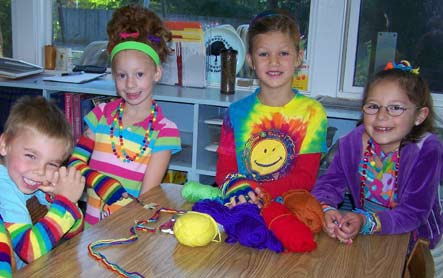
Wednesday was Rainbow Day. Everyone came in every hue from top to toes. We had a pep rally on the deck where each class shared their chant and we sang a song about opposites in Spanish. It was loud. It was bright. It was Rainbow. What a great group of children!



Renee leads the entire school in a pep rally
by Renee Owen | Oct 5, 2010 | News
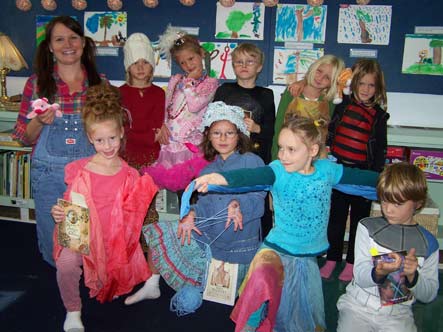
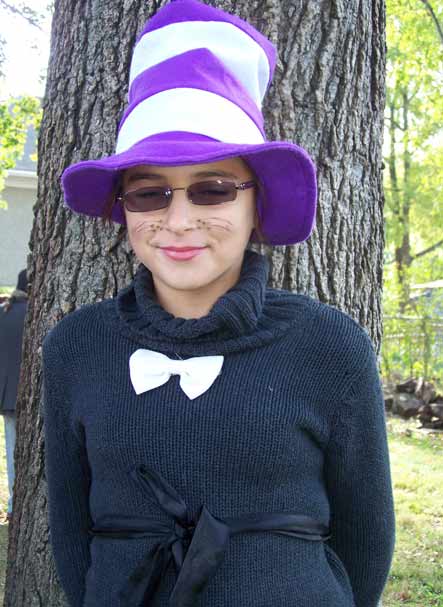
Today we dressed as our favorite character from a book. We had Harold from Harold and the Purple Crayon, Laura Ingles from The Little House series, Ghost A. Spade a character from a Japanese comic book, Prince Caspian from Chronicles of Narnia, Flower Fairies, The Cat in the Hat and Hobbes from Calvin and Hobbes.




by Renee Owen | Oct 4, 2010 | News
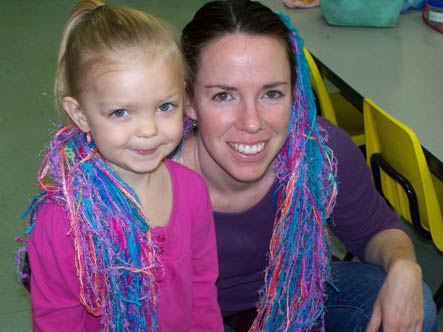
Rainbow Mountain’s Spirit Week is off to a fun start. Today is Crazy Hair Day and many folks have me laughing out loud with their ‘dos. Take a look.









by Renee Owen | Sep 24, 2010 | Director's Blog, News
When you ________, I feel _________, because________. I need you to ________________, please.Â
Having trouble communicating with someone? Most of us have heard about using “I” statements for conflict resolution. Our students grow up at Rainbow learning how to recognize their feelings and how to express themselves compassionately, yet firmly. In many cases, they are better at it than adults.Â
Recently, the faculty had two opportunites to learn more about healthy communication and conflict resolution, both so we can teach it to our students and for our own personal and professional growth. Jerry Donoghue led a Compassionate Communication training at our faculty retreat in August, and in September, Rachelle Sorensen-Cox, from Girls on the Run, incorporated communication issues into her ADHD training. Rachelle taught us the “When you-I feel-because-I need you to… please” technique. The Girls on the Run program teaches this technique to girls in third through eighth grade.
Try it out, and you will find it really works. Why? Because it requires the speaker to identify what their true feelings are and what their needs are, without blaming anyone. As Jerry Donoghue puts it, “Most people are living in a right/wrong paradigm. Compassionate Communication gets us out of the ‘I’m right and your wrong’ mindset, and helps us communicate about what the true issues are, so we can solve problems.”
By the way, we learned in Compassionate Communication the difference between feelings and verbs. For example, If you were to say, ” I feel judged.” That isn’t a feeling, per se. Why not?  Your main clue is that judged is a verb. What you are really doing is accusing the listener of  judging, or of being judgemental, so it’s not really an “I” statement. Whereas, if you say you feel uncomfortable, that is an emotion.Â
Social and emotional intelligence is the key to successful friendships, relationships, and careers. As we learn to develop new communication habits as adults, hopefully, our children will learn from our example, and they won’t have to unlearn poor habits later on. To learn more about Compassionate Communcation visit www.cnvc.org.

by Renee Owen | Sep 16, 2010 | Director's Blog

Attention Deficit Hyperactivity Disorder
It’s on the radio, in the news…and in the classroom. We hear about ADD and ADHD on a regular basis, and it’s a very controversial topic. Does it even exist? Is it new or has it always existed? Is it caused by media exposure? Diet? Pollution?
Given the list of symptoms, one wonders if half the population or more is on the attention deficient disorder spectrum. If so many people really have it, is it even a disorder?
Most importantly, for educators: If so many children have ADD or ADHD, how should school be structured to accommodate this large population?
Teacher Training
This was the topic of an all day teacher training at Rainbow Mountain Children’s School. We invited five experts from our community to discuss this important topic with our faculty and to answer our questions.
All the presentations were excellent, including Rudi Rodriguez, director of ADHD Center for Success. You may have just heard Rudi on WCQS’ Evening Rounds radio show with David Hurand.
By the end of the day, we had accomplished several learning goals:
- We learned how to identify symptoms of ADHD. Ron Stier, program manager for professional parenting helped with indentifying behaviors and how to curb the behavior challenges ADHD children present. Personally, I now feel that whether a child is officially diagnosed or not, isn’t as important as how we best meet each child’s needs. Almost everyone has at least one trait in common with ADD or ADHD, so it makes sense to be able to recognize these traits, and help children as needed.
- Strategies for accommodating specific children in the classroom. A typical dilemma is how to accommodate one child without distracting others. For example, it isn’t uncommon for an ADHD kid to do a lot of fiddling, clicking a pen, tapping, etc. These behaviors do actually help them focus (otherwise they are in danger of spacing off), but they sometimes distract other students. A wise teacher has quiet objects available for them to fiddle with, such as modeling clay or beeswax. We have folks on staff who are well-versed in this area and can provide tools for students.
- Strategies to implement for the whole class that help ADHD children, but they are simply good teaching techniques that are helpful for all children. Rachelle Sorensen-Cox, of Girls on the Run, actually took us on a run/walk to help demonstrate how essential physical activity is for the brains of all children, but especially those with ADHD. After getting the heart rate up, endorphins flood the brain, and ADHD kids can concentrate. Most important, school should be a vibrant place that addresses the whole child. Learning should be, and can be, enjoyable for all children.
Maintaining a Loving Environment
In general, the best environment for focus is one that is loving; enjoyable; challenging and stimulating; with an underlying, predictable structure and rhythm.
It felt good to receive confirmation that we are already, naturally implementing these techniques, but we’ll be more conscious of them, and we added a lot of new tools to our teaching tool box. Most importantly, we see each child as an individual.
If you sometimes wonder if your child has ADHD and you are looking for resources, here are some resources:
ADHD Center for Success
Archives for ADHD
Child Development Institute
Photo credit: