Rainbow Students Score Higher Than Any School in the Nation Tested on Cognitive Development
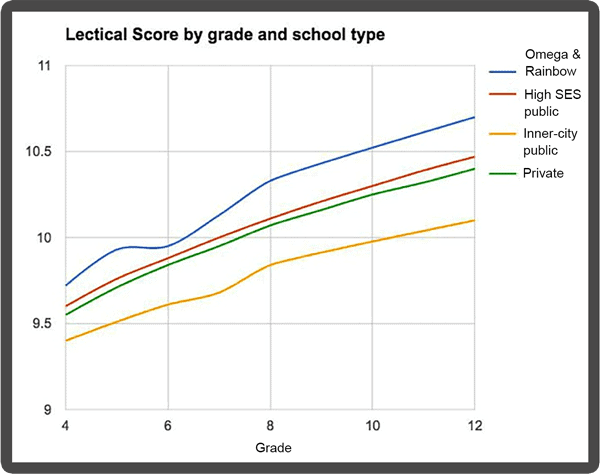
Dr. Theo Dawson and her team at Lectica have spent over two decades designing formative, standardized educational test that can assess student’s complexity of thinking and ability to reason ethically. This work is based out of research from the Mind, Brain, and Education program at Harvard Graduate School of Education, and the work of Kurt Fischer, a Lectica board member. After testing 25,000 students Dr. Dawson found the jackpot to their research – Rainbow Community School. Rainbow’s scores shows higher student development than any school tested. See graph. (Note that Lectica has graphed out the projected developmental levels of students older than 8th grade)
This February, Rainbow’s fourth through eighth graders took the Reflective Judgment test, which reveals how they think about inquiry, evidence, learning & the mind, truth & certainty, conflict resolution, persuasion, and deliberation. The test consists of open-ended questions about dilemmas, such as ethical dilemmas or societal issues. Students must write essays in response, and must defend their thinking. Lectica has a complex scoring system that codes each response and examines lines of reasoning in order to determine cognitive development.
From Dr. Dawson, “Lectica has tested many other private schools – very good ones–and also public schools of high socio-economic level, but we have never seen scores like Rainbow. We had to create new language to describe students’ thinking – embedded learning.” (Remember also that we accept a much broader demographic of students than most private schools. So our Lectica test scores include students with diverse learning needs, too.)
Not only were Rainbow students’ levels of development higher on average for their age than any school they had tested, but their level of coherence was higher than they had ever seen. Coherence is the ability to connect thoughts intelligently and develop a persuasive argument. Additionally, she said our students have incredible “perspectival” abilities to take the perspective of others — empathy, essentially.
Dr. Theo Dawson’s blog post about Rainbow Community School’s Lectica test results includes an excellent, easy-to-watch video explaining Lectica tests.
We never thought it would be feasible to have quantitative data that shows the true value of a Rainbow education, since what we do is very sophisticated. Sure, Rainbow students score very well on traditional standardized tests, like the SAT10, but those tests only show a small sliver of rote skill attainment, without showing complexity of thinking or affective skill development. Those tests only show the achievement of our students, but Lectica’s tests show development. Lectica has done the impossible – produced a way of giving a numerical score for holistic development – they’ve come as close to looking at the whole child as any quantitative test could.
What does this mean for your child? It means your child is incredible. We are so proud of the students here at Rainbow. They are truly motivated, empowered, and sophisticated learners who love learning. It means that with the collaboration between family and school, we have created a curriculum and school design that is, in fact, supporting the achievement of all seven domains… It means that the incredible sacrifice you have made to send your child here is paying off.
Rainbow students’ high level of social/emotional skills will also serve them very well when applying to colleges. The most prestigious universities are now changing their application processes to make the SAT optional, and to stress empathy as the most important quality– and this trend is going to become much stronger by the time your kids are applying for college. The Washington Post has a great article on this.
What does this mean for Rainbow Community School? Rainbow’s holistic program creates kids who are highly ethical, empathic, and cognitively developed to a level of sophistication that is beyond their years, and now we have quantitative proof. The researchers from University of Texas, Columbia, and LSU that have visited this year is only the beginning of what is to come. Our Seven Domains model of education will be sought out for research, in the hopes of it being implemented in more places and accessible to a broader demographic. Thank you for investing in the vision! We are providing hope for education and for a better world.