Executive Functioning Skills

Executive Functioning Skills

The Director’s Kaleidoscope: Exploring the many colorful aspects of learning
at Rainbow Community School

Executive Functioning Skills

Introduction to Executive Functioning

Hi, my name is Susie Fahrer, and I am the Executive Director of Rainbow Community School and Omega Middle School. One of the topics that is often discussed with our teachers and families is supporting a concept called “executive functioning skills” in the classroom. This is a term that has come to light to really embrace a set of skills or habits of learning that support a young person and their capacity for long-term planning, flexible thinking, motivation, task organization, prioritization, all of the tools that really end up being life skills, regardless of their choice of career path. They’re the tools that help us all move through the world, particularly a world now with such a high-paced level of information, to process and attend to with a level of confidence and capacity.

Classroom Structures that Support Executive Functioning

So what does that look like in the classrooms at Rainbow? Well, for many of our students, all the way starting in preschool up through our middle school, the structure of their classroom is designed for clarity of time management, scheduling, and expectations. So that looks like having some type of daily schedule visible for the students, typically one that they often engage with and dialog about with their teachers. This step alone helps our students anticipate the flow of their day, prepares them for times when a change in their typical schedule is coming and helps them understand, the general first, then nature of their school experience and helps us move through both really desirable tasks with a level of anticipation and challenging tasks with a level of capacity that we understand they are a period in time throughout a more global experience of our day.

Using Timers and Visual Tools

Equally, many teachers use timers and visual tools like a sand timer or a timer that might show a countdown of a block of time. Now, again, this is not to build a sense of urgency, but quite the opposite: to help students recognize and plan for the amount of time they have for a particular task.

For a child who is facing something that they are struggling to be motivated to participate in, maybe because it’s a challenging task or one that requires particular skills that they’re still developing, a timer can be a real relief. We might suggest, “Okay, all I need you to do is work on this task for the next five minutes, and then I’m going to check in with you and see how you’re doing.” That alone creates a relationship with the teacher and a response that offers a level of support, recognition, and affirmation that, yes, this task is hard, but “I also believe that you are capable and can do it.”

For our students that sometimes get lost in a project, seeing that there is a timer that is counting down the amount of time can help prepare them for that transition that’s coming. Most likely, when we are deep in learning, it might mean that we aren’t going to completely finish a project, and understanding how to pause in the midst of something, close it out, and prepare it for the next time you have the ability to drop deeply into that work is another skill that we grow in our students.

Building Planning and Organization Skills

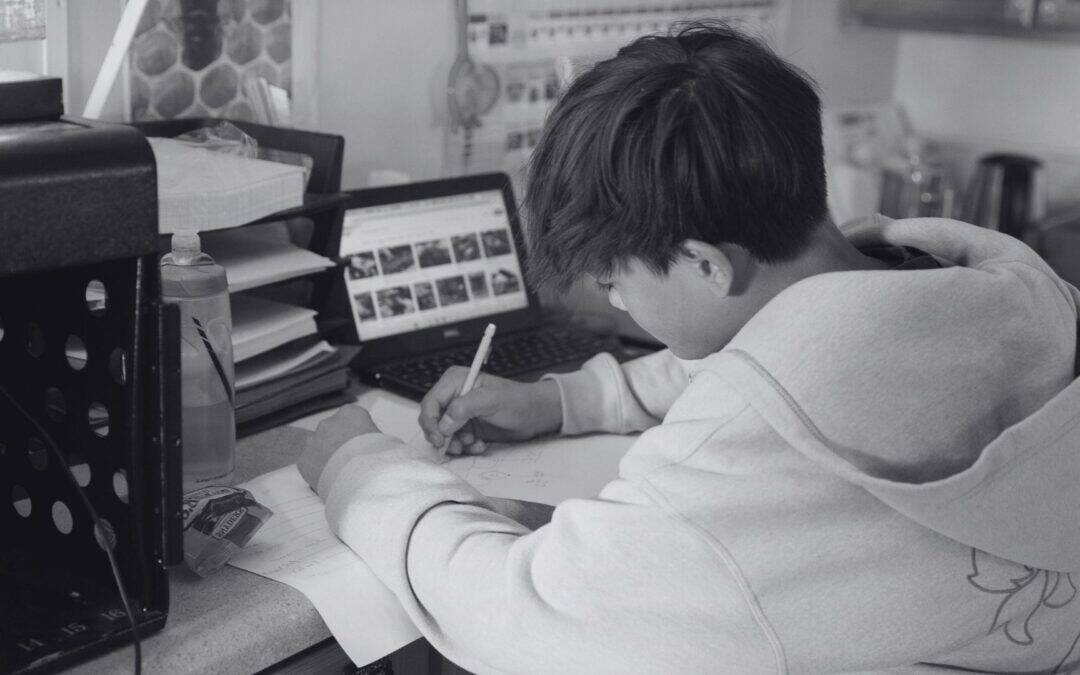
We use things like calendars and planners, and as students get older, this might even be, engagement with digital platforms that help them see the scope of a week, the scope of a month, both with, due dates that they’re in charge of, as well as, the amount of time they might be given both in school and expectations outside of school for completing large projects.

This type of planning is a critical skill that they’re going to need far beyond our doors.

Equally, students spend time in conversations about prioritizing tasks. A highlighter can be a student’s best friend, a very simple tool, but it can help note which aspects of a larger project are necessary right now. Or how many problems of this math activity are critical for you to finish in “this amount of time that we have together.”

Those kinds of tools, again, can help students prioritize where they’re putting their energy and learn that skill, where initially it’s coming with the facilitation of a teacher or an adult in the classroom. Eventually that tool, those tools are being taken with the students so that they can apply them on their own as they engage in tasks with a little bit more autonomy in the future.

Technology, AI, and Executive Functioning

It goes without saying that the skills of executive functioning are also ever-evolving, particularly with the inventions of AI and the capacity to start to engage technology as a tool. At Rainbow, we are conscious consumers of technology and recognize that the role of AI in supporting students with efficacy in breaking tasks down and chunking their larger project-based learning activities is a real asset.

Yet at the same time, we want to ensure that the heart of what they’re learning, the sensation of pushing through the capacities for rigor, the thought process it takes to prioritize and plan, that those tools are still being built in them, regardless of the aids that are available and continue to become available in the future.

Supporting Executive Functioning at Home

If you have questions about executive functioning, that’s something that our teachers are experts on, and we look forward to talking with you.

Also attached are some suggestions on how to support your child at home with executive functioning skills. As always, we welcome you to our campus and look forward to connecting with you soon. Be well.

Learn More

Continue exploring ideas from our Director’s Kaleidoscope series, including topics like executive functioning, student autonomy, and project-based learning.
Play Based Learning: Why Play Is the Foundation of Education

Play Based Learning: Why Play Is the Foundation of Education

The Director’s Kaleidoscope: Exploring the many colorful aspects of learning
at Rainbow Community School

Play in Childhood

Hi, my name is Susie Fahrer, and I’m the Executive Director of Rainbow Community School and Omega Middle School.

One of the things that we often associate with childhood is play. As a school, we recognize that play is something that is critical to children’s learning. In our Early Childhood Program, our students spend time outdoors and in their classrooms that are designed for imagination, creativity, and autonomy, to come out and develop through play-based learning.

What does play-based learning look like?

So what does that really look like? Well, on the playground, our children often engage the spaces around them and their peers in storytelling, in creative use of the materials.

A mud kitchen becomes a restaurant. The sandbox becomes a place of building community and castles. The structures for climbing might be mountaintops, or we might even see children transform themselves, imagining that they are animals, exploring the world around them – engaging with the trees, the rocks, and the grass.

Problem Solving Through Play

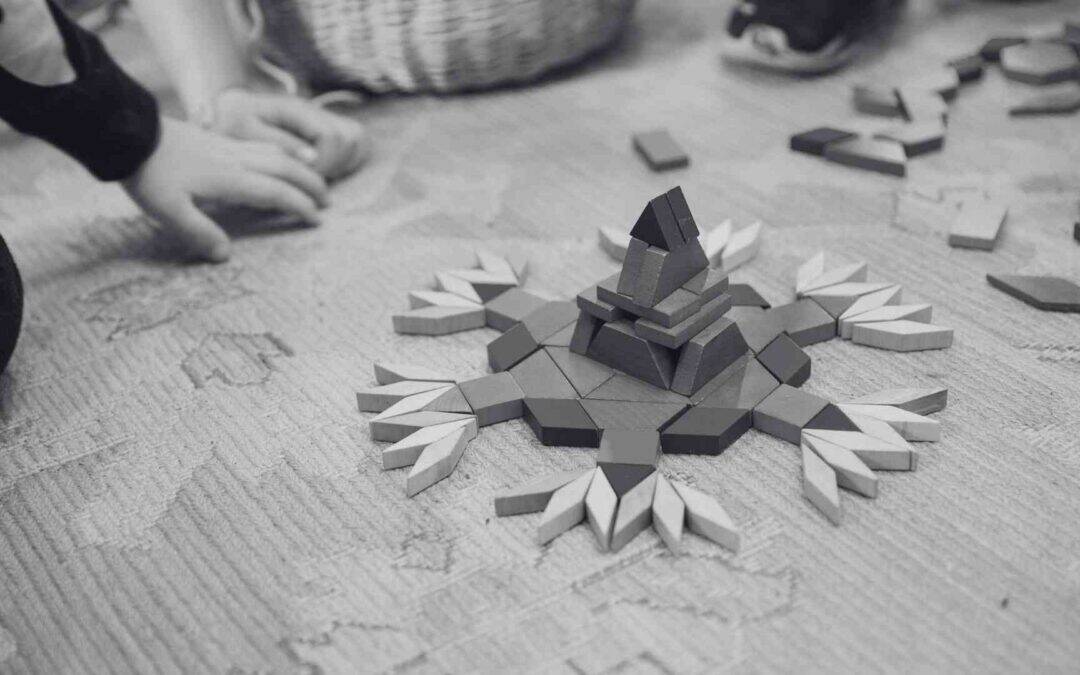
All of this is showcasing a child’s natural ability to see themselves as problem solvers, to think curiously about the spaces around them. In the classroom, this is the time when Play-Doh becomes an engagement of number, shape, size, and all of those pre-mathematical concepts. Block-building explores scientific knowledge of balance, structure, physics, and movement.

Students see story and language all around them. The creative play area might become a bank or a store. They start to explore these ideas of community, which they’re making meaning out of, every day in their daily lives.

Teachable Moments

Our teachers are trained to take these moments and really use strategies of questioning, dialogue, and play as a way to engage our students in deeper learning, but also as a way for them to be leaders and thinkers on their own.

Think about a time when you were learning something, and someone simply told you how to do it. That can be really efficient and sometimes necessary. But now imagine a time when you struggled through something. You were doing it on your own, you were exploring it, or perhaps it was an activity. Maybe it was your first time skiing or learning how to drive a car.

These were all things that took your ability to engage and “try.”

Play as a foundation of learning

Play-based learning is the beginning of those dispositions. As students matriculate, the imagination continues. But it’s built into project-based learning, their ability to explore literacy through creating projects that showcase the critical elements of a story, or the idea that they can create games that help practice mathematical skills.

It increases their social relationships through learning, but it also continues to build their confidence in recognizing that learning is about taking positive and playful risks.

Teachers and Staff Engage in Play

Equally, we create spaces for our staff here to engage playfully with one another. On Wednesdays, we have professional development, and part of that process is creating spaces for open-ended thinking, collaboration on lesson planning, and, really, at the heart of it, using the disposition of play to bring joy to the work we do with ourselves and with our children.

I hope that part of what you connect to out of this video is an opportunity to think about how you can bring more play not only into your engagement with your child, but also into your own life.

An Invitation

We all have those experiences where play has uplifted something about what we’ve learned, what we do, and how we engage with the world around us. It’s a powerful tool for supporting creativity, joy, and the capacity for each of us to recognize the ownership of our own learning. If you want to learn more, look at the attached file.

You can engage in a tour with us. Come and visit. Or if you’re already here, as always, my door is open. Let’s have a conversation about how you can use play in engaging your child in their learning journey here at Rainbow. Have a wonderful day!

Learn More

Continue exploring ideas from our Director’s Kaleidoscope series, including topics like executive functioning, student autonomy, and project-based learning.

The Power of Learning Outdoors

The Power of Learning Outdoors

The Director’s Kaleidoscope: Exploring the many colorful aspects of learning
at Rainbow Community School

Rethinking What Makes a Learning Environment Powerful

When you think about designing a space for truly powerful education and human development, what comes to mind? Often, we consider factors such as how we engage with technology, the curriculum we offer, or the level of professional development our teachers have.

And yes, these factors are critical in supporting a successful learning environment. But there’s something incredibly simple and accessible to all of us that research shows provides deep nourishment for academic success: spending time outside.

Learning Beyond Four Walls

For students at Rainbow Community School, outdoor learning is woven into the fabric of our curriculum. From the earliest childhood settings, students spend time outdoors studying seasonal changes, going on nature walks, engaging with the canopy around them, and exploring the rhythms of weather and landscape.

These experiences help children attune not only to the natural world, but to their own growth and development.

Nature as Curriculum

Being outside inherently creates a hands-on learning experience. As students matriculate through the grades, the level of complexity in their outdoor learning increases.

They move from observation to integration, cultivating a farm-to-table experience, growing their own food, engaging in composting systems, studying local ecosystems, and exploring the rivers, mountains, and geology of our region.

Outdoor learning extends beyond our campus, connecting students to real-world field studies that deepen their sense of place and purpose.

The Research Behind Outdoor Learning

Educational research continues to affirm what we see daily at Rainbow: that time outdoors amplifies a child’s capacity for curiosity, awe, and wonder. It nurtures critical thinking and builds the dispositions of a healthy learner.

Beyond the cognitive benefits, there’s also a spiritual connection that emerges when students spend time outside: a quiet sense of belonging to something greater, a reconnection with rhythm and balance.

A Sensory Awakening

You’ve probably experienced this yourself—the subtle shift that happens when you step outdoors. Maybe it’s the first breath of fresh air as you leave your home, the breeze across your skin, or the vivid colors of the changing seasons.

Each moment outdoors invites us to slow down and become present. The songs of birds, the rustle of leaves, the textures of the landscape – all awaken our senses and remind us of the living world we are part of.

Bringing Outdoor Learning Home

In this month’s Kaleidoscope, we’ve included resources to help families bring the benefits of outdoor learning into their own homes. These are simple, accessible ways to integrate time outdoors into daily life, no matter your setting or schedule.

Even five minutes outside can transform your mood, reset your attention, and bring a brighter sense of possibility to your day.

An Invitation to Step Outside

I hope that this gives you just a moment to remember that even five minutes outside can change your whole disposition, and can bring a brighter sensation and opportunity to the learning that’s here before you.

May you have a wonderful time exploring the natural world.

Learn more and download or print our free guide on Integrating Nature Connections into Family Routines.

Learn More

Continue exploring ideas from our Director’s Kaleidoscope series, including topics like executive functioning, student autonomy, and project-based learning.

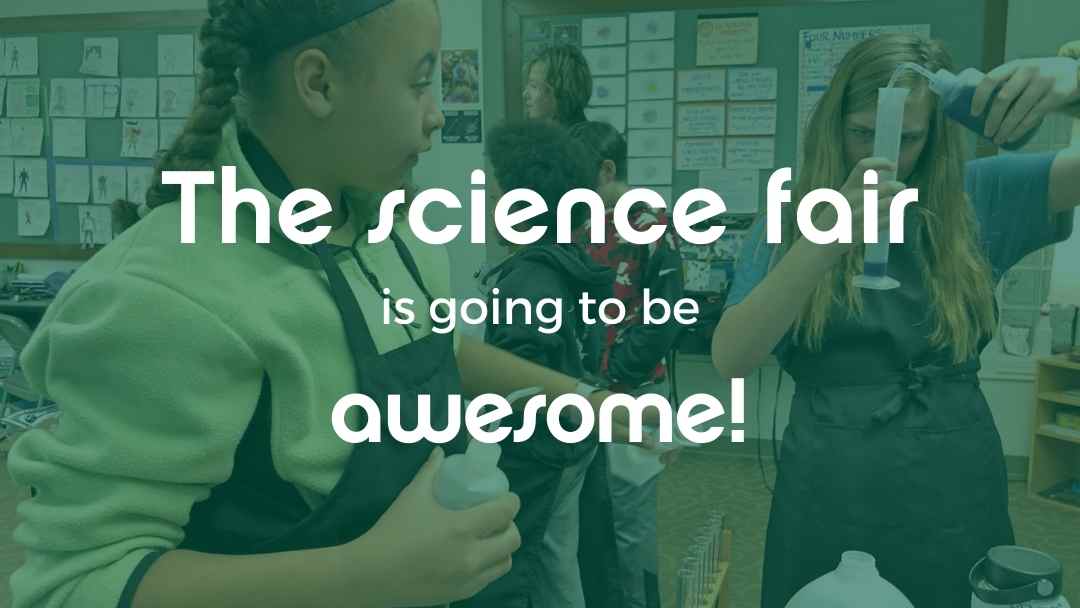
This year’s science fair is going to be awesome!

This year’s science fair is going to be awesome!

The science fair has some great experiments going on.

The annual science fair is always a fun event. Across grade levels, all students participate and present their projects to the other grades. All students – whether individually or in groups – are responsible for coming up with testable ideas, hypotheses, drawing conclusions and interpreting results.

It’s not always so easy to come up with something that is both interesting and challenging. But, we have a sneak peek of our Omega 7/8 students doing just that.

We visited their classroom recently to see them testing and working diligently on their science projects to get ready for the upcoming science fair. In the Omega classroom, students were working in four different groups on a specific science experiment they chose.

Proving that gases have weight

This particular group set out to prove that gases have weight by using combustion. They weighed out pieces of wood and magnesium before burning. Next, they put each one to flame and tested their weight after the burning process.

Their prediction was that the wood would weigh less, and the magnesium would weigh more.

Omega students set out to prove that gases have weight by burning wood and magnesium, while comparing the weight of each before and after the burn process.

Engineering a Reptile Egg Incubator

The idea behind this science project was to engineer how to transport a reptile egg from site A to site B while using heat chemistry. The goal was to keep the egg stable and warm, as it could not shift position or roll over, nor could it endure temperature fluctuation.

The incubator required calcium chloride, baking soda and water. Students needed to measure whether they could detect temperature changes after they dissolved calcium chloride, and baking soda into water. The eggs needed a constant temperature of 28 – 32C during transport and being able to maintain temperature for a certain amount of time was an important consideration in this investigation.

Two of our Omegan students work on their project: Engineering a Reptile Egg Incubator (with heat chemistry).

The Digestion of Minerals in the Stomach

This group began their science class by heating up small glass pipes and bending them to simulate the “pipes” in human digestive systems. Once complete, they would then mix hydrochloric acid and marble to observe the reaction (much as it would happen in the stomach). The last step was to measure the resulting water and carbon dioxide from the process.

Above: Two Omegans heat and bend glass pipes to simulate “pipes” of the digestive system.

Below: All the materials needed to complete their investigation.

Testing for Vitamin C Content by Titration

Are you curious about how much vitamin C is actually in the things you buy? This group set out to answer those questions by testing how much vitamin C is present in various common beverages through a titration technique. Students used an indophenol solution to determine the presence of vitamin C by how much the color changed. The various beverages they tested included freshly squeezed lemons, limes, and oranges. They also tried orange juice found in the grocery store, and sodas that claimed to have Vitamin C.

This Omega group is checking the presence (and amount) of Vitamin C in common beverages using titration.

The Results

The results from each of these experiments is the subject of the upcoming science fair. You’ll have to check out the Omega 7/8 classroom to find the conclusions to burning magnesium and wood, how to maintain temperature in an egg incubator using chemical reactions, what happens to calcium carbonate when it reacts with hydrochloric acid in the stomach, and how much vitamin C is really in our common drinks. Check Rainbow Reminders for science fair details!

Third Grade – Legend of Chocolate and the French Broad Chocolate Lounge

Third Grade – Legend of Chocolate and the French Broad Chocolate Lounge

The Legend of Chocolate

The third grade class just completed a unit on the Legend of Chocolate in Spanish. Their Spanish teacher, Cynthia, worked with West, their third grade teacher, to create a unit that would complement what the students were learning in their main classroom.

Students studied about how things work – machines, phones, etc. – in their main classroom lessons and in Spanish class, students learned about where chocolate came from.

At the end of the unit, third graders got a chance to see how chocolate is made, and how the machines work to make all that chocolate.

In their Spanish unit, students learned many new vocabulary words such as food (comida), drink (bebida), the Toltecs (los Toltecas), as well as many more vocabulary words.

They learned abut Quetzalcoatl, the god of Light and Tezcatlipoca, the god of darkness. Quetzalcoatl was the god to bring the food of the gods – chocolate – to the people, especially when they were so hungry. He taught them to farm, and how to turn cacao into a chocolate drink fit for the gods!

Third graders at the French Broad Chocolate Tasting Room

Third graders at the French Broad Chocolate Tasting Room

From there, they learned the mythical story about where chocolate originated. They learned the story in Spanish and even learned to recite it.

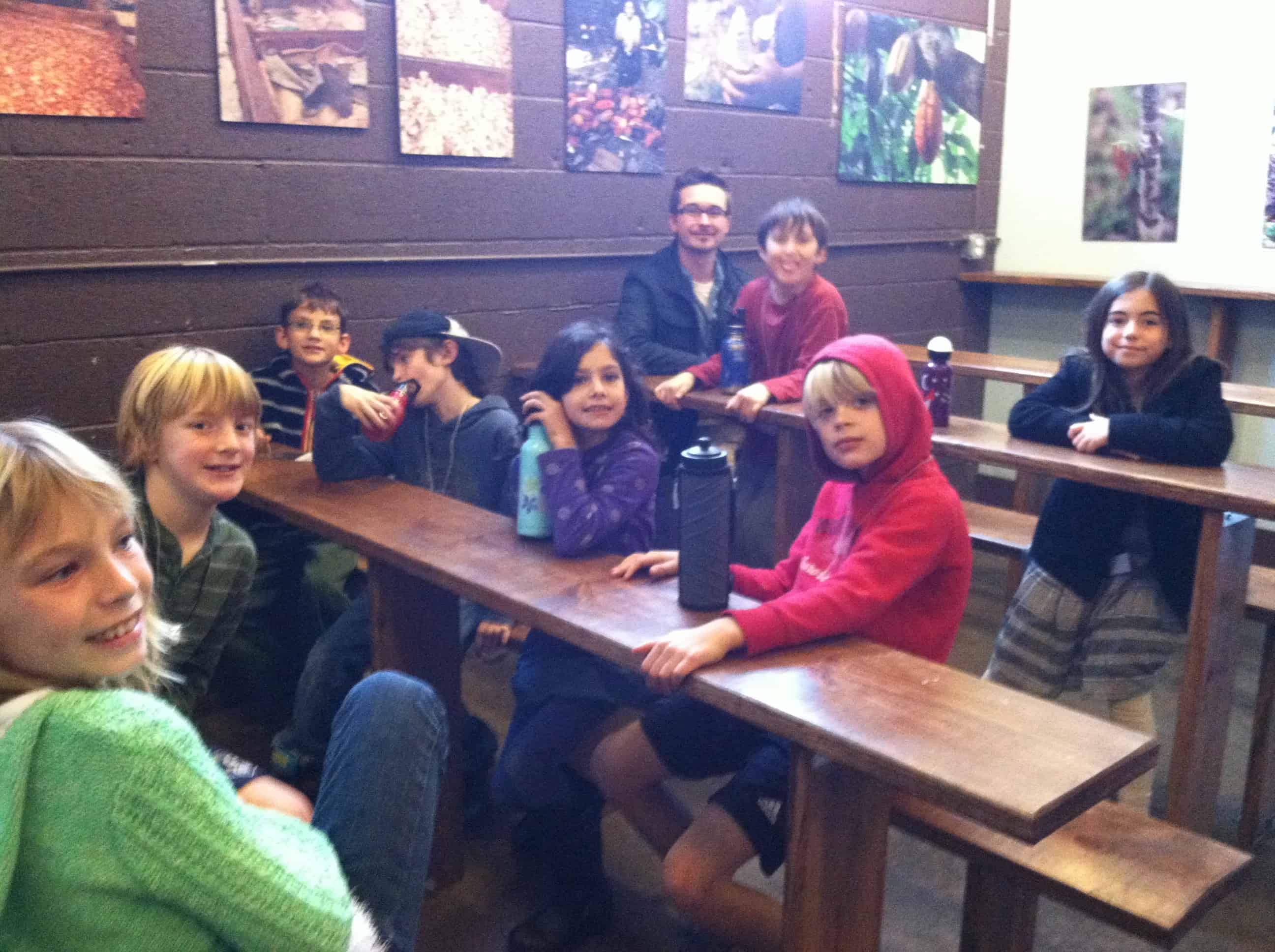
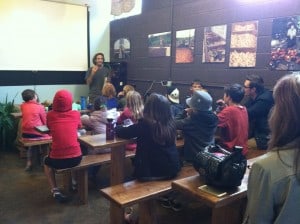
At the end of the unit, they took a field trip to the French Broad Chocolate Factory and had a tour of the Tasting Room. They listened to Evan, a Chocolatier, talk about cacao, where it comes from, how the Chocolatiers turn the cacao beans into chocolate and how they try to be as sustainable as possible in the process.

The crew at the French Broad Chocolate Factory led everyone into their “back rooms” where students could see all the machines at work. From rinsing, to sifting the cacao beans, to grinding them down into chocolate, they were able to see the entire process from start to finish.

Students sampled chocolate – the dark, unsweet kind directly derived from cacao – from different regions and it has a different taste from different regions!

Learning about chocolate and cacao

Learning about chocolate and cacao

At the end of the presentation, the third graders performed the skit of the Legend of Chocolate in Spanish for the French Broad Chocolate Lounge Staff.

Did you know that the French Broad Chocolate Factory uses solar power to heat all its water? And that they make every attempt to source all their ingredients locally?

They also deal only with farms that use fair trade in their practices. In fact, the owners and employees make trips to cacao farms in Costa Rica, Nicaragua and Peru and help harvest the cacao by hand.

They have developed mutually beneficial relationships with farmers in those countries.

third grade

Watching the grinding machine take off the outer shell of cacao.

Rainbow would like to extend a special thank you to the Chocolatiers – especially Evan – for a wonderful lesson on chocolate, sustainability, how things work, and the idea of being as responsible to the planet and to each other as possible!