by Susie Fahrer | Oct 27, 2025 | Director's Blog
The Director’s Kaleidoscope: Exploring the many colorful aspects of learning
at Rainbow Community School
Rethinking What Makes a Learning Environment Powerful
When you think about designing a space for truly powerful education and human development, what comes to mind? Often, we consider factors such as how we engage with technology, the curriculum we offer, or the level of professional development our teachers have.
And yes, these factors are critical in supporting a successful learning environment. But there’s something incredibly simple and accessible to all of us that research shows provides deep nourishment for academic success: spending time outside.
Learning Beyond Four Walls
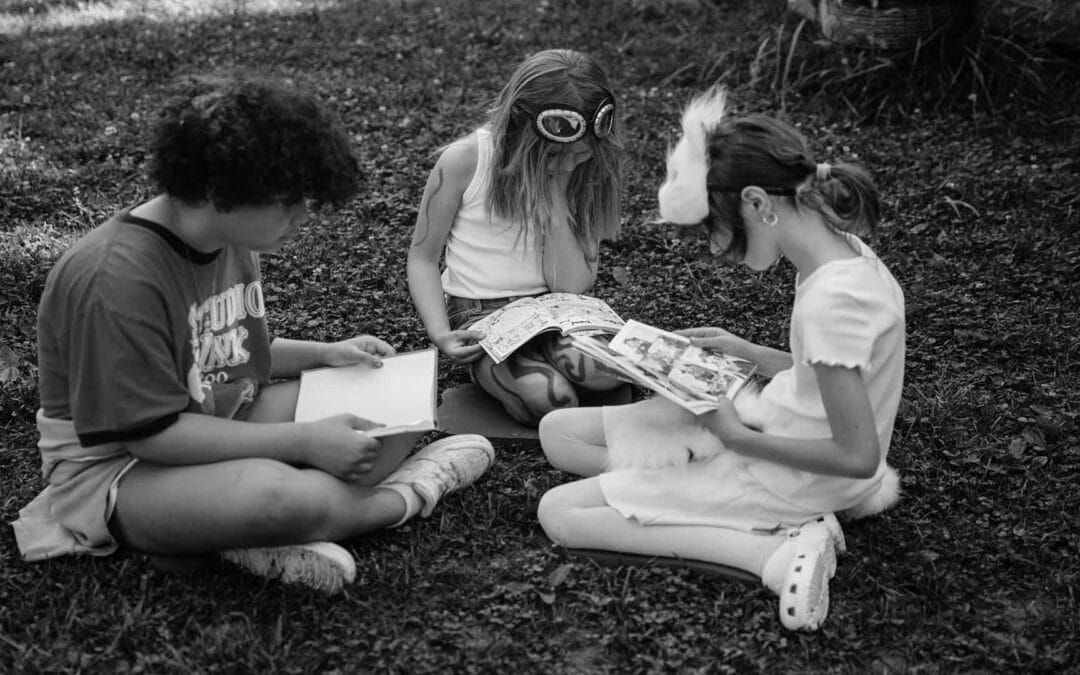
For students at Rainbow Community School, outdoor learning is woven into the fabric of our curriculum. From the earliest childhood settings, students spend time outdoors studying seasonal changes, going on nature walks, engaging with the canopy around them, and exploring the rhythms of weather and landscape.
These experiences help children attune not only to the natural world, but to their own growth and development.
Nature as Curriculum
Being outside inherently creates a hands-on learning experience. As students matriculate through the grades, the level of complexity in their outdoor learning increases.
They move from observation to integration, cultivating a farm-to-table experience, growing their own food, engaging in composting systems, studying local ecosystems, and exploring the rivers, mountains, and geology of our region.
Outdoor learning extends beyond our campus, connecting students to real-world field studies that deepen their sense of place and purpose.
The Research Behind Outdoor Learning
Educational research continues to affirm what we see daily at Rainbow: that time outdoors amplifies a child’s capacity for curiosity, awe, and wonder. It nurtures critical thinking and builds the dispositions of a healthy learner.
Beyond the cognitive benefits, there’s also a spiritual connection that emerges when students spend time outside: a quiet sense of belonging to something greater, a reconnection with rhythm and balance.
A Sensory Awakening
You’ve probably experienced this yourself—the subtle shift that happens when you step outdoors. Maybe it’s the first breath of fresh air as you leave your home, the breeze across your skin, or the vivid colors of the changing seasons.
Each moment outdoors invites us to slow down and become present. The songs of birds, the rustle of leaves, the textures of the landscape – all awaken our senses and remind us of the living world we are part of.
Bringing Outdoor Learning Home
In this month’s Kaleidoscope, we’ve included resources to help families bring the benefits of outdoor learning into their own homes. These are simple, accessible ways to integrate time outdoors into daily life, no matter your setting or schedule.
Even five minutes outside can transform your mood, reset your attention, and bring a brighter sense of possibility to your day.
An Invitation to Step Outside
I hope that this gives you just a moment to remember that even five minutes outside can change your whole disposition, and can bring a brighter sensation and opportunity to the learning that’s here before you.
May you have a wonderful time exploring the natural world.
Learn more and download or print our free guide on Integrating Nature Connections into Family Routines.
Learn More
Continue exploring ideas from our Director’s Kaleidoscope series, including topics like executive functioning, student autonomy, and project-based learning.
The Director’s Kaleidoscope: Exploring the many colorful aspects of learning at Rainbow Community SchoolExecutive Functioning Skills Introduction to Executive Functioning Hi, my name is Susie…
The Director’s Kaleidoscope: Exploring the many colorful aspects of learning at Rainbow Community SchoolWhy Electives Matter in Middle School Hi, my name is Susie Fahrer,…
The Director’s Kaleidoscope: Exploring the many colorful aspects of learning at Rainbow Community SchoolMistakes in the Math Classroom Many students grow up believing that being…
by Susie Fahrer | Oct 20, 2025 | Director's Blog
The Director’s Kaleidoscope: Exploring the many colorful aspects of learning
at Rainbow Community School
What do you think of when you hear “school” or “schooling”?
Hi, my name is Susie Fahrer and I am the executive director of Rainbow Community School and Omega Middle School. Have you ever stopped to wonder what comes to mind when you hear the words “school” or schooling? For many of us , we were transported to a large building, often with a wide hallway, usually having classrooms on either side, particularly designed with tables and chairs, oriented towards the front of the room, where perhaps the teacher is standing delivering their content for the day.
How do you design a space for learning?
And more often than not, nowadays we’re probably picturing a classroom filled with computers or iPads where students are behind a screen engaging technology as a primary part of their schooling experience. While much of this is creating a foundation, perhaps if we would change the scope, if we considered reframing the question. What would you think about if we actually asked, how do you design a space for learning?
The Elements of Space
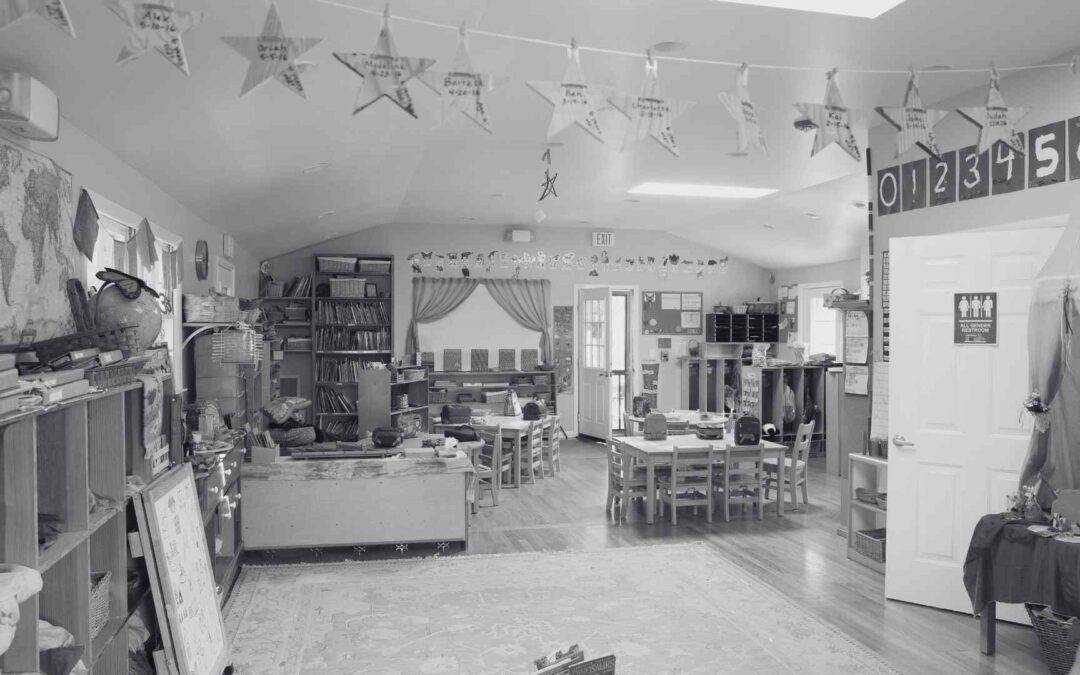
Well, for many of us, we start to imagine the beauty of a space. Natural light and beautiful materials. Creating a space that feels welcoming. Or maybe we think about how we engage a diversity of learners through design for flexible seating and hands-on materials. And maybe still, we think about that technology, but we recognize that it’s integrated with intention and balance.
Designing for Learning at Rainbow
Also offering space for discourse and project-based learning and meaningful curriculum. And finally, for some of us, the walls might even dissolve, and we consider stepping out into the natural world, engaging space for play and physicality. Understanding that brain science allows us to know that optimal learning is spent both indoors and out. So here at Rainbow, we have the ability to design for learning.
A Learning Village
For many people, when they first step on our campus, they describe it as a village. And this couldn’t be a better imagery to capture the vibrancy with which we design our classroom and our campus spaces, to meet the needs of preschoolers through middle schoolers in an engaging and joyful learning experience. If you are new to Rainbow, I invite you to look at our website or perhaps book a tour and come see what we’ve built here and designs for learning, and an optimal experience for children where they are nurtured and supported through a learning journey from the earliest childhood experience into adolescence.
The Door is Always Open
For those of you who are already part of our community, I invite you to come and sit with me and continue the conversation. My door is always open.
Click to read and download our free resource guide on Designing Space for Learning at Home.
Learn More
Continue exploring ideas from our Director’s Kaleidoscope series, including topics like executive functioning, student autonomy, and project-based learning.
The Director’s Kaleidoscope: Exploring the many colorful aspects of learning at Rainbow Community SchoolExecutive Functioning Skills Introduction to Executive Functioning Hi, my name is Susie…
The Director’s Kaleidoscope: Exploring the many colorful aspects of learning at Rainbow Community SchoolWhy Electives Matter in Middle School Hi, my name is Susie Fahrer,…
The Director’s Kaleidoscope: Exploring the many colorful aspects of learning at Rainbow Community SchoolMistakes in the Math Classroom Many students grow up believing that being…
by West | Jun 19, 2018 | News
Rites of passage are important, sacred ceremonies that highlight a transitional period in a person’s life.
In many cultures, tribes and soceities around the world, children engage in various rites of passage. Often these are times when a child is recognized for passing though the threshold toward adulthood. Graduation at Rainbow Community School serves as an integral rite of passage for our graduating Omega Middle Schoolers.
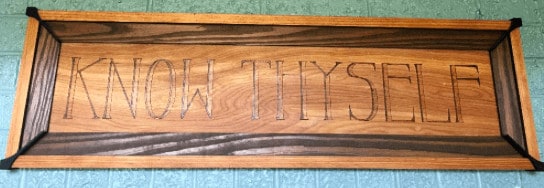
Preparation for this rite officially begins as they join the Omega program. Subtle and more obvious practices support each Omegan’s readiness. For example, each day that middle schoolers pass through a physical threshold. As enter the building, they pass under a wooden panel inscribed with “Know Thyself.” Additionally, their arrival is also marked with a sacred time called Centering; this time is used for grounding, centering, pondering life’s big questions. Lessons, activities and learning experiences throughout the day not only foster a culture of connectedness but support the work of nurturing the child to individuate- to
Know Thyself.
These opportunities, although grounded in the safety of community, encourage personal identity development, person spirituality and ultimately- wholeness. According to decades of research by Dr. Lisa Miller, head of clinical psychology at Columbia’s Teachers College, teens who have the benefit of developing a personal spirituality are 80% less likely to suffer from ongoing and recurring depression and 60% less likely to become substance abusers. To that end, it is reasonable to suggest that spirituality is indeed the cornerstone for mental health and human well-being. Intentional rites of passage are but one way to nourish that health.
To KNOW THYSELF is to answer these questions:
Who am I?
Who are you?
Why am I here?
What is my purpose?
Graduating Omegans write commencement speeches that reflect on their time at Rainbow and acknowledge their gratitude, growth, challenges, hopes and dreams. Each student, as part of the rite, share these speeches publicly. This public sharing is an amazingly brave yet vulnerable challenge.
But more importantly, the words of wisdom spoken by these young adults are nothing less than profound.
They are informed by years of social, emotional and spiritual engagement and learning. They are guided by opportunities to explore life’s big mysteries and ponder personal purpose. They are rooted in a a collective AND personal identity.
If you are curious what happens when soul is invited into the classroom, please click here to listen to Noah Mraz’s graduation speech.
Please also consider:
- What are the implications of integrating rites of passage, existential questioning and the spiritual domain into your own work with children?
- What are you already doing that serves the spiritual development of your students? What more can you do?

by West | May 19, 2018 | Blogs, Home Page News, Rainbow Institute
The integrated RCS curriculum fosters learning in a holistic way.
This approach is void of the restrictions often imposed by teaching discreet subjects. Purposeful integration acknowledges, builds on and reinforces the existing relationships between subject areas and/or topics. The hope is that learning is then more easily transferred into other settings.
Integration is also a “brain compatible strategy” as described by brain researcher, Eric Jenson. Jenson (1996) suggests that, “The brain learns best in real-life, immersion-style, multi-path learning [and] fragmented, piecemeal presenting can forever kill the joy and love of learning.” This immersion style is considered a best practice and is embraced by our teachers. It is, therefore, not uncommon for the theme, topic or unit of study to be woven into the fabric of an entire school day, week, and/or month. For example, the element of water and its states of matter are introduced in kindergarten. First grade elaborates on the water cycle and studies rivers and oceans. During these units, water often becomes a central theme that invites cross curricular learning.
Centering offers cross curricular learning opportunities.
The intended purpose of centering is to awaken the spiritual center of each child, opening pathways to learning. The centering practice activity includes a contemplative experience, but teachers also strive to extend the learning by integrating with the academic curriculum. The Mind Jar centering serves as an excellent example. The Mind Jar begins with a conversation about the various properties of water. Perhaps prompted by photographs of water in various forms or by a book such as, The Water Dance by Thomas Locker. Discussion yields a shared understanding of the ways in which water moves- Water is always moving, flowing, changing, essential to life, found deep in the ocean, under the ground, high in the sky, freezing, melting, etc. The focus being more heavily on the magical and mysterious qualities of the element rather than the scientific descriptions.
The teacher guides students to make connections between their own thoughts and feelings to the movements of water in the natural world
(i.e. a raging river can represent anger, a waterfall- excitement, snowfall- peace) After giving an example or two, the children are then prompted to suggest additional feelings and water movements connections. The teacher explains that The Mind Jar is simply a jar filled with water and glitter. But it is representative a tiny world where we can watch the movements of water and match those movements to our own feelings. The water represents our mind’s natural state and the glitter represents our thoughts, emotions, fears, concerns, and wonderings. When the jar is shaken, our thoughts will whirl around and our mind becomes cloudy and hard to see through. But, as the glitter begins to settle and still, so do our thoughts and feelings. It is in this stillness and calm state that we are able to make good decisions.
The Mind Jar is a simple mason jar containing water, glitter, glitter glue, and food coloring.
Combine warm water with the glitter glue, glitter, and food coloring. Close the Jar tightly. Depending on the amount of glue you use, the glitter will settle more slowly. This tool can be used when a child is feeling stressed, overwhelmed or upset. It can calm and relax them. It can serve as a meditation tool or a self-regulation tool. You can explore many versions of this on the web. If you have an interest in extending the learning from this centering, you may want to try a follow up centering using the picture book, Moody Cow Meditates. Peter the cow is moody after having a rough day. A series of unfortunate circumstances leads Peter’s grandfather to teach him how to settle his mind and let go of his frustration using some mediation tools.

by West | Mar 8, 2018 | Blogs, Home Page News, Rainbow Institute
We live in a time of uncertainty, in a world that is unpredictable and in a society that is, in some cases, changing rapidly and in others stuck. Nevertheless, our work as educators is more important now than ever.
As an organization, we aim to live our mission everyday. Some days we do so effortlessly and seamlessly. Other days we detour, stumble and struggle. Many days yield cheer and celebration, yet many yield mistakes and misunderstanding. Regardless of the outcomes, we see them ALL as an opportunity to deeply reflect, adapt and grow.
We are an organization on a transformational journey informed by these opportunities, guided by our hearts and our spirits and fueled by our mission.
We develop accomplished, confident, and creative learners who are prepared to be compassionate leaders in building a socially just, spiritually connected, and environmentally sustainable world.
As a teacher, to live this mission means that you are intentional about circling back to it and that you are willing to hold a mirror up to your classroom culture and programming. These opportunities often show up in unexpected ways but, if you are waiting with that mirror, some amazing learning can happen.
Spirit Week at RCS
Next week is Spirit Week at RCS. This week fills our school classrooms, campus and culture with fellowship and fun. It invites costumes, and creativity while building community. As Student Council began to flesh out the daily Spirit Week themes, they stumbled on an opportunity- a real teachable moment. In an effort to give this teachable moment greater context, our Equity Director wrote a letter to our families.
“In the interest of our ongoing efforts to be more mindful of equity, we are eliminating ‘Crazy Hair Day’ from our Spirit Week schedule. There are a couple of concerns about this practice. To begin with, the regular and loose use of the term ‘crazy’ is disrespectful to those who live and struggle with mental illness. Even if we are innocently using the term to refer to something that is different and/or weird, we need to ask ourselves if that’s really the message we want to send about hair. While there are some really cute and elaborate ideas out there for ‘Crazy Hair Day’, all too often, the expressions that come out of this Spirit Week practice are styles that closely resemble (intentionally or not) actual cultural and ethnic hairstyles. The suggestion that those styles are crazy or weird is offensive. Would it be ‘crazy hair’ if a child with curly hair came to school with their hair straightened for the day?
Here at Rainbow, equity is a practice. So we’re using this as a teachable moment for our students. Some of your teachers are taking this time to talk about culture and cultural practices, and concepts of ‘different’ vs. ‘weird’. If you want to continue these discussions at home and feel like you could use some supportive material, please reach out to our Equity Director. In addition, HERE is a link to a very thoughtful post from a parent about ‘Crazy Hair Day’.
Teachable Moments
This topic became inspiration for a 4th grade centering practice. Centering began when the class found stillness and silence. The candle was then lit for “safety” and the teacher began, “Yesterday we talked about physical safety and today we will talk about emotional safety.”
Susie, the teacher, followed by asking for a volunteer to read Rainbow’s mission statement. She then asked, “Where does this come from?” The kids responded, “The School!” She explained that this was our mission statement and ultimately our hope for each action, every day.
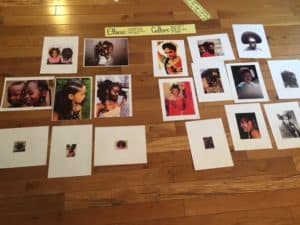
Around the altar were the words Ethnic and Culture. The teacher asked the students what these words meant to them. As a group, the kids built collaborative definitions and came to some common understandings of each word. Susie then revealed a final sheet of paper with the phrase ‘Crazy Hair Day’ written on it and began touching on some of the concepts that were explained in the above letter. Finally, she began showing the group images of hairstyles that were based on the cultural or ethnic backgrounds of the people pictured.
These images were passed around the circle in silence. The students were asked to simply use their powers of observation, acknowledge any reactions, consider the terms ‘ethnic’ and ‘culture’ while making mental notes as they cycled through each image.
In closing, Susie asked to kids to try to weave all the centering elements together and identify the message that she was trying to share with them. One child responded,”By saying something or someone is crazy, you are judging them.” Another student said, “The things that may be fun for me, like crazy hair day, could really hurt someone else. This might be the way they do things and if you make fun of them, it could hurt their feelings.” Another child said, “What you might consider crazy hair for you may be they way that others wear their hair everyday.” One noted that, “Yesterday we talked about how some cultures greet people in different ways we should think about how some people wear their hair in different ways.” Susie ended with a simple statement about how we, for the last several years have been hosting Crazy Hair Day and upon reflection and insight we have realized that this choice does not fit within our mission statement. As a community, we decided to let go of it because we strive for emotional safety for all.
Now what?
Consider your personal mission statement or that of your school or organization. Reflect…
What are you doing to successfully achieve this mission? Celebrate that!
Now consider, how can those mission statement words be better represented with action?
What changes to your direct practice can open up pathways of learning for you, your family and/or your students?