In Omega, teachers often incorporate ways to make a lesson come alive. Students embarked on a design challenge of sorts, one in which they challenged themselves, worked against the clock, and figured out how to quickly problem-solve for a solution.
Rocket Launching
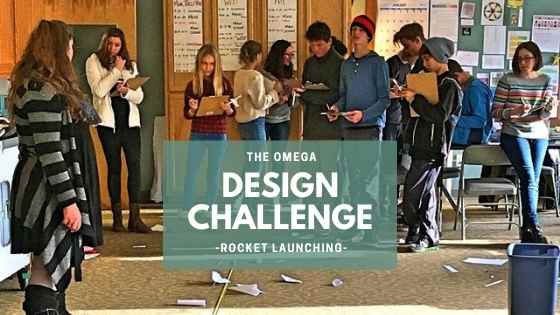
Using a piece of paper, tape, and a straw, students were challenged to make a flying object. The idea was to repeat the process three times, except they had less and less time with each round.
Round One
Students had five minutes. They collaborated in groups and could talk about what sort of rocket they’d like to build. When time was up, they only had one chance to launch and measure how far their paper rocket traveled.
Collaborating in groups. Round One.
The results for this first round would help inform students as to what trends they spotted, what modifications they might need to make, and what they could do to make their rockets go farther.
After all students launched their rockets, the range was from 0 inches all the way to 168″!
What’s so incredible is that students were extremely supportive of one another, and they immediately got to work on the second round to make iterations. In essence, they were using failure to inform their next decisions.
Round Two
The next round meant a shorter time: three minutes. Students concentrated furiously and worked to design better rockets.
The biggest challenge was not having the amount of time they did on the first round. But, using experiential data, they tried to figure out what would sail through the air the farthest.
The results were as varied as the first time! Flight paths ranged from 0″ to 176″!
Round Three
This time, all students only had one minute thirty seconds to build their rockets. The time constraint created the ultimate pressure! In fact, time went by so fast that they had only enough time to quickly put together something and line up for the final launch:
Older rockets were left in place so students could compare and contrast their results. They began to analyze results, as well. All the scores ranged from 0″ to 159.5″.
Results
Interestingly, it was the second round where someone got 176″. Perhaps it was the sweet spot between time and thinking to pull off something that would sail farther through the air.
Student observations included things like how it seemed like all the rockets formed a bell curve, how longer and narrower rockets seemed to go through the air more easily (though they didn’t always fly the farthest), and that being “smaller” wasn’t necessarily an indicator of how far an object would go.
Some students stayed with the same design all three rounds: one student built small paper airplanes and attempted to refine the configuration on each round. Other students modified their rockets based on their observations. Rounds two and three saw more slender rockets.
This incredible lesson helps students learn to innovate. By doing so, they’ll come up with ideas for an incredible Design Fair later in the semester.
The week back to school after a long winter break is often buzzing with excitement and anticipation. During these days, children will share stories of their time apart, celebrate coming back together and show enthusiasm for what is to come. Time is also set aside for deep reflection, individual and collaborative goal setting and for the renewal of commitments to oneself and to others.
This last week yielded particularly frigid temperatures and harsh weather conditions, embedded within the season of darkness. These winter circumstances provided a perfect context for a centering led by 4th-grade teachers, Susie and Molly.
As the centering began, Susie picked one of several snake skins that were decorating the classroom altar. She explained that the snake skin was a symbol of renewal and that by being able to let go of or shed that which no longer serves us, we make room for a renewal of those things that do.
She then invited all her students to collect a meditation mat and cushion, to remove their shoes, and to lie down and stretch out their bodies. She asked them to begin to settle in by allowing their bodies to become still, to notice their breath and to quiet their minds. She played some soothing music while she and Molly applied warm compresses to the eyes of those students who had requested them. She explained that the compresses served as a tool that helps you to relax, tune out the things around you and help you to send your focus inward.
Susie then led the students in a meditation that began with a body scan; a mindfulness technique that allows you to focus your attention on your physical being in an effort to achieve deep relaxation.
Susie proceeded with a guided meditation. She stated, “now that the work of your body is settled, lets gently enter the mind. Even in the state of easy rest, your thoughts have great power.”
“You have the power to build light inside of yourself each day. So as we settle into winter, a time of darkness and rest, take these next few breaths to speak kind thoughts to yourself. Allow yourself to imagine that with each thought, your body fills with light.”
“Now that you have built your fire, keep it burning. Remember that this time of renewal does not only come once a year, but every day, and with every moment. Continue to stoke your fire”
“You also have the power to share your light with others.”
“Imagine that your light streams out through your ears, use this to listen for opportunities to compliment a friend.”
“Imagine that your light streams out through your hands, use this to create beauty and offer a gentle touch to friends or family.”
“Imagine that your light streams out through your eyes, use this to observe others from a place of integrity and empathy so that you do not judge just based on what you see.”
“Imagine that your light streams out through your mouth, use this to speak with intention and compassion because words are so deeply powerful.”
“Imagine that your light streams out of the top of your head, use this to share your brilliance and uplifting thoughts with others.”
Susie closed centering by inviting an awareness back to the room, the present moment and one another.
I am sure many of you have already engaged in your own reflective practice for the new year. I am sure many of you have worked to let go of the things that don’t serve you. I am sure many of you are already rich with goals and intentions for a new year filled with joy and happiness.
In order to better achieve those goals or live those intentions, I invite you, during this time of darkness, to claim your personal power and to embrace the tools and techniques that help you to turn your light and share it with others.
“Happiness can be found even in the darkest of times if one only remembers to turn on the light.” ~ Dumbledore
Centering practices aim to strengthen our learning community by inviting spirit and sacredness into each space and each day. At RCS, we see this daily practice as a meaningful ritual that is integral to a child’s healthy spiritual development.
We also host school-wide, annual celebrations and ceremonies that are also rooted in the sacred and serve to deepen the connections we have to ourselves, our community and a higher power. These shared celebrations, ceremonies and rites of passage empower all involved to turn both inward and outward so as to realize their part in an integral community and their connection to something greater than themselves.
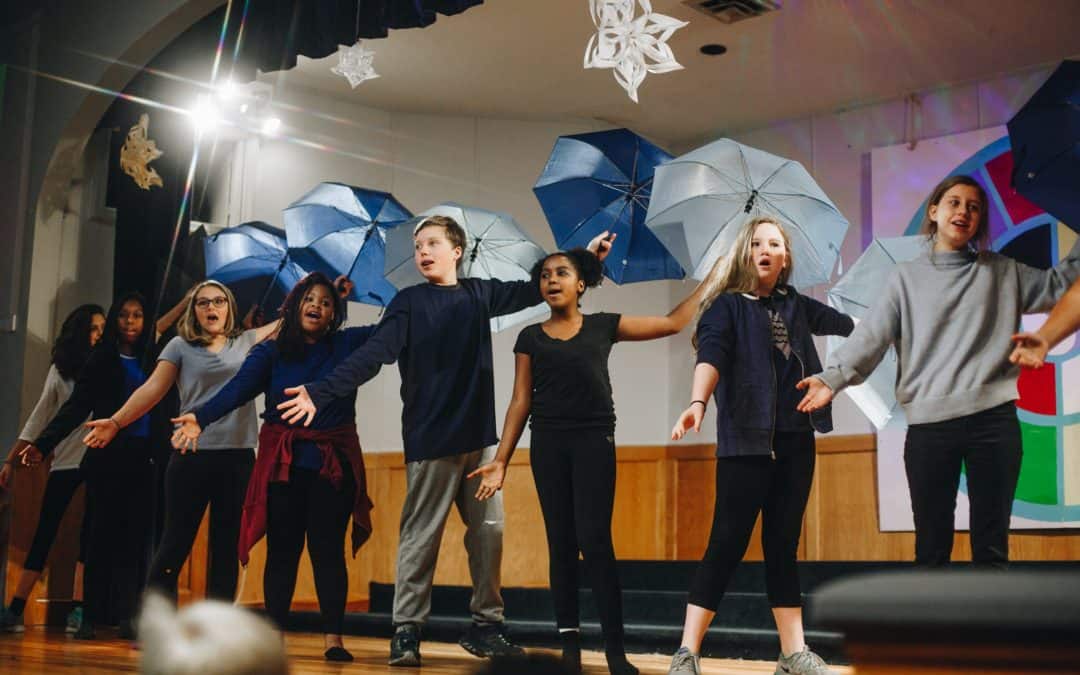
The annual winter program is one of those sacred ceremonies. During this time, the staff and students celebrate the true meaning of the holidays by sharing original songs that embrace the human values that unite us. Each year the theme of the program is inspired by one of the universally held virtues and serves as a guide for the students as they collaborate with Sue Ford, our music director, to draft lyrics for each performance.
For example, a few years ago the theme was LOVE. The students were asked to ponder the power of love and the many ways to give and receive love. This reflection yielded various interpretations and heart-felt lyrics rooted in “Love.” Follow the link below to hear one of the many songs from the love feast.
The following year, the theme “Unity through Music” invited the students to create songs in cultural styles from around the world as a way of honoring our connection to local and global communities. Follow the link below to experience the 2nd grade song, “One Human Family.”
This year, Sue Ford has invited students on a sacred circle journey. The circle is a symbol of wholeness. Sacred Circles, Medicine Wheels, Mandalas, Hoops and Rings are found all over the world in history, art, architecture and ceremony. Carl Jung says, “I saw that everything, all paths I had been following, all steps I had taken, were leading back to a single point — namely, to the mid-point. It became increasingly plain to me that the mandala is the center. It is the exponent of all paths. … I knew that in finding the mandala as an expression of the self I had attained what was for me the ultimate.”
This year the theme “Journey Through the Sacred Circle” is an exploration of how we as individuals and as communities relate to the seven directions and elements within the circle. We begin with our Roots (Below), ascending into Fire and Air, grounding with the Earth, flowing with the Water, floating into the infinity of Space (Above) and finally back home in the center, Spirit. The songs in this journey are original collaborations between students, Sue Ford our music teacher and many of the RCS teachers.
I am sure many of you have experienced the joy and celebration that comes with holiday programs. At each RCS winter program, these feelings are echoed and then bolstered by the invitation of spirit, the emphasis on the sacred and the purposeful connection present at these programs.
As you enter into each holiday season and embark on learning adventures with your students, memory making with your family, and connections with your friends and acquaintances… I ask you to consider the ways that you can invite the true spirit of the holidays along on your journey?
We have some pretty amazing staff here at Rainbow Community School.
We have so many folks with myriad talents.
This month’s team highlight is Katie Wilson, our 5th grade teaching assistant. You’ll never guess what Katie was able to do last summer.
It all starts with a story about how she found Rainbow in the first place.
How did Katie become a part of the staff at Rainbow?
Katie’s life has been serendipitous! She temporarily relocated to Boone, NC after living abroad. She’d been teaching English in Mexico and returned to the US to continue her teaching career here.
While up in Boone, she found out about an opening in the after school program at Rainbow and decided to take it. Right then, she was working as a nanny part-time.
She loved Rainbow so much, that when the opportunity came to be able to work with Susie in fourth grade as a full-time employee, she jumped at the chance.
Later, she was able to move up with the same students to fifth grade this year.
Earlier in the year, the director from a summer camp where Katie used to work contacted her.
He was leaving his company to focus on retirement and asked if she would be willing to take on directing the summer camp for international students who wanted to learn English.
Katie’s former director worked the business side of the camp while she worked the educational and development side, including overseeing staff.
Knowing that she always wanted to develop her own educational programs, it was a great opportunity.
This past summer, she developed the entire ESL curriculum for the summer camp, as well as all the programming. She also had the pleasure of locating it at Rainbow!
The Summer Camp: Visions USA
The camp operated by recruiting students from Germany, Spain, and Italy who were interested in learning English. It provided an authentic setting in which to learn English as a Second or Other Language, as well as give students an incredible international cultural experience.
Students stayed with local host families and attended English classes in the morning at Rainbow for four days per week, and then engaged in more fun activities in the afternoons.
They spent time volunteering one day per week as part of the program. Volunteer work is an important component of camp programming.
This gave international students a chance to see what the Asheville community was all about, the struggles people faced and provided visiting students with opportunities to give back to the community in which they were living and learning.
Similar to what Rainbow students do during the school year, campers went to Manna, Black Mountain Home for Kids to help with events, volunteered at local high schools, helped to paint a mural, and more.
Fridays were reserved as field days where they would go rafting, to Carrowinds, go on an overnight to see the Atlanta Braves, or other similar activities.
The camp also offered language courses for the host families’ siblings, as well.
What were some things Katie learned about running a summer camp?
The summer camp session of 2017 was incredibly successful.
Students from different countries experienced US culture, and experienced each others’ culture in a supportive environment.
In only three weeks, they became best friends and formed deep friendships that will last well beyond their time at camp.
Katie loved the fact that she was affiliated with Rainbow and how she was able to share the attitudes that Rainbow cultivates, including its teaching styles, with all the international students.
Activities included centering, teaching to the domains, and incorporating positive discipline techniques to students who hadn’t experienced that before.
[bctt tweet=”Students can tell that Rainbow Community School is different: they value the whole child.” username=”@rainbowcomsch”]
The international students could really tell that life at Rainbow was different.
They were accustomed to a more regimented school setting and often remarked about the freedom and support they had.
Were there any challenges you faced as you ran the camp?
Katie reported how it’s interesting that every country and municipality has stereotypes and attitudes that they form about other cultures and people.
She found it necessary to look for ways to get past those preconceived ideas and really reach students to show them that we humans are more alike than we are different.
Overall, however, she had a successful first year as the director of a summer camp right here at Rainbow! She’s already gearing up for the 2018 session.
If you’d like more information about summer camp and even possibly hosting students, check out Visions USA.
Rainbow’s centering curriculum aims to support the spiritual identity development of each learner through various contemplative, mindfulness and meditative practices. It also serves to cultivate a strong class coherence and foster a collective wisdom through team-building initiatives and collaborative learning opportunities.
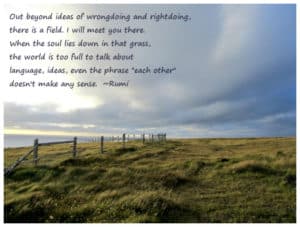
Omega Middle School students often take on the incredible responsibility of leading a centering for their peers. The student chooses a quote that resonates with them, shares it, asks for reflections, and then facilitates an extension activity. In a recent Omega Middle School centering, class coherence was nurtured through a team-building initiative rooted in the wise words of the poet Rumi. Rumi, a 13th century Persian poet, was a Sufi mystic and an Islamic dervish, and is often regarded as a spiritual master and one of the world’s most popular poets. Interestingly, Rainbow founders, in addition to being innovative educators, were also spiritual Sufis with strong beliefs in universal peace and acceptance of all spiritual traditions. To that end, Rainbow’s 40-year lineage of spiritual curriculum is founded in Sufi mysticism, an arm of the Muslim faith in which the practitioners believe that a personal experience with a higher power can be achieved through mindfulness and meditation.
The Rumi quote below served as inspiration for this particular centering:
We can all acknowledge that judgments of right or wrong permeate our society and that societal pressures often yield citizens motivated by competition, achievement, success, winning and losing. Even the mission statement of the U.S. Department of Education emphasizes these. It states, “Our mission is to promote student achievement and preparation for global competitiveness by fostering educational excellence and ensuring equal access.”
All of us, I am sure, acknowledge the importance of setting and achieving goals. But do we always ask ourselves who or what loses if we win, or does my success come at the expense of who or what? As parents, educators and mentors, we absolutely want our children to experience goal setting, success and personal growth; but do we do everything we can to teach them to consider the bigger picture by reflecting in this way? Team building, if scaffolded properly has the power to do just that.
Rainbow recognizes the positive impacts that team building experiences have on classroom culture and morale and also on the development of the whole child. Team building is about working together to achieve a shared goal– one in which everyone succeeds. Team-building initiatives encourage perspective taking, empathy and trust. Team building is about connection.
Team building anchored in spirituality or inspired by contemplation asks each person to turn inward first so that they can show up outwardly in a positive way. What if, before we launched a team-building initiative or worked towards any common goal, we were reminded of the things that bind us? What if we were reminded of the greater good?
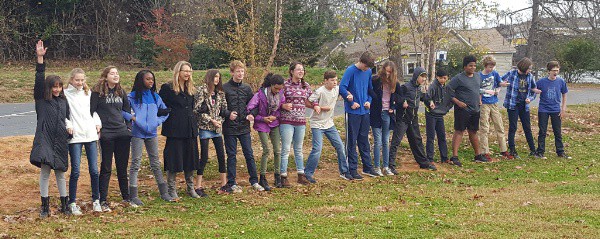
The Omegans spent some time reflecting on the quote. Then the group was tasked to cross a field, arms joined and with their feet touching their neighbors (a symbolic bond). The collective goal was to stay connected throughout the entire journey.
Ultimately, they were asked to enter Rumi’s field of consciousness and to move beyond right and wrong, success and failure, and to focus on what is truly important– the things that bind each of them.
We at Rainbow make it a habit to practice gratitude – not just around Thanksgiving – but all during the school year.
It happens in centerings, and teachers work to instill the two words, “thank you” into every student.
As Renee mentioned in her November Kaleidoscope, the practice of gratitude can boost happiness, optimism, overall life satisfaction, and more. So much more.
Around Rainbow, we speak a lot about the 7 Domains and how each teacher carefully plans lessons that integrate each one. Like a puzzle piece, gratitude fits beautifully into each domain, making it easy for students to become mindful of the power of gratitude.
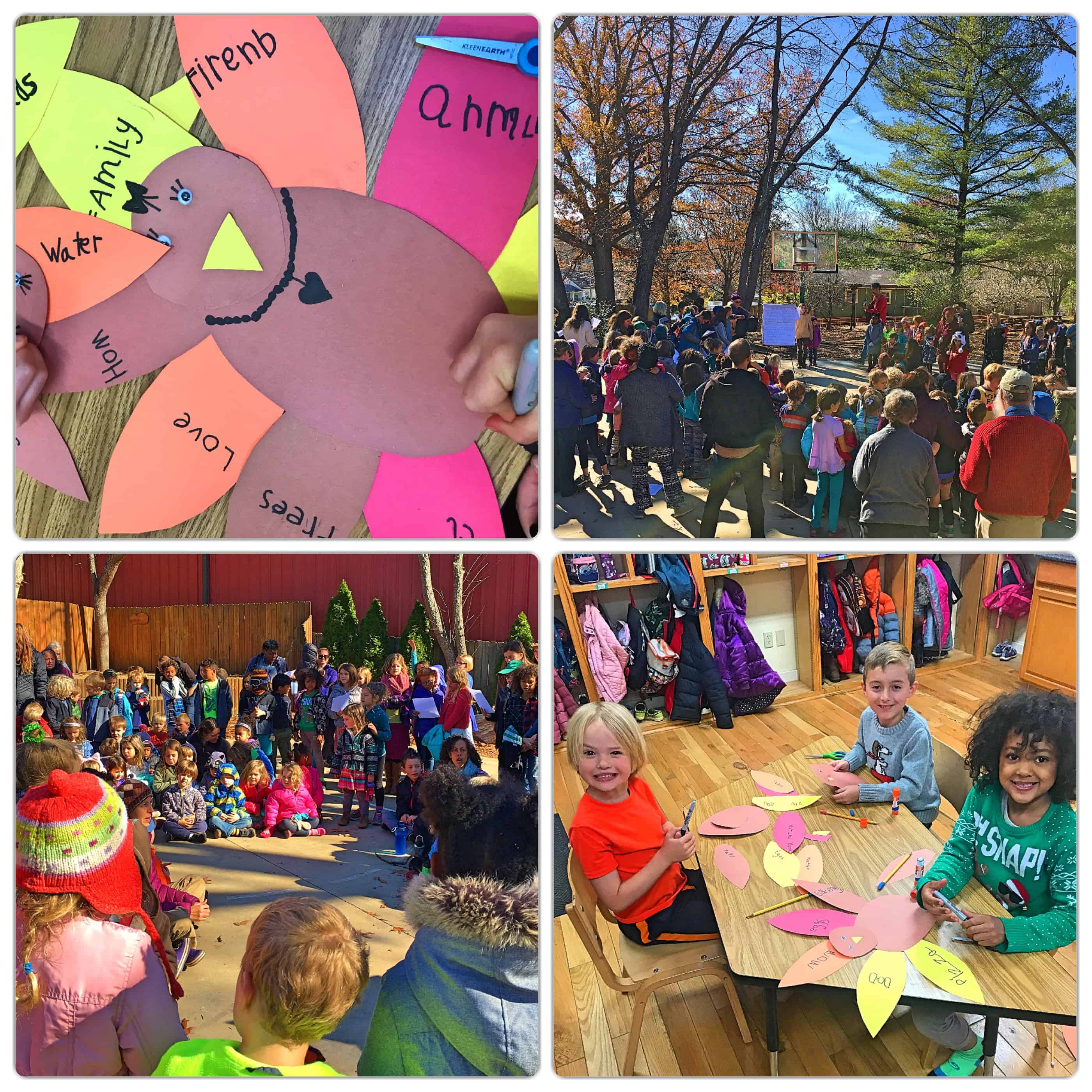
In the days and weeks leading up to Thanksgiving break, students engaged in centerings and activities to help drive home the idea of a solid practice of giving thanks.
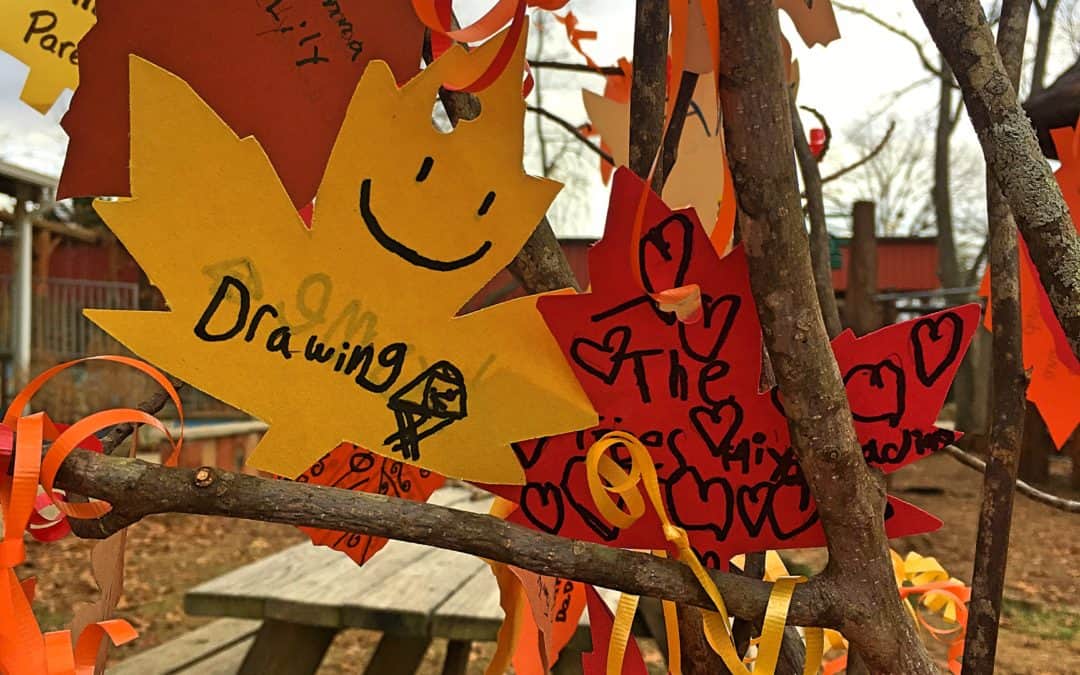
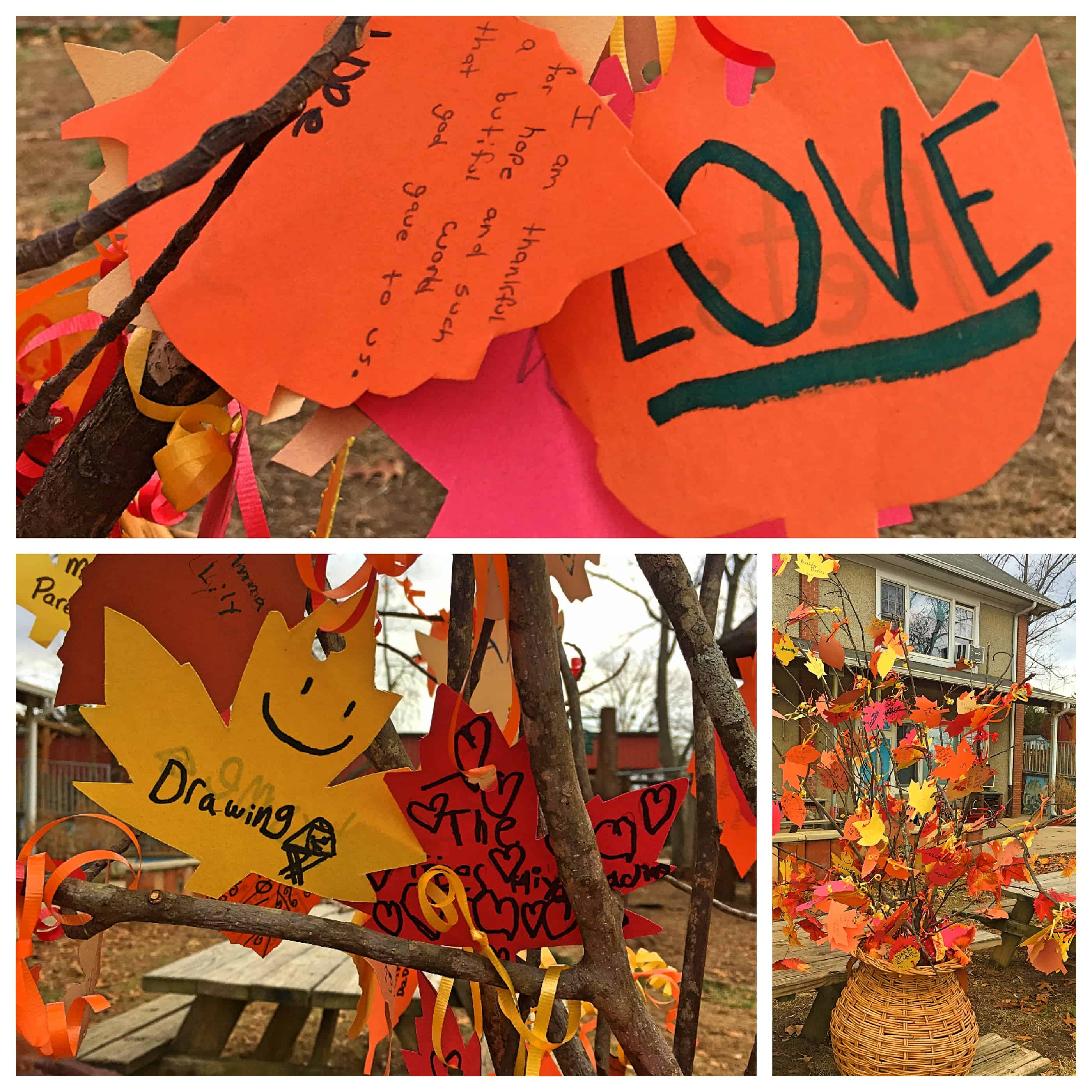
All over campus, students participated in centerings, song circles, and wrote things they were thankful for on leaves to create a gratitude tree.
Indeed, students have a powerful sense of appreciation. We went to the After School to ask students what they were thankful for. They all instantly came up with life’s most precious and priceless gifts: family, friends, animals, nature.
Take a look for yourself:
Activities Around Campus
Gratitude is about connection.
In Preschool (Blue Door), they asked “What are you connected to?” This led to a discussion about how we’re all connected to the elements of the earth, how we feel love, and that gratitude is part of that.
The first grade Cheetahs made turkeys with feathers of gratitude. Fourth grade culminated their archaeology unit with a centering that incorporated appreciation for studying archeological discoveries.
Song circle this week incorporated songs about family, spending time in the woods, and the “Best Day of My Life.”
We invite all students to lead their families in a centering with a focus on gratitude over break. They will know what to do.
However, if you would like some ideas, here are some ways to incorporate a centering with your child.
Gratitude Centering
Gather in a circle. Take three deep breaths. You can optionally light a candle.
Have everyone in your circle write down something for which they are thankful and put it into a jar. When everyone’s finished, each person can randomly take out a slip of paper and read it aloud. Younger students who are learning to write will need help with this activity.
A variation of this could be to go outside, or to write down thoughts of gratitude on a ball and have people in the circle catch it and read off a line of gratitude nearest their right or left thumb. This activity can have so many variations!
Have your child say a blessing over your food.
Close with three more deep breaths.
For more ideas, a quick check on a search engine will give you many to choose from.
Gratitude unlocks the fullness of life. It turns what we have into enough, and more. It turns denial into acceptance, chaos to order, confusion to clarity. It can turn a meal into a feast, a house into a home, a stranger into a friend. Gratitude makes sense of our past, brings peace for today, and creates a vision for tomorrow. — Melody Beattie
In closing, we hope that all Rainbow families, friends, staff, and students have a wonderful holiday break!
We are grateful for all the love you give, the hope, the inspiration, the peace, mindfulness, and how you give back to the earth.