Willow the Welcome Dog – Highlighting a Special Friend!
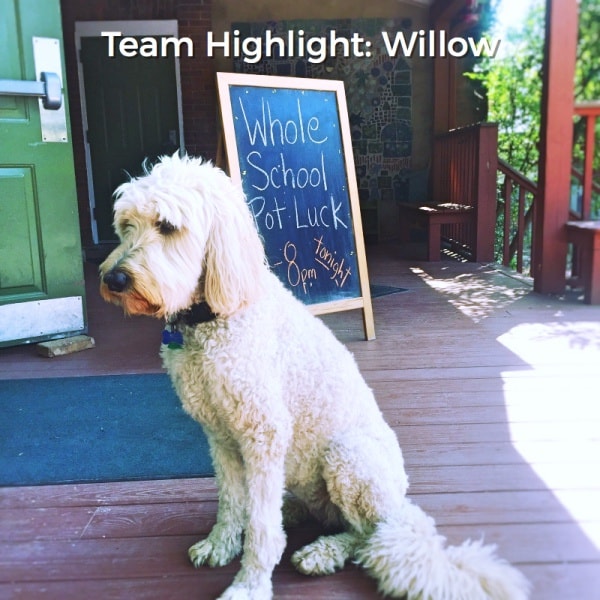
For this month’s team highlight, we have something sweet to share. You may have noticed a sweet dog greeting you when you come to Rainbow. She’s the official “Welcome Dog,” a self-imposed designation by our four-pawed friend. In fact, she’s so adept at being a greeter and interacting with humans, we think Willow doesn’t know that she’s a canine and not, in fact, a homo sapiens.
Willow claims West Willmore as “her human” – the Curriculum Director and Development Coordinator, as well as the Director of Operations for Rainbow Institute.
But Willow has come into her own as the Welcome Dog. She’s quite at home in our community and loves it when people come up and pet her.
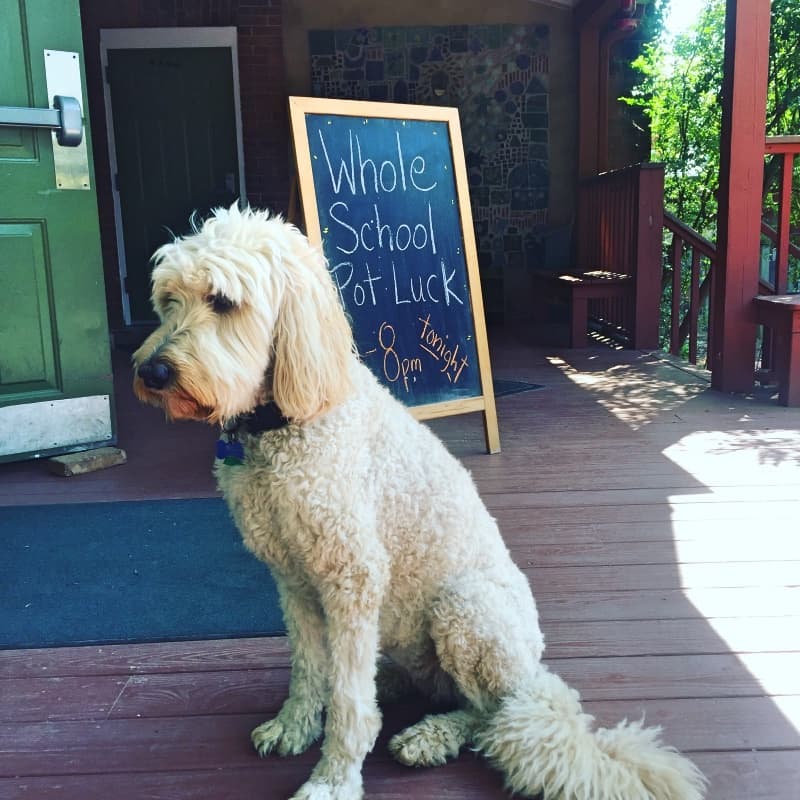
Willow is happy to welcome you to Rainbow!
During the course of the day at Rainbow, she loves being part of centering. In fact, she hopes that her presence will be perfect for “therapeutic student interactions.” She loves how she can help students calm down – just when they would want some time to take a few breaths.
Willow loves being pet and finds that this calms students, too!
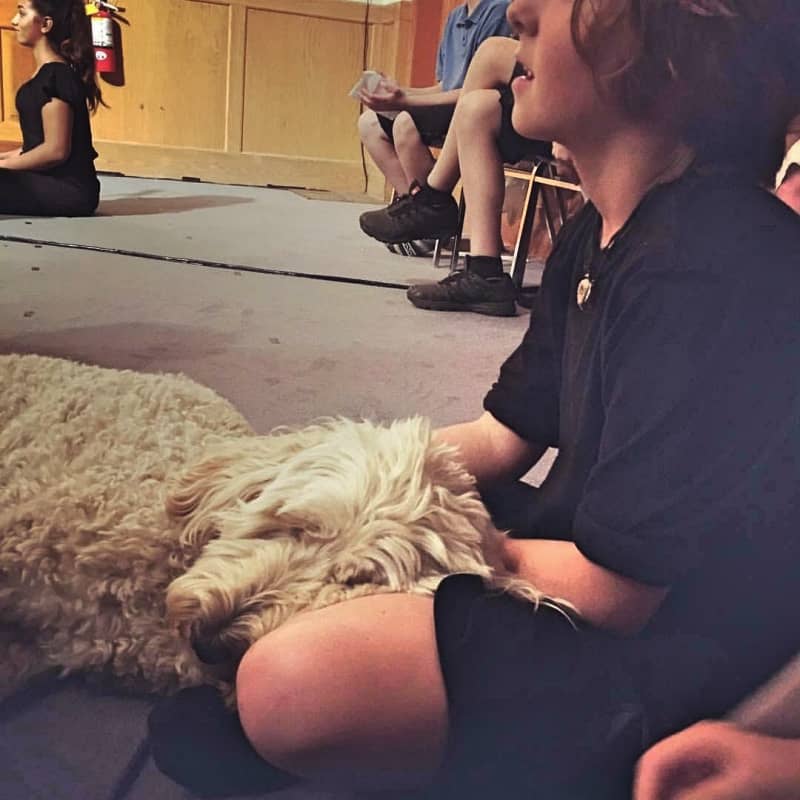
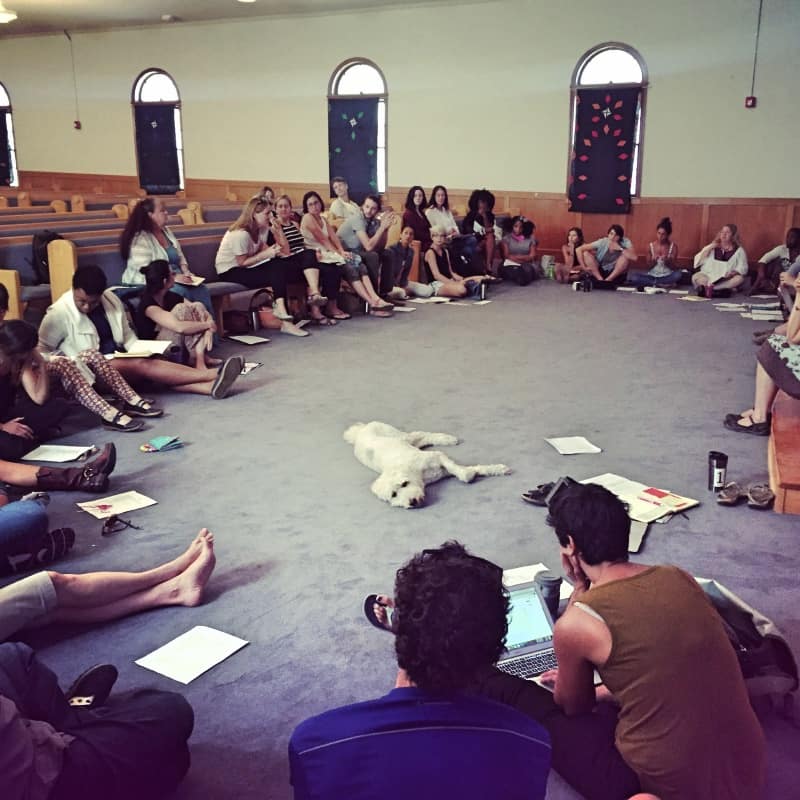
She attends faculty circle from time to time and likes to keep tabs on what’s going on in the community. It’s hard to sit perfectly next to other staff members in the circle, so she doesn’t mind going into the center. She figures if she just listens really well, no one will mind.
Sitting in the center of the circle.
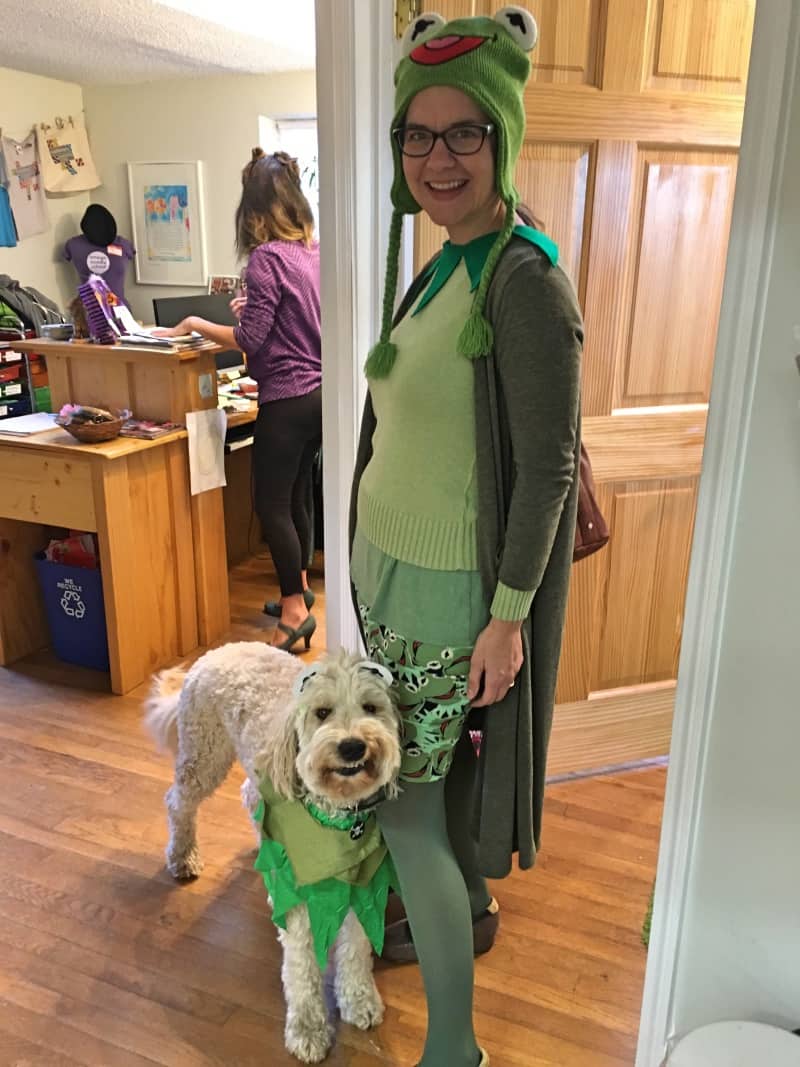
Willow sees to it that she’s present for all school celebrations. One of her favorites is Halloween.
Willow and Sandra, our Director of Operations, all dressed up for Halloween!
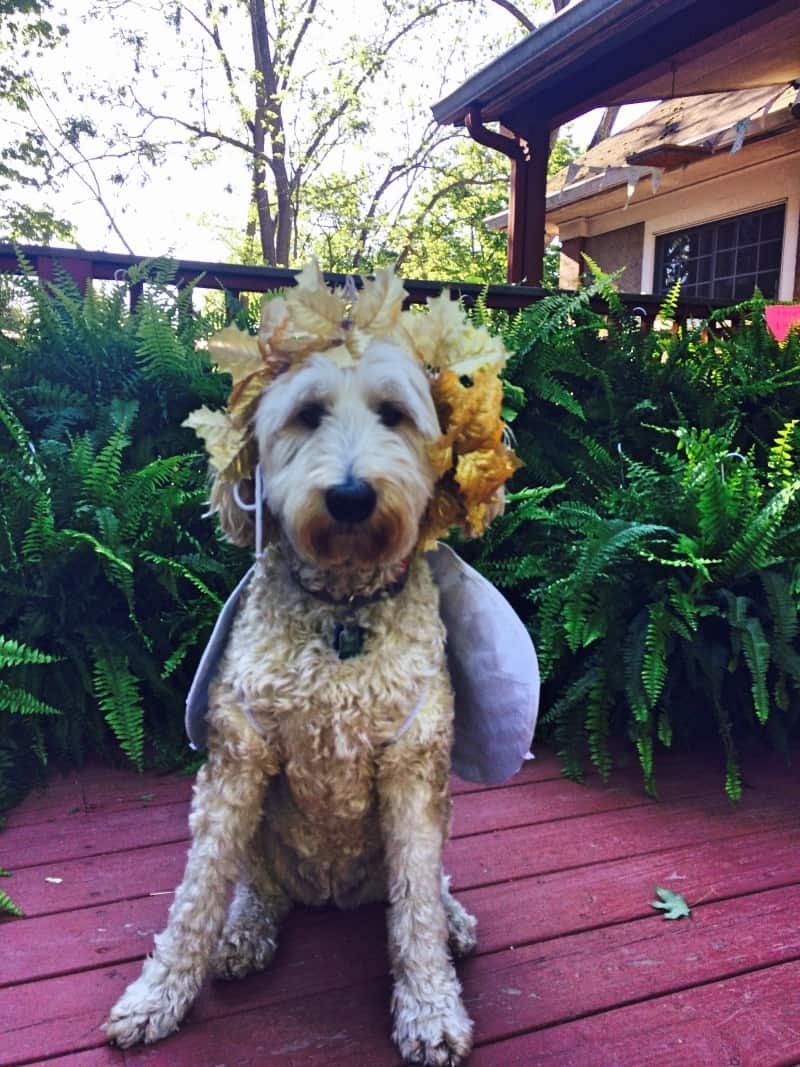
Another favorite is May Day each year.
May Day celebrations with Willow!
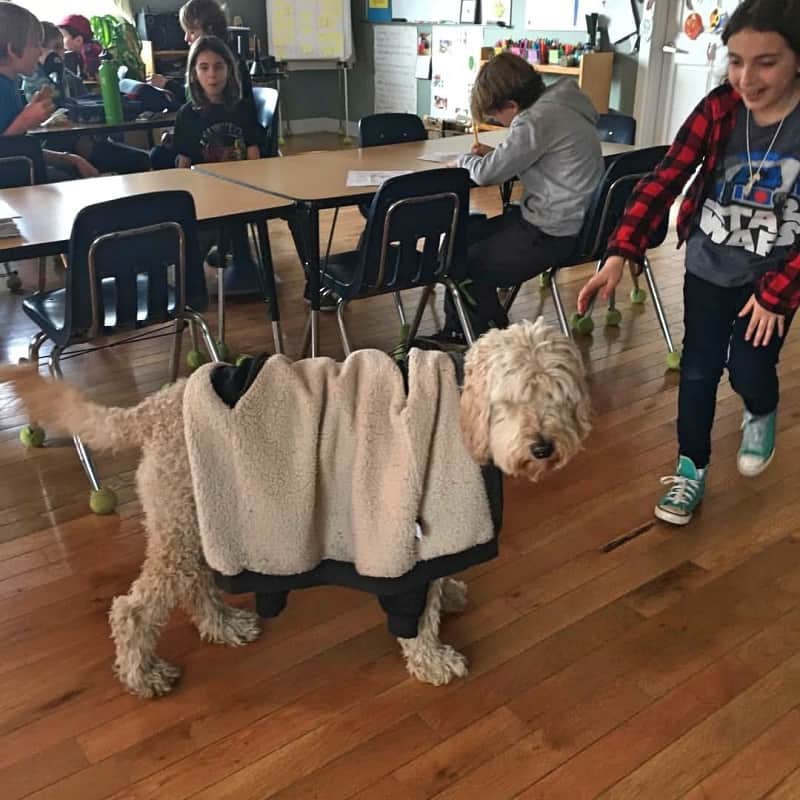
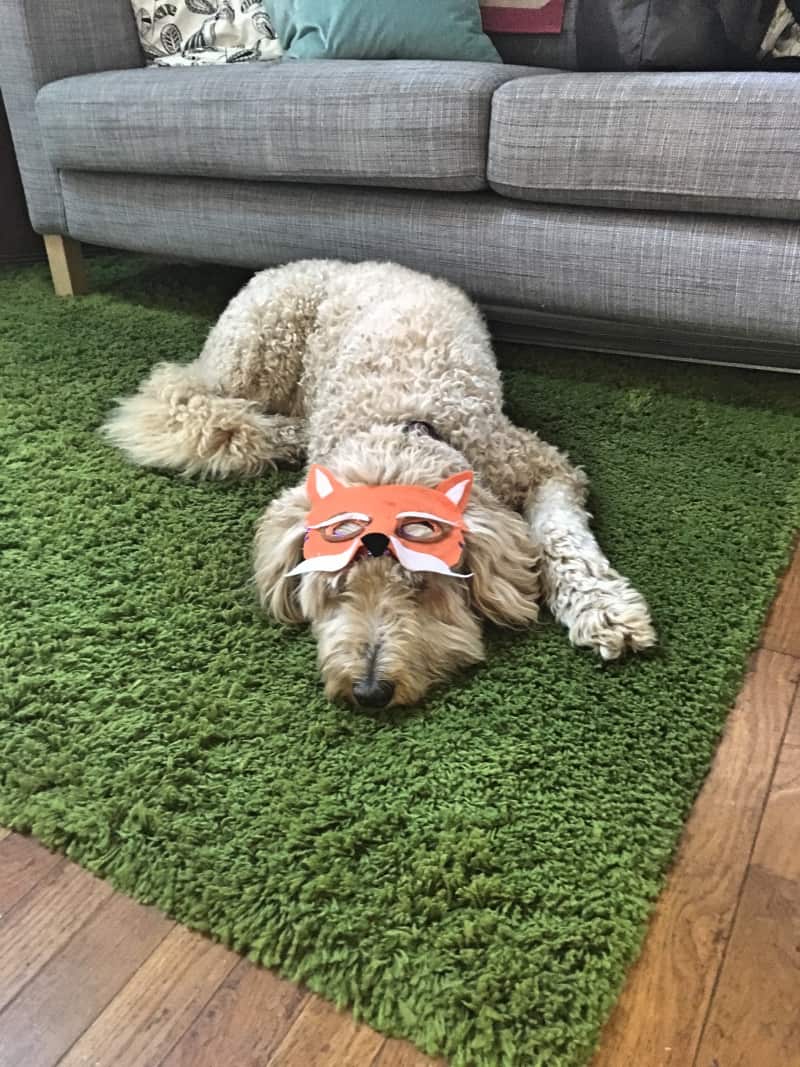
She also doesn’t mind an impromptu “long lost cousin” costume, either.
We think that perhaps that extra layer should be sheared…
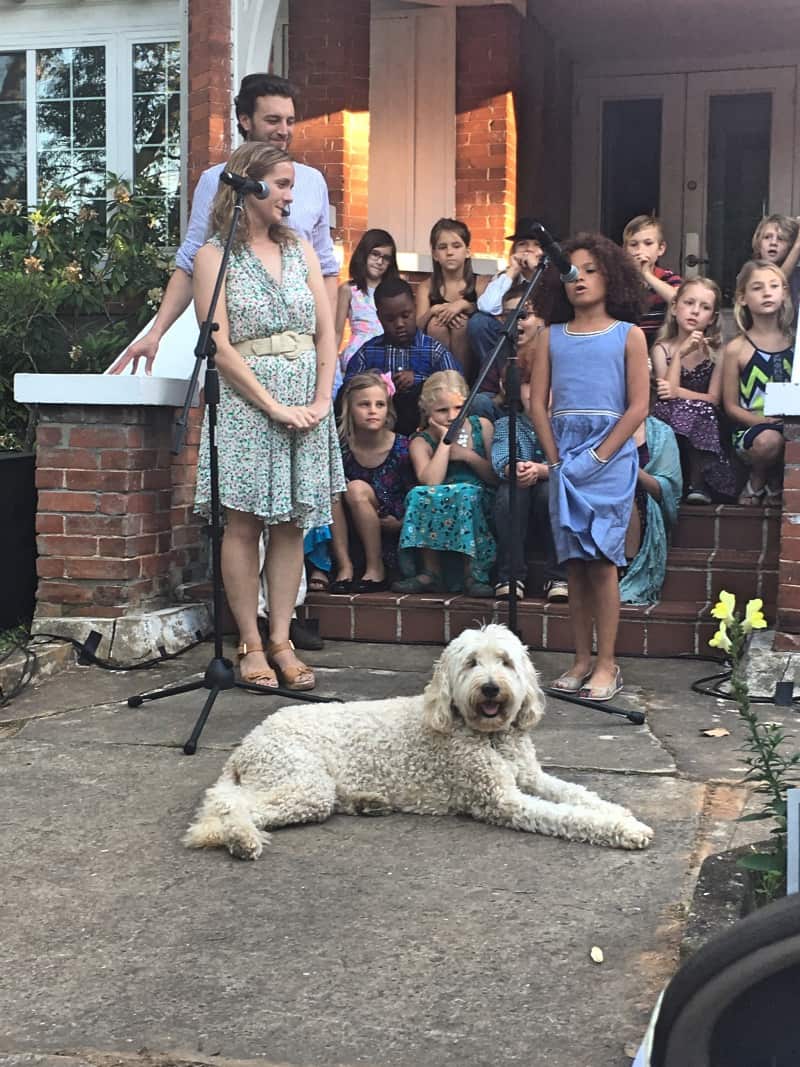
She even likes to hear the graduation songs and speeches at the end of the year.
Graduations are reasons for everyone to gather around…
She doesn’t mind crowds or having them look at her. That’s funny because although she doesn’t bark, West reports that she’s kind of afraid of everything.
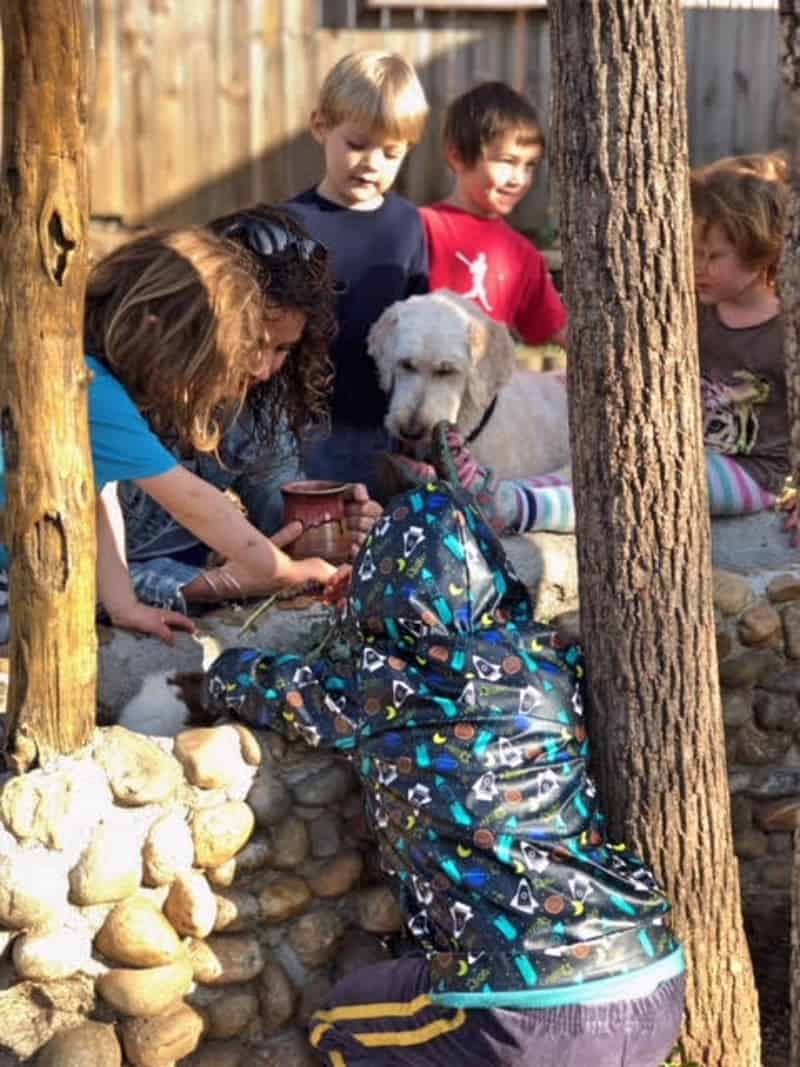
Willow doesn’t mind helping students out with their science projects. She gives them lots of ideas.
Willow just doing her part for science.
Willow On History, Science and Sports
When she’s not helping students out with centering or science, she likes to sunbathe on Rainbow’s main deck – as long as it’s warm enough to do so. She figures what would be the point of sunbathing if the sun doesn’t bathe you in some warmth?
During history lessons, Willow is great at illustrating the idea of “hunting and gathering.” She hunts and gathers bits of food from snack time and is really good at keeping the floors clean.
She can be a comedian, too. One of the funniest things she does is stand in her water bowl. When she does that, we think she’s trying to tell us that it’s time to get out and play. Preferably in the water.
Indeed, she loves to swim! Not only does she go with her human to the lake quite often, she also goes on rock climbing trips, hiking, trail running, and more. Even though she likes to hunt, she’s content with the thrill of the game and accepts the fact that she doesn’t catch much.
Travels All Over
She also accompanies West on plenty of road trips. She’s been all over the U.S. and has her sights set on international travel. For now, she can boast that the farthest she’s ever been outside of North Carolina is California.
Willow has made quite a life for herself in the world of humans. When she was born, she was the runt of her litter-mates. As soon as she met West, however, it was loyalty at first sight.
If you see a light-colored fluffy dog around the campus of Rainbow, just say, “Willow!” and she’ll come right over to you and make sure you feel welcome. Don’t worry if you’re allergic to dogs: Willow is hypoallergenic.
You might find Willow in an office, ready to offer her insights, but she can’t promise complete seriousness all the time…
You can find Willow in Instagram under her owner’s account with the hashtag, #willowthewaterdog.
A few years ago, I wrote a piece for the Mountain Express. It was after the Sandy Hook tragedy. I explore that why we as educators cannot resort to arming ourselves, but instead, embrace a hope for the future without arms. The article shows how this is still relevant in 2018.
Integrated thematic units are considered best practice at Rainbow. Thematic lessons are layered in both discipline and in learning domain. Layering in this way encourages theme engagement from many angles and through many lenses. This allows a student to connect with the material through their preferred learning domain while nurturing a lasting relationship with the material. For example, what is taught in science may be incorporated into the social studies topic, written about in language arts, or read through literature. This method nurtures learning that is both circular and interconnected.
First grade is currently studying Africa. A recent centering lesson was layered in mindfulness and contemplative ritual, kinesthetic learning, teamwork and critical thinking. It was also rooted in the geography, natural history and culture of Africa.
The centering begins, like all RCS centerings, with a prompt to, “still your minds, bodies and voices and at the sound of each chime, take three audible deep breaths.” Josie, the teacher, then asked the class Mindful Mediation Leader to offer a word or intention that we can hold in our hearts. “African animals” was offered and Josie struck a match and said, “may we honor African animals as our teachers.”
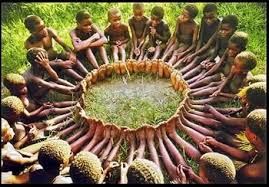
These rituals served to shift the class energy inward resulting in a moment of silence and stillness. Josie then showed a picture of the Efé children of the Zaire, Ituri Forest and asked contemplative questions.
“What do you see, think and wonder about this picture?”
The Osani Circle Game
Josie explained that these children were playing a game called The Osani Circle Game. This prompted a conversation about circles. She stated that circles and cycles are seen everywhere. They are symbols of connection and wholeness. They are considered incredibly strong. Josie asked, “Can we name some circles or cycles?”
She went on to describe that the players of the game harness the strength of the circle by physically creating a circle with their feet and bodies. Each person then takes a turn naming a circular object, concepts or cycles such as apples, belly buttons, pies, time, the water cycle, butterfly cycle, the seasons. The goal being to hold the circle throughout the game while, without hesitation, naming circular objects.
In an effort to anchor the kids in teamwork, set the tone for the game and harness the power of the circle, Josie started by sending a “squeeze around the circle.” She then led them to create a human mandala. Finally, she guided them through a closed-eyed medication that allowed them to picture the circles all around us.
The kids named things like the butterfly cycle, the Sun, the belly of a bear, our noses, etc… More importantly they had fun while learning in a rich and integrated way- from learning about Efé children, to physically and collaboratively recreating the circle, to thinking fast and maintaining concentration throughout the game.
However, it was the unwritten curriculum that spoke volumes- the wisdom of the circle. The circle as a powerful symbol has been referred to since the beginning of time. It is celebrated in many religions and cultures as divine. It holds archetypal influence in story and myth and is represented by so many natural phenomena. Consider the Tibetan mandala, the Native American medicine wheel, the wedding ring, the Hero’s Journey, the Sun or Moon cycle. This centering ended with a closing verse that integrated some important circular objects found in our lives.
Informing your practice
If children are deeply and comprehensively connecting to the Circle, then they are more likely to return to it later in life as a teacher or guide, a tool, a strategy, an anchor or a healing source. I ask you to consider how circles show up in your life, to pay attention to their influence, and to invite them in as teachers.
Centering practices aim to strengthen our learning community by inviting spirit and sacredness into each space and each day. At RCS, we see this daily practice as a meaningful ritual that is integral to a child’s healthy spiritual development.
We also host school-wide, annual celebrations and ceremonies that are also rooted in the sacred and serve to deepen the connections we have to ourselves, our community and a higher power. These shared celebrations, ceremonies and rites of passage empower all involved to turn both inward and outward so as to realize their part in an integral community and their connection to something greater than themselves.
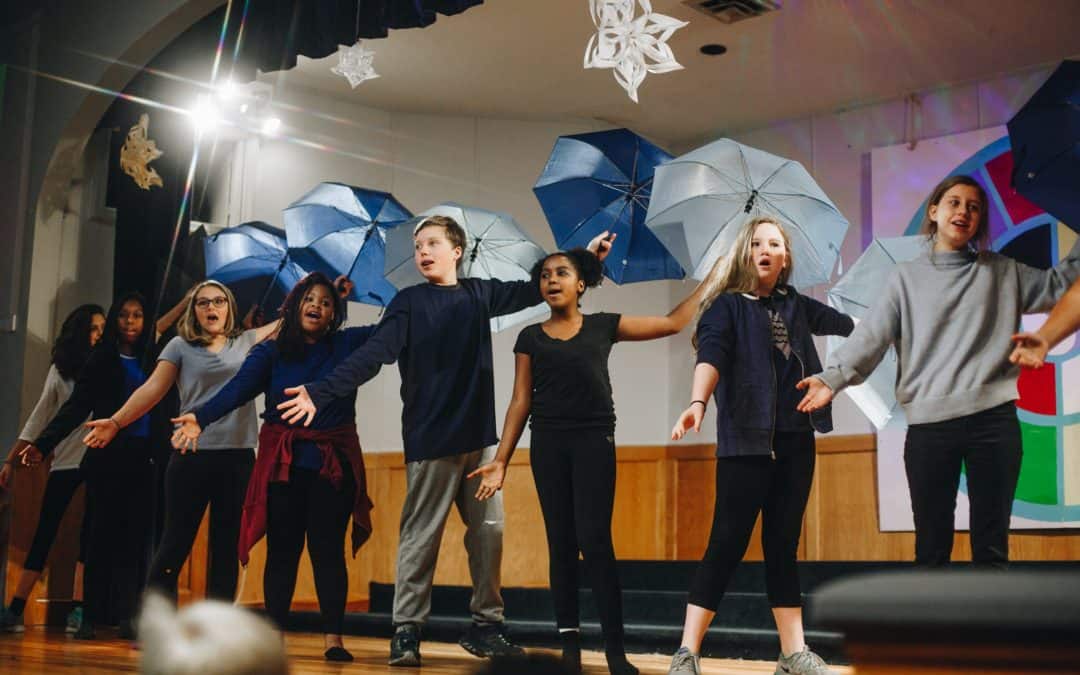
The annual winter program is one of those sacred ceremonies. During this time, the staff and students celebrate the true meaning of the holidays by sharing original songs that embrace the human values that unite us. Each year the theme of the program is inspired by one of the universally held virtues and serves as a guide for the students as they collaborate with Sue Ford, our music director, to draft lyrics for each performance.
For example, a few years ago the theme was LOVE. The students were asked to ponder the power of love and the many ways to give and receive love. This reflection yielded various interpretations and heart-felt lyrics rooted in “Love.” Follow the link below to hear one of the many songs from the love feast.
The following year, the theme “Unity through Music” invited the students to create songs in cultural styles from around the world as a way of honoring our connection to local and global communities. Follow the link below to experience the 2nd grade song, “One Human Family.”
This year, Sue Ford has invited students on a sacred circle journey. The circle is a symbol of wholeness. Sacred Circles, Medicine Wheels, Mandalas, Hoops and Rings are found all over the world in history, art, architecture and ceremony. Carl Jung says, “I saw that everything, all paths I had been following, all steps I had taken, were leading back to a single point — namely, to the mid-point. It became increasingly plain to me that the mandala is the center. It is the exponent of all paths. … I knew that in finding the mandala as an expression of the self I had attained what was for me the ultimate.”
This year the theme “Journey Through the Sacred Circle” is an exploration of how we as individuals and as communities relate to the seven directions and elements within the circle. We begin with our Roots (Below), ascending into Fire and Air, grounding with the Earth, flowing with the Water, floating into the infinity of Space (Above) and finally back home in the center, Spirit. The songs in this journey are original collaborations between students, Sue Ford our music teacher and many of the RCS teachers.
I am sure many of you have experienced the joy and celebration that comes with holiday programs. At each RCS winter program, these feelings are echoed and then bolstered by the invitation of spirit, the emphasis on the sacred and the purposeful connection present at these programs.
As you enter into each holiday season and embark on learning adventures with your students, memory making with your family, and connections with your friends and acquaintances… I ask you to consider the ways that you can invite the true spirit of the holidays along on your journey?
Hallowed Eve. All Souls. Day of the Dead. Halloween. The various cultural traditions of mid-autumn have much in common. In general, the veil between the living and the dead is considered to be at its thinnest this time of year when the plants are dying and all is growing darker.
How do we talk about death with children?
What does it mean to be dead? What happens when I die? Can I communicate with my ancestors who have passed? Children are naturally curious about death and need healthy ways to process it.
They need loving adults around them who can authentically talk about death and even celebrate it, such as we do this time of year. As a secular school, we do not promote the beliefs of any one particular religion, but we do learn from various cultures and traditions.
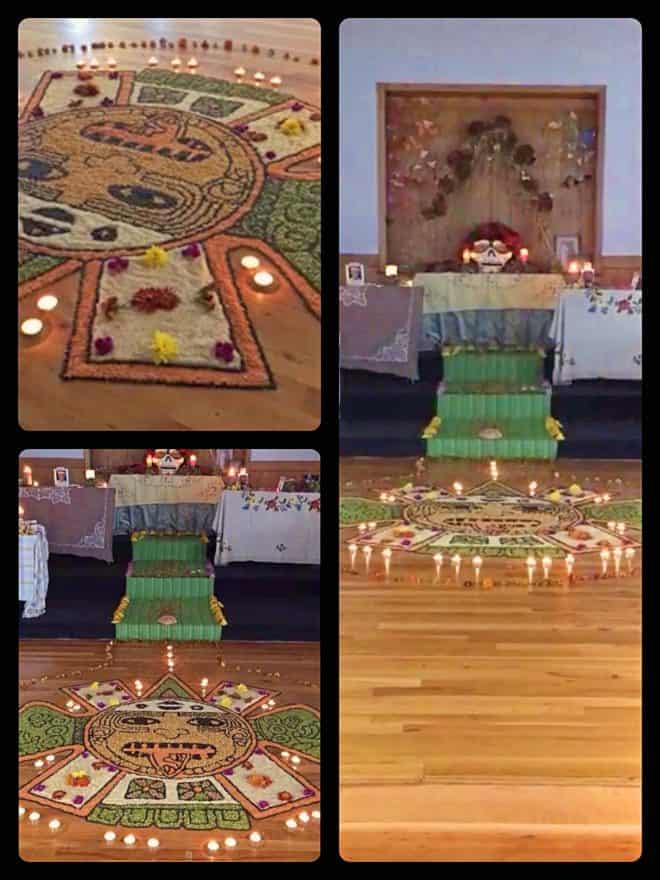
Day of the Dead, or in Mexico, Día de los muertos, was honored at Rainbow on November 2.
One of our families from Mexico, Tona’s mom and dad, worked a whole day with Spanish teacher, Lisa Saraceno, and art teacher, Tracy Hildebrand, to build a stunning traditional altar.
Parents and students also helped, along with a community friend named Yaran.
On November 2nd, throughout the day, children, parents, teachers, and even neighborhood guests, brought photos and artifacts of loved ones to the altar where they could pray, meditate, mourn, sing, or commune.
We are glad Rainbow can be a safe place and a sacred place for children and people of all ages and backgrounds to celebrate the lives of those who have passed.
From Halloween to the Hoedown, with Love
When we “borrow” from various cultures, it is important that we appreciate those cultures and borrow with due respect, rather than appropriate their culture in a way that commercializes it.
Of course, Halloween has become highly commercialized (something that is also increasingly happening to Day of the Dead), but we like to celebrate Halloween whole-heartedly at Rainbow.
I love the creativity and joy that our students, families, and faculty put into it!
The annual Halloween Harvest Hoedown (which was simply the Harvest Hoedown this year since it was rained out and rescheduled for after Halloween) is SO MUCH FUN! It is a great fundraiser. This year, it raised $5,500! Thank you, Hoedown leaders and volunteers. You are the best!
A Love in Action Story
Some of the funds raised from the Hoedown will go toward Rainbow’s Love in Action Committee. Love in Action works to provide services, goods, and food for families within Rainbow who need a helping hand.
Everyone makes sacrifices to send their child to Rainbow, but for some it’s a very different kind of sacrifice than you may think. Imagine living at, or close to, the poverty level and joining a private school where everyone else has a totally different economic reality and privilege.
People can feel very out of place, which can be embarrassing, intimidating, and also can involve giving up a lot. For those who get scholarships, they are giving up free breakfast and lunches and the transportation that public schools provide. For some scholarship families, this makes attending Rainbow impossible or very difficult.
I remember one single mom who didn’t have a car and had three children all under the age of 5. As a recipient of federal aid, she was required to have steady work. She would drop off the first of her children at Rainbow at 7:45 in the morning, get her baby and toddler to two different daycare centers, take the bus to the end of its route, and then walk along a highway to get to the fast food restaurant where she worked.
At the end of the day she would pick up each of her children from all three places, still using the bus as her main source of transportation. She would barely get to Rainbow when afterschool was closing in the evening. Somehow, she would have to go grocery shopping and carry groceries with three little ones (one not yet walking and one barely walking) using the bus!
It would have been so much easier for her to send her preschooler to the public school where the child would have been picked up with a school bus and receive free breakfast and lunch. But she dreamed of her children being able to receive a high quality, holistic education. She didn’t want the obstacle of poverty to obscure that dream.
She, like all of us, made the sacrifice to send her child to Rainbow, even though it seemed impossible. Isn’t humanity incredible? We all have our unique struggles.
Love in Action is headed by Denisa, our after-school director. She works tirelessly to bring in food donations and other help to families who need it. The story I just mentioned was from before we had Love in Action.
Imagine if this mom’s preschooler could have had her snack and lunch already at school when she arrived – one less lunch box for this incredibly busy mom to prepare, and of course less food for her to purchase with her finite food stamp budget to cart home without a car. Imagine if someone would have been able to give her child a ride home and leave a box of food from Manna with them. What a huge difference this would have made for this mother.
Thank you, Denisa, for your loving work with Love in Action. Thank you Love in Action Committee volunteers. We are also grateful to Manna for their food donations. Still, more gratitude goes to the Hoedown committee!! You are changing lives. If you want to donate to or volunteer with Love in Action, please contact Denisa at denisa.rullmoss@rainbowlearning.org.
So much to be grateful for!
This next thank you goes to the Gathering Church who rents the Omega campus on Sundays. Instead of having church on November 4, they had a volunteer day. They worked with Max to fix up the community area by the entrance to the middle school (where two picnic tables are). It’s no longer a mud-pit. It’s lovely, and be sure to check it out!
More and more thank yous!
The Pollinator’s Volunteer Fundraising Committee is blown away by how generous early donors have been to the annual campaign. (Note that those who have donated to the annual campaign have their names written on little pennants on the deck.)
If you have not donated yet, please make the hard-working pollinator volunteers happy by making your donation today. They have put in countless hours to improve our school “bee hive,” and they can rest as soon as everyone has participated in the annual campaign. Truly, any amount is SO welcome. A donation of any size creates a buzz! And that makes people happy! It takes everyone to make a hive.
Hope is alive at Rainbow.
One month ago we held the 2nd Annual More Than Mindfulness Conference. I honestly cannot put into words an adequate description of how positive and inspirational the conference was. The phrase “high vibrations” comes to mind. Over 100 people attended –mostly teachers. Emotions were strong as teachers from around the country experienced the Rainbow Seven Domains Model of Education. Some became deeply emotional as they discovered what a truly holistic education looks and feels like.
Many said that all children should be developed as whole people. All children should get to do centering every day. All children should be recognized for who they really are. Seeing education done the Rainbow way was incredibly empowering and brought tears of hope (and at the same time sadness as many teachers doubted they would ever be allowed to teach holistically in their school).
The more teachers and parents see what is possible, the more people’s expectations for education will be higher, and the more our paradigms for education will shift. When paradigms change, we truly have hope of changing the world. “The betterment of the world mostly depends up the development of the coming generation.” ~Hazrat Inayat Kahn.
Did you know?
Rainbow was founded by Sufis who based their educational philosophy on the teachings of Hazrat Inayat Kahn. Our keynote speaker at the More Than Mindfulness Conference was Nura Laird (formerly Ashrita Laird), one of Rainbow’s founders.
Nura has dedicated her life to helping children and adults become whole, healthy human beings by developing their spirituality. After leaving Rainbow, she and her husband founded a Sufi university of healing in California, which she still runs today.
Nura is an incredibly loving and peaceful person, and her keynote reflected her hope for education and the world. She also shared some of Rainbow’s history. Her speech is located on Rainbow’s website, entitled, “Establishing a Heart-Centered School.”
Rainbow alumni are some of the most interesting people!
The same weekend as the conference, we had a very special alumni reunion, and about 130 people attended! There were many people from the original 15 families that founded Rainbow back in 1978! As you know, being a part of a school really bonds people.
We go through times of sorrow, immense joy, and conflict – together – all for the sake of our children. These people had countless experiences together, and many hadn’t seen each other in years, maybe even decades. It was so joyous to see people reuniting and staying until the tables were being cleared and cleaned up.
Omega teachers Jason Cannoncro, Mark Hanf, and Justin Pilla worked on it over the summer, and I helped West write the narrative on the overall philosophy and culture of Rainbow.
Melissa Henry (Mom of Calvin, Sharissa, Dallas, and Melody) did the professional editing to get it ready for press. We started selling the book at the conference, and it can be purchased online under “A Seven Domains School.”
Omega Middle School is the crown jewel of Rainbow.
Over and over, specialists, such as speech therapists, who go to all the private and public schools in town, say they are most impressed with our middle school – the rigor, the joy of learning, not to mention the expertise of the teachers.
At our Omega Open House this month, we featured a Rainbow alumni panel.
Most of them are in high school at Carolina Day School or SILSA (the all honors alternative high school), and remarked how often they hear their teachers and high school administrators publically, loudly, proclaim how much they love Rainbow students for their intellect, maturity, hard work, and character.
You are all invited my 50th and Margaret Gerleve’s 60th birthday party!
It is on December 8 at 8pm (that makes it easy to remember) at The Block off Biltmore at 39 S Market St (the YMI Building downtown.) The Block is a wonderful venue, and I am grateful that they are opening their doors for our party.
DJ Whitney will be spinning tunes that will make you want to dance. For those of you who know past faculty and families, it’s also Judith Beer’s 65th and Wendy Sause’s 50th. We are women celebrating landmark birthdays late at night – mature people having a mature gathering where we get to act like kids.
(Sorry, children are not allowed in the venue. Get yourself a babysitter and come join in the fun!) It is free! On me! If you want to bring some food or snacks to share, some people are doing this, but be sure it is vegan because The Block is a vegan establishment.
Gratitude: The Magic Potion
Thanksgiving has always been my favorite holiday – not because of the inaccurate account of the Thanksgiving story I got when I was growing up in Minnesota, and not even because of the food. It’s because gratitude is my favorite thing to celebrate.
Positive Psychologist, Robert Emmons, defines gratitude as a recognition of a source of goodness that lies at least partially outside of the “self.” His book Thanks! provides robust empirical evidence about the benefits of being grateful.
In general, research participants who engaged in intentional practices of gratitude demonstrated greater levels of happiness. They expressed more optimism about the future, including feeling greater satisfaction with life as a whole and more vitality. They reported fewer symptoms of physical illness, and, interestingly, they also reported a large increase in time exercising.
They even reported sleeping better. Researchers who work with people in trying times found gratitude to be perhaps the single most effective remedy for improving psychological and physical circumstance – and the benefits are lasting.
Gratitude is an ongoing theme at Rainbow, with the idea that gratitude should become a lifelong habit.
Thanks to daily centerings, blessings at mealtimes, and other Rainbow traditions, your child practices gratitude fully and skillfully here at school. It’s one of the reasons Rainbow is such a joyful place!
So this Thanksgiving, I hope you have the opportunity to ask your child to lead the family in a gratitude centering. Looking one another in the eye and openly expressing gratitude for each other is truly something to celebrate. Blessings to you!