by West | Mar 22, 2018 | Blogs, Home Page News, Rainbow Institute
An altar is commonly associated with a religious purpose. It is often a structure or space, considered sacred, on which offerings are placed and used in a rite or ritual. However, we often create altars to honor various things that aren’t necessarily associated with a religious purpose.
We make altars all the time, some intentionally, some unintentionally and others out of habit. Consider how you may arrange your collectibles, how you may display your family photos or art, or how you may plan your garden. Think about the forts or fairy homes that your kids make in the backyard or how they arrange their special artifacts or favorite toys. With these “altars” we aim to elevate, focus energy and/or bring special attention to something.
Altar creation can be a very powerful process. It provides a space to slow down and reconnect to something very personal or meaningful to you. Creating a spiritual altar can also be a physical and visible representation of an intention you may have. It may also serve as a sacred way to invite spiritual energies and questions into your life . Ultimately, altars become focal points or reminders of our inner spirit and our connection to the divine.
Altars are very much a part of the culture of Rainbow
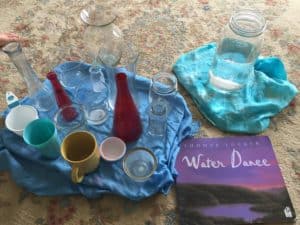
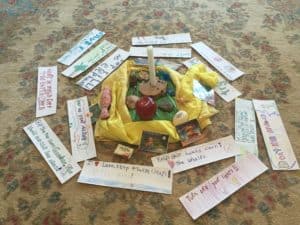
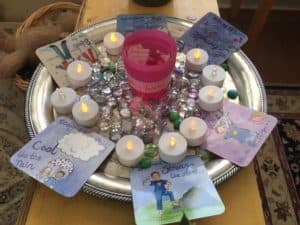
They are found in every classroom, used each day in centering practices and are often created by the students. The elements used in each altar vary but are often reflective of the season, the theme that the class may be studying, or the message the centering practice intends to convey. Below are some classroom altars.
Co-creating altars
In an effort to raise money for their end of year trip, some of our students recently designed, created and sold traveling altars. Each altar provides various resources and tools that may help others to bring a centering practice into the home.
- The tablecloth serves a way to transport the altar as well as an aesthetically pleasing foundation to set up the altar.
- The candle, when lit, sets the tone for the practice and invites spirit into the room. It is also a visible reminder to celebrate the light in ourselves, others and the world around us.
- The shell demonstrates our connection to the natural world. Displaying nature artifacts bring forth the wonder and magic of the natural world and reminds us that time in nature can yield deep connection and contemplation.
- The painted rock displays a word of intention and reminds us to aim to bring positive emotions into our lives.
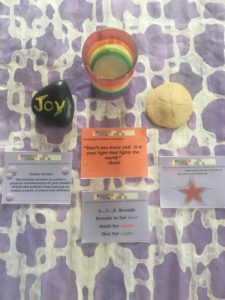
The blue cards share three different breathing techniques that help the mind and body achieve awareness, presence and peace. The orange quote card is intended to engage the reader’s mental domain by encouraging them to reflect on words of wisdom. The yellow cards highlight social conversation questions posed by the students. These cards encourage the readers to ponder big questions such as, “When and how was the universe born?” and “What happens after death?” or ask the reader to personally reflect on things like, “What type of personal do you hope/aim to be?” or What helps you to feel calm and grounded?”
How might these inform your practice?
The creators of these traveling altars were hoping that the altars would prompt centering practices within the home. The elements of each altar are simply starting points out of which family ritual, contemplative practice and spiritual development can grow.
Consider what your family or classroom altar could look like. Where might it live? What elements would you include? What question cards or breathing techniques could be added to this package? What inspirational quotes might serve your family or classroom?

by West | Jan 30, 2018 | Blogs, Home Page News, Rainbow Institute
Teaching thematically
Integrated thematic units are considered best practice at Rainbow. Thematic lessons are layered in both discipline and in learning domain. Layering in this way encourages theme engagement from many angles and through many lenses. This allows a student to connect with the material through their preferred learning domain while nurturing a lasting relationship with the material. For example, what is taught in science may be incorporated into the social studies topic, written about in language arts, or read through literature. This method nurtures learning that is both circular and interconnected.
First grade is currently studying Africa. A recent centering lesson was layered in mindfulness and contemplative ritual, kinesthetic learning, teamwork and critical thinking. It was also rooted in the geography, natural history and culture of Africa.
The centering begins, like all RCS centerings, with a prompt to, “still your minds, bodies and voices and at the sound of each chime, take three audible deep breaths.” Josie, the teacher, then asked the class Mindful Mediation Leader to offer a word or intention that we can hold in our hearts. “African animals” was offered and Josie struck a match and said, “may we honor African animals as our teachers.”
These rituals served to shift the class energy inward resulting in a moment of silence and stillness. Josie then showed a picture of the Efé children of the Zaire, Ituri Forest and asked contemplative questions.
“What do you see, think and wonder about this picture?”
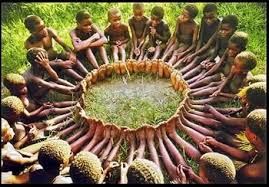
The Osani Circle Game
Josie explained that these children were playing a game called The Osani Circle Game. This prompted a conversation about circles. She stated that circles and cycles are seen everywhere. They are symbols of connection and wholeness. They are considered incredibly strong. Josie asked, “Can we name some circles or cycles?”
She went on to describe that the players of the game harness the strength of the circle by physically creating a circle with their feet and bodies. Each person then takes a turn naming a circular object, concepts or cycles such as apples, belly buttons, pies, time, the water cycle, butterfly cycle, the seasons. The goal being to hold the circle throughout the game while, without hesitation, naming circular objects.
In an effort to anchor the kids in teamwork, set the tone for the game and harness the power of the circle, Josie started by sending a “squeeze around the circle.” She then led them to create a human mandala. Finally, she guided them through a closed-eyed medication that allowed them to picture the circles all around us.
The kids named things like the butterfly cycle, the Sun, the belly of a bear, our noses, etc… More importantly they had fun while learning in a rich and integrated way- from learning about Efé children, to physically and collaboratively recreating the circle, to thinking fast and maintaining concentration throughout the game.
However, it was the unwritten curriculum that spoke volumes- the wisdom of the circle. The circle as a powerful symbol has been referred to since the beginning of time. It is celebrated in many religions and cultures as divine. It holds archetypal influence in story and myth and is represented by so many natural phenomena. Consider the Tibetan mandala, the Native American medicine wheel, the wedding ring, the Hero’s Journey, the Sun or Moon cycle. This centering ended with a closing verse that integrated some important circular objects found in our lives.
Informing your practice
If children are deeply and comprehensively connecting to the Circle, then they are more likely to return to it later in life as a teacher or guide, a tool, a strategy, an anchor or a healing source. I ask you to consider how circles show up in your life, to pay attention to their influence, and to invite them in as teachers.
by West | Oct 30, 2017 | Blogs, Home Page News, Rainbow Institute
The centering rituals, although all rooted in mindfulness and in sacred spirit, vary from Rainbow classroom to Rainbow classroom. For example, the middle school, known as Omega, opens each centering with a reflection on a quote, a lyric, or a blessing. As centering opens, the students turn inward by recording the quote, which is displayed on a whiteboard, in their centering journals and connect with it through silent reflection.
This daily “food for thought,” sets a reverent tone, encourages contemplative thinking, nourishes class coherence while reminding us that learning is scared. A volunteer is asked to recite the quote and then the facilitator fishes for any reflections, questions, insight or comments. Students are encouraged to offer their own wisdom, tweeze out meaning, make connections, share personal stories, and/or give an emotional reaction to the quote.
On one particular morning, Freddie, an eighth grade student lead a centering inspired by the words of spiritual teacher, Eckhardt Tolle,
“Realize deeply that the present moment is all you ever have.”
Freddie paused after the quote and waited for responses. One student offered, “that we are often caught up in our past memories and mistakes or are thinking about what will happen next, that we dont realize the important things that are happening right in front of us.” Another student responded with “the past is full of memories, the future of hopes or dreams and the present- the present is where the two collide. It is important to savor that.”
Interacting with students in this way, keeps me in constant awe of the wisdom that is alive within them. What if every child had the opportunity to be contemplative, like this, each day? How would their inner potential and their inner wisdom reveal itself?
After a round of sharing, Freddie attempted to put the quote’s wisdom into practice. He asked that we each find a comfortable position somewhere in the classroom, close our eyes, and begin to focus on our breath. He began to ring a bell and noted that the bell would serve to anchor the breath. He said that if our thoughts wandered or drifted, each time he rang it, it would remind us to come back to our breath and to the present moment.The students seemed to relax into the meditation with ease and Freddie held space for this practice for about five minutes. Each individual student emerged from the practice relaxed, calm and focused and the group’s energy seemed more bonded or in a higher state of flow.
Overall, I feel that the mediation succeeded in supporting the transition from home to school, supporting class coherence and in opening up additional pathways to learning.
Meditation is one crucial tool that our children access…it allows them to focus on their breath, their bodily sensations, or on a word or phrase. In today’s fast paced society, it has become increasingly challenging to direct attention or efforts to a single point of reference or action. Alarms, meetings, deadlines, chores, commitments and to do lists can make it hard to embrace a mindfulness practice, a mediation or any deep relfection. A mediative practice, like the one described above has the power to turn attention away from distracting thoughts, past memories, mistakes or regrets, or future obligations and into the present moment. It is not only empowering but powerful.
What if alarms were used to remind us to be present, to pause, to notice- instead of to wake us up or get us somewhere on time? What if our to do lists became to be lists? What if every child was equipped with these tools and resources? What if…
by West | Oct 16, 2017 | Blogs, News, Rainbow Institute
The words of American spiritual teacher and author Ram Dass encourage us to live FULLY, in the present moment, without judgement. How do you achieve this? What practices do you embrace?
“Be Here Now” for example, calls on mindfulness practice.
“The quieter you become, the more you can hear” invites stillness.
“The heart surrenders everything to the moment. The mind judges and holds back” summons your love.
As individuals on our own unique spiritual journeys, we are always looking for inspiration that may guide our inner work. Ram Dass’s wisdom offers insight and intention that may aid in cultivating a heightened self-awareness. We know that an elevated self-awareness has the capacity to lead to meaningful and enduring relationships.
RCS is founded on meaningful relationships.
The relationship between the teacher and the learner is the heart of education and a parent is a child’s first teacher. Rainbow honors that and strives to communicate with parents compassionately and empathetically, learn from the parent, see the child from through many lenses, support the child holistically and bridge home life and school life. One of the many ways these relationships are nurtured is through meaningful and intentional conferencing. Rainbow sets aside a conference time in early September called Listening Conference. During this conference the faculty calls upon self awareness by practicing the skills of deep listening.
Deep Listening is a way of hearing in which we are fully present in the moment without judgement or control. Deep listening asks us to let go of our inner dialogue, pre-formed opinions and assumptions, challenges us to abstain from crafting a response and simply listen in a mindful and respectful way to what is be shared. This is a time to be attentive not reactive, to listening actively not passively, to embrace compassion and empathy, AND to bring a great self-awareness to the act of listening.
To do this effectively requires that our mind takes a backseat to our heart.
Each conference embraces these powerful questions: Can we develop a practice of listening that allows another person to find their next step? Can we become the birthplace of understanding for someone else? Can we learn to carry in our hearts the destinies of others?
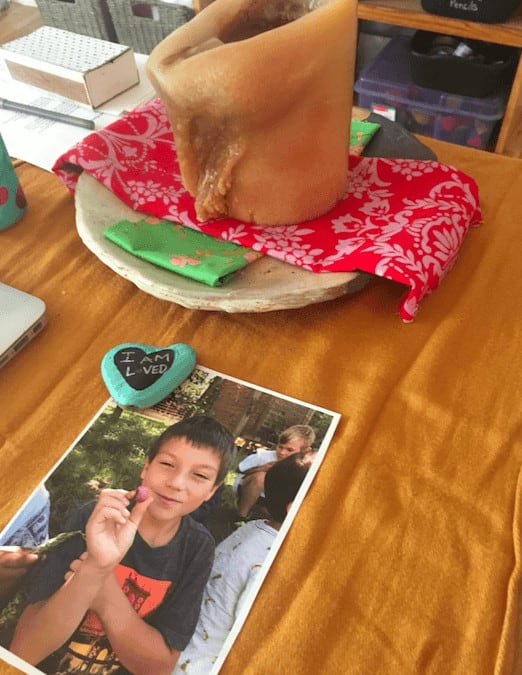
Each conference opens with a sacred ritual. Teachers may light a candle, read a reflective quote, hold space for silence, lead a guided mediation and/or offer a prompt with the purpose of inviting the child’s spirit to the conversation.
How can what we do at RCS inspire your own personal or professional work? What if we practiced deep and mindful listening in our everyday lives, what if we always invited spirit in to the conversation?
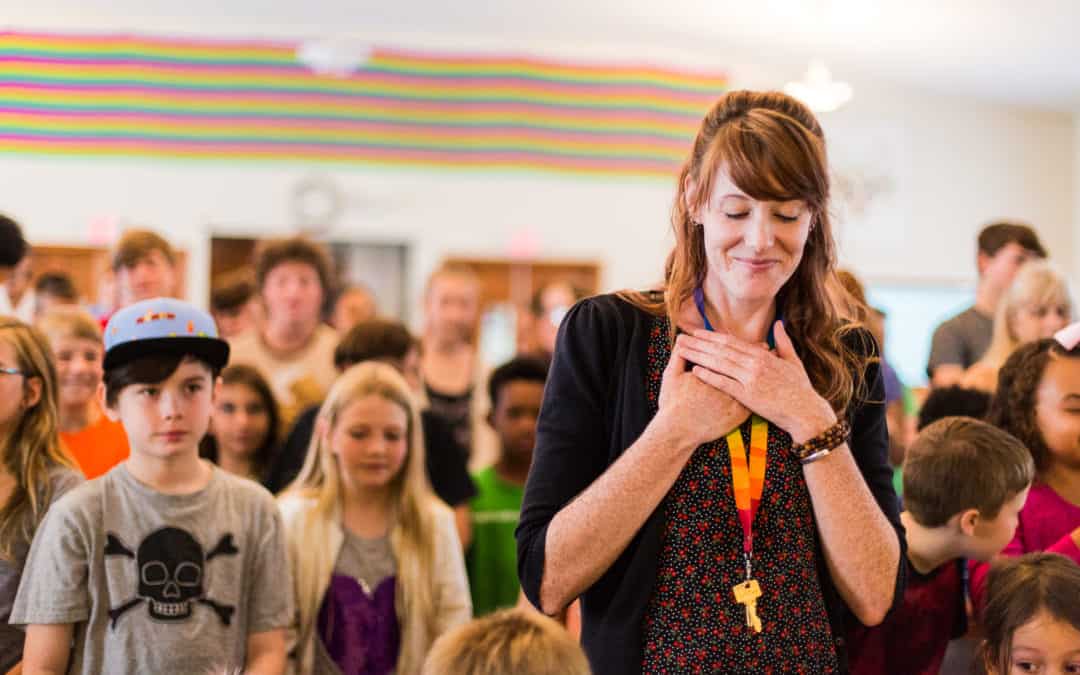
by West | Oct 16, 2017 | Blogs, News, Rainbow Institute
Fall is here and fall break has likely come and gone for many of us. This season often brings a lot of transition for our students. These transitions are embedded in the rhythms of the natural world, the energy around celebrations and holidays, and within the refection and personal goal setting that emerges from the start of each school year.
With this in mind, I invite you to stop for a moment and imagine the experience of a child as he transitions from home to school after just one night, a weekend, or a long holiday.
Maybe you imagined the hustle and bustle as he arrvied- the classroom filled with stories, sharing, reconnection and laughter. Or maybe you imagined the groggy, sleepy child, dragging his feet and resisting the weekday routine. Or even the child emerging from a car ride full of screen time. Maybe you witnessed a child arriving hungry without a proper dinner and/or breakfast. Or a child who is sleep deprived due to long working hours from the previous. Or even a child who is managing some sort of trauma in his life. Regardless, the classroom you imagined was likely flooded with 20+ learners holding varying levels of energy, focus, fuel, and general centeredness. As educators, we recognize the importance of holding space for all those varying energies but for also fostering a culture of centeredness so that all pathways to learning are open.
How do we actively support this transition from home to school each day?
How do we invite a level of awareness or mindfulness for our learners?
How do we foster a sacred intention for learning?
At Rainbow we achieve this through a morning ritual called centering. Ritual is simply defined as a ceremonial act. To that end, our centering practices are ceremonial in nature. During these practices, simple routines are turned into rituals through tone, intention and mindfulness.
First, the hustle and bustle of the morning is calmed and quieted with the ring of a chime or bell. It is amazing how a soft sound can silence a room and even more amazing how silence can invite sacredness into a space. This sound is a reminder to the students that they are about to engage in a sacred ceremony.
Secondly, pausing to take deep breaths together shifts each person’s individual energy into a collective synergy. Then, lighting a candle in silence invites something powerful and even magical into the classroom. This fire also serves as an anchor point for which learners can choose to cast their gaze when reflecting or meditating. Additionally, sending a greeting around the circle or turning to greet a neighbor not only allows each individual to be seen and to be witnessed, but it invites compassion, empathy and mutual respect. Speaking a verse, blessing or word into the circle also supports coherence and connectedness among all class mates. It serves as another reminder that we are on this learning journey together.
These rituals not only help to support the home to school transition, focus each learner, nourish class coherence and synergy, but they remind us that learning is scared.
Rainbow utilizes ritual in other transformative ways; meal blessings, honoring and memorializing people, animals & places, expressions of gratitude and appreciation, blessing ways and other birth and death transitions, rites of passage, communal celebrations all become ceremonial acts.
How can what we do at RCS inspire your own personal or professional work?
Can you replace a daily routine with a ritual by adding a mindful presence to it or by enhancing it with ceremony?
Try creating ritual for your classroom, organization and/or home?
Here is a brief list of simple rituals:
A gratitude exercise, a silent nature walk, quote reflection, a daily song/ verse or blessing, a visualization, read a daily story with a virtue/ moral, draw and/or color a mandala, borrow/adapt a ritual from a particular culture/religion, create nature art, give affirmations to friends and family members, practice mudras, yoga, qigong, or a martial art, and daily journaling.