by Renee Owen | Mar 25, 2019 | Blogs, CEO's Kaleidoscope, Director's Blog, Home Page News
Happy Spring – Kaleidoscope March 2019
Happy Spring, everyone. We made it through winter! I am reminded of the line from the Merle Haggard song, “If we make it through December, everything’s going to be all right.” The thing is, I always wondered why Merle doesn’t mention January and February. With the darkest months now past, our students seemed to have sailed through the winter with great success. Around Rainbow, wintertime is rich with learning.
Flu Season
Flu season was fortunately mild this year. We are also grateful the chicken pox virus (varicella) never spread beyond three students. Some in our community might be under the impression that Rainbow’s immunization rate is low. Incidentally, Rainbow families choose to immunize their children at a rate higher than some of the charter schools and other alternative private schools in Asheville.
It might be helpful to know that some of the families who are exempt from the immunization requirements do get some immunizations. We are relieved that the number of cases of varicella in our community did not reach outbreak status, forcing many children to unnecessarily miss school. We are glad the three children who contracted it recovered well. I am grateful for all you do to be mindful of the health and well-being of our whole community.

New season, new life
As I write this, spring has just begun. New life is emerging everywhere. Our campus is no exception. Have you seen the baby hawks that have taken up residence here? If not, I suggest taking a stroll over to the red oak tree that is near the pavilion and wetlands on the Omega campus. A pair of big red-shouldered hawks are nesting there. It’s been a thrill for the children to watch these hawks fly around campus. It’s a great opportunity to listen to them squeak and squawk. You may know that our campus is a designated wildlife habit, an honor we received because of the many factors that make our campus amenable to wildlife in the city, including over 75 trees on campus of more than 20 varieties. Many of these are old-growth.
Exploration through the Seven Domains
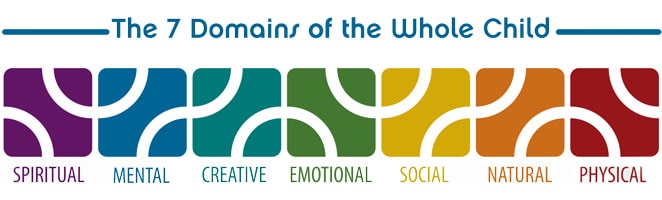
Spring is a great time for outdoor exploration through the lens of the seven domains. The natural domain is often central to our spring activities. Starting in 3^rd grade, all classes go on end-of-year trips, most of which are wilderness experiences. Of course, May Day is our most well-known celebration of the natural domain, in which Rainbow students have a chance to dance around the maypole.
We recently had our annual Domain Day. As an administrator, it’s always a special treat to get to spend an entire school day with students. I helped lead a group in the creative domain and shared my candle-making craft with the children. It was exciting at the end of the day to reveal what the candles looked like as we took them out of their molds and sent them home, a metaphor for discovering the hidden creative potential within all of us.
Creative Opportunities – Imagine!
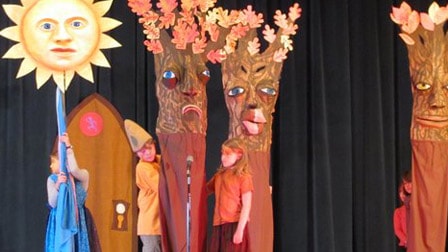
Still, there are other creative opportunities happening around campus. These include preparation for the Imagine performance on May 17. If you are new to Rainbow, you are in for a treat. It’s a little hard to describe Imagine. Kindergarten through sixth grade students, as well as Omega electives students, perform various vignettes of their choosing. These often include original music and dance. The result is a performance in which faculty and students weave together an original play with an important message and nuanced layers. It’s an explosion of creativity. Some have called it “psychedelic.” Others say it is “brilliant” and “well-coordinated.” This begs the question: is Rainbow a school of the arts? The answer is yes…and so much more.

New wheels
We have a new member of the family: a bus! We came across a good deal on a 15-passenger gasoline bus and purchased it from the YWCA who was selling off the fleet from their after school program which just closed. We have found that our existing white gasoline bus is easier to maintain, and that faculty prefer this shorter, easier-to-drive bus to the larger diesel yellow one we also own. With the purchase of this new bus, we now have two matching, short, white buses, which will proudly display our Rainbow logo. To that end, are selling our yellow diesel bus. If you know anyone who would be interested, it is for sale at $15,000, obo. It’s a 2006 with 89,000 miles. You can contact Max at 828-258-9264, ext. 145.

Office Hours
Do you sometimes find that you have general questions about the school? My office hours are Mondays from 2 -3 pm. This is a time that anyone is welcome to visit either the division heads or me to ask a question, express an idea, or just to talk. One question that someone asked recently was What happens on early release Wednesdays and staff training days? Many high quality schools around the country have an early release day once per week so teachers can meet, train, and work on planning.
Professional Development and Teaching
There is a direct correlation between the quality of teaching and the amount of professional development a teacher receives, the amount of time a teacher has to plan fantastic lesson plans, and how much time they have to collaborate with their colleagues and administration. Wednesday meetings as well as staff training days address this need. These meeting/training times help keep the school running smoothly, so that every minute spent with the children is of the highest quality possible.
A closer look at testing and data
An example of one of our recent training days centered around student data. We made a long list of all the types of data that inform our instruction and how we work with children and families. Next, we drilled into some of our CTP test data. Throughout the year teachers create dynamic lessons driven by by data and personal knowledge of each student that every teacher has derived over the school year.
This particular training was more of a bird’s eye view of data. In groups, teachers worked together to understand trends of data to help guide our curriculum goals. We posed questions, hypothesized about the data, and bounced ideas off each other. Every year in June, after graduation, the faculty meet for two or three days. During these meetings we reflect on the school year and analyze and adjust the scope and the sequence of our curriculum. Our data discussions are one important part of that reflection and planning.

Looking to next year
Our administrative team is in the process of vetting new candidates for next year’s faculty. Although we typically have very low teacher turn-over, there is always a little bit of change. This year, our fourth grade teacher, Molly Sawyer, is choosing to take a few years off to start a family. Molly is a vibrant teacher who is very well loved. We hope she returns to us as soon as possible!
In the meantime, Susie, Sandra, and I are enjoying our teacher search. We have narrowed the pool of applicants down to a few finalists. These folks will come in to do demonstrations in the classroom, as well as in-person interviews. We already know it’s going to be difficult to make a final decision, but we also look forward to announcing our new-hire in about a month.
Your authentic self
I’d like to close with an excerpt from a letter that really touched me. It was a cover letter from a teacher applying for the fourth grade position, and I found myself tearing up as it read it. Just as I believe every child should be able to express their authentic self, so should every teacher. Rainbow brings hope and inspiration to teachers. The author of this excerpt illustrates this. This candidate also gave me permission to share it with you.
When I clicked on the job listing for the Rainbow Community School the most amazing thing happened, I felt hope. I felt a spark. As the camera moved through the different rooms of your school during the “Life is Better With You” video I cried because I felt incredibly moved and inspired and happy! I am a public school teacher of 20 years who has been considering leaving teaching because of what I believe standardized testing and forced curriculum and pacing have done to the minds and will of my students. I don’t want to give up teaching – I understand children. But I can’t teach any more in a setting I very much consider to be stifling and limited for children’s emotional and intellectual needs. Your school inspired me to hope that the next 15 years of my teaching career can be different…I’ve never seen anything even close to what your school offers children (and educators.) I’m willing and interested to completely change my life to each in a school that honors the whole child.
Rainbow is a special place
We receive letters from teachers similar to this every year, but this one in particular reminded me of the special school we have. I am grateful every day for how lucky we are to be in a place where we – whether children, staff, or parents – can express our authentic selves.
This letter prompted me to remember how my greatest vision isn’t for Rainbow to be special, but for all schools to honor the whole child, and for children to have access to a meaningful education that celebrates the human soul, and develops their highest potential. When that day comes we will have a world that is well on its way to being socially just, spiritually fulfilling, and environmentally sustainable.

by West | Oct 23, 2018 | Blogs, Home Page News, Rainbow Institute
In 2012 Rainbow Community School (RCS) was selected as an Ashoka Changemaker School, a network of schools that empower students as changemakers by prioritizing empathy, leadership, and collaborative problem-solving as student outcomes. They recognize the capacities of young people to make a BIG difference and highlight empathy as the centerpiece for all changemaking efforts. RCS was nominated as a changemaker School because of its belief that educating for the wholechild directly impacts humanity’s collective awareness and capacity for growth.
The Journey from I to We:
Gandhi’s wise words remind us that it all begins with our inner selves: “Be the change that you wish to see in the world.” At RCS, we believe that real change originates out of an individuals’ commitment to their own evolution. As a result, we strive to support all learners in becoming whole, finding purpose and then making change. Our educational model nurtures the holistic development of the child and by doing so, these whole humans are better equipped and more empowered to serve the needs of humanity and the planet through their positive change making efforts.
It is not uncommon for our learners to acknowledge that before they can show up for others they must show up for themselves and it is the emphasis on self-discovery and personal well-being that opens the doors to connection, collaboration and thus meaningful work. Our students explore, at a very young age, what it means to “know thyself” by recognizing their unique gifts and exploring practices that highlight self-empathy and self-gratitude.
By inviting a child’s inner life into the classroom we are awakening their spirit. A spiritually nourished child is not only ready to learn but it’s the child’s strong spiritual identity that is the catalyst for meaningful work. The catalyst for change!
There are certain stand out elements of the Rainbow Seven Domains Learning Model that help to create favorable conditions for spiritual identity development and the daily centering practice is one of them. This morning ritual serves to awaken the spiritual center of each child, opening pathways to learning. As a centering begins, the classroom is filled with ritual and reverence. These rituals vary from classroom to classroom but the essence of centering is such that the students gather in a circle on a rug, the space is set with intention, the lights are dimmed, a chime or bell invites silence, reverence fills the room, a pause is taken for audible breath work, the invitation of fire through candlelight is summoned- this begins the sacred work of the day. The results are often a harmonious learning environment in which focused thinking come naturally, trust among the group yield effortless work and innovative solutions are manifested.
Recently I joined Lucy and the preschool Dragonflies for centering. The preschool centering ritual leader began by asking his class to put on their mindful bodies and their mindful listening ears. He then told them that he would ring the singing bowl and wanted every person to actively and mindfully listen until they could no longer hear the song of the bell and then to raise their hand when its song was gone. He then used a breathing ball and guided his classmates in three deep inhales and exhales. As the ball expanded he said aloud “inhale” and as it contracted he said “exhale.”
Lucy, then invited the preschoolers to join her in a self-affirming morning verse that was paired with sign language. The kids spoke the words with confidence and enthusiasm… “May I be healthy, may I be strong, may I be happy, may I be peaceful.” I was happy to witness the use of self-affirmations with such young learners. Positive affirmations or positive self-talk are great motivators for self-reflection and self-change. Statements such as these can easily become identity statements. Thus, benefiting not only oneself but those that you interact with.
Lucy deepened the experience by extending the lesson. She went on to explain that each person would have the opportunity to choose a kind wish they have for themselves. She showed and read the kind wish cards aloud and asked to kids to be thinking about which kind wish they wanted for themselves today. When the kids were ready to share, they signaled to Lucy by placing their thumbs on their knees.
She invited each them to approach the altar which was filled with the kind wish cards, candles and the wishing water. The kids were asked to speak their kind wish aloud and in the direction of the wishing water. It was obvious that Lucy had worked hard to create a supportive and safe yet vulnerable space for the Dragonflies as each child spoke, the rest of the group held a quiet space.
Finally, Lucy reminded the children that much like plants need our care to thrive, our intentions and affirmations need that attention too. As the centering practice came to a close, she explained, that she would take the wishing water (filled with their wishes) and send the kind wishes in to the world by watering the plants and that the plant’s health and growth will be a visual reminder of our own personal growth.
If we feed our body, it can grow. If we feed our mind, it can be stimulated. If we nurture our spirit, it can flourish. What daily affirmations will help you flourish?

by West | Jul 16, 2018 | News
Freedom and Creativity
Summer is a time when folks often invite freedom and creativity back into their busy lives. Maybe they pick up a project that has taken a back seat, take a workshop, or reconnect with a lost skill, art or craft. Maybe they learn, read, or try something new. Summer is a great time to nurture the young inventor in each child.
The long days of the season allow more time to drop into open-ended, free and constructivist play. Making time for STEM concepts, for inventing and engineering can tap into imaginations, foster creativity and enhance problem-solving capacities. You can try offering this space to them by spending some time exploring, asking questions, creating and building. Allow for simple invention and engineering projects by providing tools and materials such as items found in a junk drawer, recyclables, or simple office supplies.
Once you have ignited their passion for inventing, try stretching their thinking with various books.
What do you do with an Idea? By Kobi Yamada
This is a great book a child’s brilliant idea to bring it to the world. After reading, you can begin by asking what an animal needs to survive. Then you might ask what more the animals need to grow and thrive. Continue the discussion by likening animal growth to “idea growth.” State that our ideas can grow, thrive, survive, and evolve by nurturing them. Follow up with a discussion about the author’s message: stick with your idea, follow it through, persevere and your idea could change the world.
Not a Box
Next time you read with your child, you can try reading Not a Box by Antoinette Portis. This is a fabulous book about a rabbit with a very BIG imagination. After completing the book, you can discuss with your child how imagination and creativity are magical elements of who they are. Talking about different perspectives allows children to see that showing and sharing are part of what makes them unique and special.
Next, lay out a box of recyclables or knickknacks and let your child choose one or more items to repurpose. Ask your child to reimagine how this ordinary object can become extraordinary. Encourage them to use their artistic skills to reimagine it by creating something new. You may also want to extend their learning by inviting them to use the materials and resources to create a 3-D representation of their new invention. Once they have finished, it’s always quite powerful to spend time reflecting about it together.

Implications of Your Work
Children appreciate “thinking outside of the box.” They thrive off of creation and love to deep dive into their own imaginations. They approach STEM activities, such as this one, in the most authentic way when they know that their learning environment is supportive and safe. Children are most creative when the learning environment highlights many perspectives, emphasizes process over product, and failure as opportunity.

by West | May 19, 2018 | Blogs, Home Page News, Rainbow Institute
The integrated RCS curriculum fosters learning in a holistic way.
This approach is void of the restrictions often imposed by teaching discreet subjects. Purposeful integration acknowledges, builds on and reinforces the existing relationships between subject areas and/or topics. The hope is that learning is then more easily transferred into other settings.
Integration is also a “brain compatible strategy” as described by brain researcher, Eric Jenson. Jenson (1996) suggests that, “The brain learns best in real-life, immersion-style, multi-path learning [and] fragmented, piecemeal presenting can forever kill the joy and love of learning.” This immersion style is considered a best practice and is embraced by our teachers. It is, therefore, not uncommon for the theme, topic or unit of study to be woven into the fabric of an entire school day, week, and/or month. For example, the element of water and its states of matter are introduced in kindergarten. First grade elaborates on the water cycle and studies rivers and oceans. During these units, water often becomes a central theme that invites cross curricular learning.
Centering offers cross curricular learning opportunities.
The intended purpose of centering is to awaken the spiritual center of each child, opening pathways to learning. The centering practice activity includes a contemplative experience, but teachers also strive to extend the learning by integrating with the academic curriculum. The Mind Jar centering serves as an excellent example. The Mind Jar begins with a conversation about the various properties of water. Perhaps prompted by photographs of water in various forms or by a book such as, The Water Dance by Thomas Locker. Discussion yields a shared understanding of the ways in which water moves- Water is always moving, flowing, changing, essential to life, found deep in the ocean, under the ground, high in the sky, freezing, melting, etc. The focus being more heavily on the magical and mysterious qualities of the element rather than the scientific descriptions.
The teacher guides students to make connections between their own thoughts and feelings to the movements of water in the natural world
(i.e. a raging river can represent anger, a waterfall- excitement, snowfall- peace) After giving an example or two, the children are then prompted to suggest additional feelings and water movements connections. The teacher explains that The Mind Jar is simply a jar filled with water and glitter. But it is representative a tiny world where we can watch the movements of water and match those movements to our own feelings. The water represents our mind’s natural state and the glitter represents our thoughts, emotions, fears, concerns, and wonderings. When the jar is shaken, our thoughts will whirl around and our mind becomes cloudy and hard to see through. But, as the glitter begins to settle and still, so do our thoughts and feelings. It is in this stillness and calm state that we are able to make good decisions.
The Mind Jar is a simple mason jar containing water, glitter, glitter glue, and food coloring.
Combine warm water with the glitter glue, glitter, and food coloring. Close the Jar tightly. Depending on the amount of glue you use, the glitter will settle more slowly. This tool can be used when a child is feeling stressed, overwhelmed or upset. It can calm and relax them. It can serve as a meditation tool or a self-regulation tool. You can explore many versions of this on the web. If you have an interest in extending the learning from this centering, you may want to try a follow up centering using the picture book, Moody Cow Meditates. Peter the cow is moody after having a rough day. A series of unfortunate circumstances leads Peter’s grandfather to teach him how to settle his mind and let go of his frustration using some mediation tools.
by West | May 2, 2018 | Home Page News, Rainbow Institute
Rainbow Community School had a special guest this week!
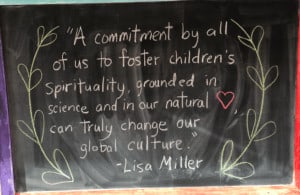
Best-selling author and Ph.D., Lisa Miller, toured our school. Lisa authored The Spiritual Child and is also the head of clinical psychology at Columbia University Teachers College. She has conducted and compiled decades of research on spiritual development in children and teens. Her research specifically quantified the effects of healthy spiritual development on mental health, resilience and thriving and provided empirical evidence that children are naturally spiritual beings. Her book also serves as a resource for parents as they navigate the important work of raising spiritual children.
Lisa is currently heading up a new project called the Collaborative for Spiritual Development. This work is aiming to develop resources for educators who wish to nurture their students’ spiritual capacities. Lisa became aware of Rainbow’s 40-year history of embracing a secular spiritual curriculum and as you learned in our Executive Director’s video, she wanted to find out more about how Rainbow is doing just that! We are hoping that her visit will yield new resources for a wide range of educators working to nurture the spiritual identities of their students.
The commitment to this work is outwardly palpable among Rainbow’s staff and faculty and as a result, the spiritual curriculum is woven into the daily rhythm of each classroom.
The RCS spiritual curriculum has four primary aspects under which all its goals and objectives fall:
- Mystery and Contemplation
- Spiritual Virtues
- Ceremony and Celebration
- World Traditions.
Often, a centering practice is developed with one specific aspect in mind. Many Omega Middle School (OMS) centerings embrace theMystery and Contemplationaspect. These centerings welcome the unknown as a source of inspiration and wonder and are filled with questions, quotes or prompts that invite the students to seek deeper meaning and purpose through reflection. Just this morning, for example, Albert Einstein’s wise words were written on the whiteboard as a welcoming for each OMS student upon arrival.
“The important thing is not to stop questioning. Curiosity has its own reason for existing.”
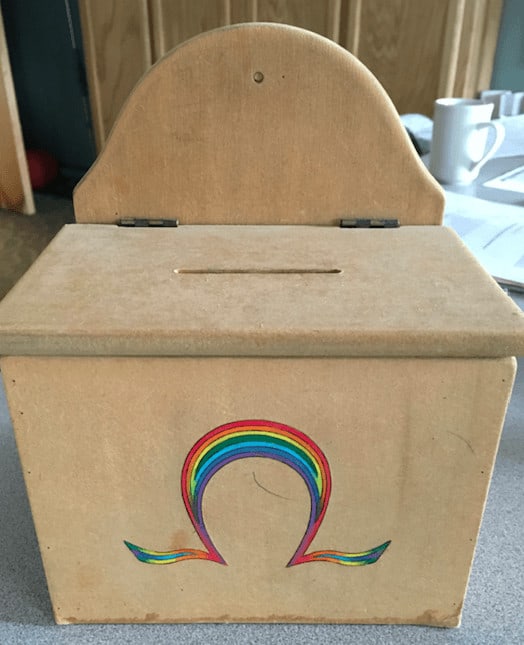
One of the OMS classrooms has a special centering called The Philosopher’s Box. The intended purpose of this centering is to encourage this deep questioning.
To introduce this activity, ask the students what they know about the word “philosophy”, and/or if they know what the role of a philosopher is. Then share the etymology of the word “philosophy.” This word is Latin and Greek in origin and means to love knowledge: Philo=love, Sophia=knowledge. Follow by explaining that philosophy is the study of fundamental questions about the nature of existence, big ideas such as love, truth, beauty, and what it means to lead a fulfilling life.
At this point the teacher introduces the Philosopher’s Box. This is a physical box decorated with a bit of magic and whimsy or as you see fit.
Each student then writes down at least two philosophical “wonderings.” These are questions with no right or wrong answers.
Some examples for students may be:
- “Do you believe life exists on other planets?”
- “Is it important to always be 100% honest and truthful at all times (why or why not?)”
- “Do you believe it’s possible to predict the future?”
- “If you could have the abilities of one animal, which animal would you choose and why (i.e. to fly like a bird or to breath underwater like a fish)?
After giving specific examples, the students are asked to take the next few moments to reflect upon the kinds of open-ended questions they wonder about, and then place their questions in the box. From here there are many options for discussion. The teacher can pick a question at random from the box, and have students take turns answering. Or, students can pair up and discuss their answers with each other. Students and teachers can add to the box throughout the year – for example, when a good “wondering” or “what if?” question comes up during class discussion.
This centering is intended to provide a healthy and intentional space where learners can feel safe and supported as they ponder the “big questions.” Centerings like these help to bring a sense of meaning and purpose into their lives. Research suggests that having a stronger sense of purpose can make a significant difference in our lives. In fact, Lisa Miller’s research, link spiritual purpose to improved health, well-being, and a more meaningful and successful life.
Centerings like these connect our students to something greater than themselves- to something deeply spiritual.