by Webmaster | Feb 21, 2009 | News
As parents we assume – by default – the role of teacher, whether we’re predisposed to it or not.
And most of us might agree that if we were only able to pass on one life-lesson to our children, just one, that it might very well be to teach them to think for themselves.
Daily, in subtle (and not so subtle) ways, we have “for generations“ done our best to reinforce the idea. Don’t worry about what everyone else is doing; if they jumped off a cliff would you?
Or, conversely, maybe we take a more hands-on approach and model the behavior ourselves (doing our own research prior to a doctor’s visit or opting for a short-cut vs. the main-road).
Of course, we’re all familiar with the old adage, “Give a man a fish; feed him for a day. Teach a man to fish; feed him for a lifetime particularly, in the education circles.
However, since it is still as true today as it was in 4-6th century BC when Lao Tzu coined the phrase, no wonder it’s till circulating.
If you teach a man to fish he will (hopefully) learn how to fish. But what if he doesn’t care for fish, or, like most of us, would prefer a more varied diet? What if he longs for rabbit, blackberries or a thick, juicy char-grilled portabella?
In fact, instead of teaching him one specific bit of information (how to fish) wouldn’t it be better to teach him a cognitive process he could apply towards anything? Wouldn’t it be ideal if you weren’t just teaching one man, but several together, who could mutually benefit from their shared experience and dialogue? Who could then take the analytical power you’ve invested in them out into the great big world and thrive?
I don’t know about you, but I am the product of a public education. We moved around a lot when I was growing up and I attended several school districts. Some better, some worse; overall, my education was a mixed bag. I can’t say how it compared to others, but I can say – with absolute conviction – that I did not really learn how to think for myself until I went to university. Not properly. Though I completed my last two years of high school in the same state in which I would later go on to university (California), once I got there, I – and many others I knew – struggled. There seemed to be collective feeling of despair at the educational chasm that faced us. Yes, we’d had some good, perhaps even great, teachers. But we’d still left a system largely fueled by textbook-led lectures, rote memorization and multiple-choice tests. The road was clear and easily navigated: the teacher talked, you followed the page in front of you; you studied. Then you fastened your seat belt, took out your carefully sharpened #2, and (quickly!) maneuvered your way through the bubbles. Suffice to say, I had little to fall back on when I was later faced, as a student at UC Santa Cruz, with the task of writing a 15-20pp paper on a poem from the traditional canon. I remember I choose Donne’s “Valediction Mourning†and that I received the worse marks (well, evaluation; back then UCSC still did evaluations) I’d ever received. I was shocked; I’d always believed I was good at English. Further, I was mortified to discover that in some classes I would be expected to lead lectures. For, up until then, I had managed (rather successfully) to escape getting up in front of the class for any considerable length of time.
If you’re still with me, I apologize for the delay in getting to my point. It’s taken me awhile to set the stage, but the reason I’ve gone into such personal (and hopefully not painful) detail is that I believe that for those of us who’ve gone through the public system, our experiences probably aren’t that different. In fact, it may be one of the primary things that attracted us as parents to RMCS in the first place…
We wanted something different for our children; something better. After all, their world differs vastly from the one we grew up in; for one thing it’s shrunk considerably. Technological advancements and an increasingly global marketplace have made our kids global citizens now. Yet, according to Wallis and Steptoe’s article in Time, How to Bring Our Schools Out of the 20th Century, “fewer than half of our (public) high school students are enrolled in a foreign-language class†and “the social studies curriculum tends to fixate on U.S. History.â€
It doesn’t really sound like – across the board – that much has changed; does it?
Yet, thanks to the Internet and other technological advancements our kids are exposed to far more information now that they ever were; literally bombarded with TMI. According to a recent article published on PhysOrg.com, researchers predict that “the Internet will double in size every 5.32 yearsâ€. Today, our kids are forced in a way we never were to process information more rapidly, and more intelligently. To not only distinguish a good source from a bad one, but to manage it successfully. (All a long departure from our own childhood when you went to the local library to do a report, and often had to wait days for the book you needed to arrive…)
Yet, one of the parents at the Community Circle Meeting, employed by a leading publisher in education, says she’s noticed an alarming shift lately; from the textbook driving the education system to technology becoming the main vehicle. This in a system that has traditionally placed more importance on teaching content than process.
And all in the face of respected research that directly contradicts such methodology. In the 70’s, the Carnegie Foundation conducted a study on learning and retention. They found that as much as 95% of all learning is “primaryâ€: meaning that which occurs spontaneously through encountering, embracing, and playing with our environment. Further, Allan Schore, a leading researcher in the field of neuropsychology, says (to paraphrase) that the brain is “experience dependentâ€; meaning that the actual growth of individual brain cells, and the learning connections they make, depend on their corresponding interactions with – and responses from – the environment.
Which, as a parent, is one of the things I admire most about RMCS’s curriculum; how it encourages and embraces experiential learning. How it recognizes that thematic, project-based and collaborative learning are vital. At the community circle meeting that day, one former alumnus disclosed that her choice for her independent project one year was Anne Frank, while her brother’s was root beer. Despite the dramatically different subject matter, they both learned a similar process; one that could – in the future – be applied towards anything.(Be it hunting, fishing or foraging.)
Obviously today’s kids need more than a public system that was, according to Wallis and Steptoe, “originally designed to educate workers for agrarian life and industrial-age factoriesâ€. Now, in the 21st century, they need to “ 1) Know more about the world. 2) Think outside the box. 3) Become smarter about new sources of information and 4) Develop good people skills.†As a parent, I firmly believe that RMCS is ticking each – and every – one of these boxes. At the Community Circle meeting Renee said, “I can’t believe this school started in 1977, and just how far ahead it was philosophically.â€
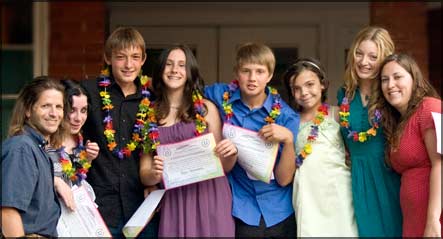
Neither can I. Nor can I believe the panel of former RMCS alumni that were with us that day; all now freshman in the esteemed SILSA program at Asheville High School. I have never seen a group of more mature, more self-aware and more articulate young adults. I kept having to remind myself that they were high school – not university – freshman. Not only were they comfortable speaking to a room full of adults, they were extraordinary. When I compare myself – and my peers at that age – to the young people I saw before me, I feel like another species.  Not only did their testimony about their experiences at RMCS speak volumes, but so did their quiet confidence.  Now well into the first year of high school and all that it notoriously entails, these were not the kind of kids you might worry would lose their way. Instead, what was obvious is that they’re blazing their own, individual paths to the future.
Anyone concerned about the next generation should sit down and have a chat with them.
A special thanks to Sandra McCassim, RMCS’ 1st Grade Teacher, for her enlightening presentation. As well as former alumni: Wyatt Montgomery, Makenzie Peterson, Kaya Greenfield and Shannon Waldman.
Founded in 1977, Rainbow Mountain Children’s School offers a private, independent and alternative educational program for preschool through middle school-aged children that draws from the best in current educational thinking and holistic models of child development. It is recognized nationally as a leader in contemplative education.
Its progressive program supports the development of the whole child in five domains: mental, emotional, moral/social, physical and spiritual.
Marlo Bester-Sproul is a mother of a Rainbow Mountain Preschooler, and a writer and editor. You can reach her at www.writtenbird.com
by Renee Owen | Oct 7, 2010 | News
Wednesday was Rainbow Day. Everyone came in every hue from top to toes. We had a pep rally on the deck where each class shared their chant and we sang a song about opposites in Spanish. It was loud. It was bright. It was Rainbow. What a great group of children!
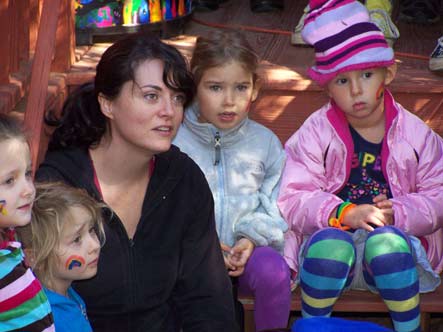
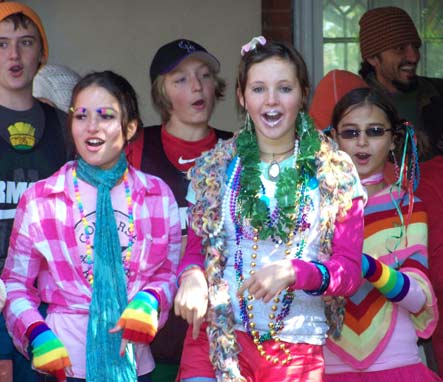
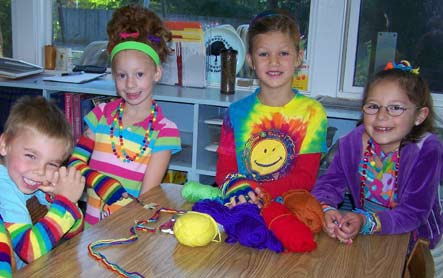
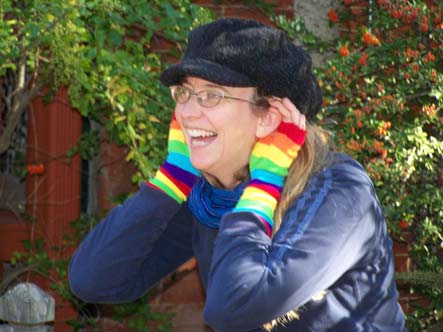
Renee leads the entire school in a pep rally
by Webmaster | May 16, 2007 | News
by Cecil Bothwell in the Mountain Xpress, Vol. 13 / Issue 42 on 05/16/2007
Rainbow Mountain Childrens School in West Asheville has brought in its first outsider to run a school that put experiential, holistic learning on the Western North Carolina map 30 years ago. Renee Owen was hired away from Paradox, Colorado but how she came to be here requires just a bit of storytelling.
Once upon a time, after college, Owen was feral which is to say, she was a wild thing, a gatherer of tropical fruit and dweller in the margins in Hawaii, where the (feral) livin is easy. She was on a spiritual quest and came to see that she was finally finding herself when she let go of pretty much everything and accepted each day as it came. The quest continued for four years.
Then Owen met a wonderful jeweler and decided to marry him and do art. They moved to the high desert in Utah near the intersection known as Four Corners. But livin wasn’t necessarily easy there. They wanted some land, and land wasn’t cheap while renting seemed impossible.
We went to Moab just as a tourism boom hit and when we tried to find a rental we were 47th on the list of would-be renters, she told Xpress, but there were none available.
So they moved from a conundrum to Paradox. There was even less there, and they could consequently afford to buy five acres with a stream running through it. Then they had children, but there wasn’t a school. Students in town who attended classes spent three hours per day on a school bus because the community was regarded as too poor to support a public school. So, being a gatherer and a crafter, Owen gathered some families together and crafted a school based on learning as she had learned through experience.
Looking back at the school she invented in Paradox, Owen tells Xpress, in the first state testing cycle, 70 percent of the students there were below grade level. A lot of the students were two to three grades below level. At the end of the first year, our students matched the state average, and for the last four years we were rated in the top 2 percent of grade schools in the state.
Owen had decided (and convinced an investor) that creative freedom was a cornerstone of learning. The investor provided money for keyboards instead of going for more traditional items like new textbooks or desks. Every student received private piano lessons and classes moved outside.
We started doing place-based learning, very hands-on stuff, Owen says. We went on field trips with a geologist and collected oral histories from older residents. We bought a video camera and the kids made an oral-video history archive for the town. Then they wrote skits about pioneer life based on the histories they’d collected.
Others took notice. Last year the school won a Creative Ticket Award from the Kennedy Center, becoming one of five schools in the country recognized for integration of the arts into academic programs. This spring the students traveled to Washington DC and performed at Kennedy Center.
The Road to Rainbow
Last fall, Rainbow Mountain was looking for a new chief. Director John Shackelton had somewhat reluctantly accepted the post in 2004 after several years as the schools curriculum director, a position he much preferred. Still, as he tells Xpress, he believed in the school and its methods and if taking on the directorship was what the school demanded of him, he was willing. During Shackeltons tenure, the school restructured its program to support almost explosive growth. An institution that had been started by three mothers in 1977 grew to include 70 students by 2002 and doubled that enrollment by 2006. Organizational methods that worked when the school was essentially a family affair needed to be revamped to accommodate the much larger community of students, parents and teachers.
But now, Shackleton tells Xpress, he feels like that work is done and he is ready to hand off the job and get back to his own agenda: teaching English and writing a book about his experience as an educator.
Joe Walsh, a member of the team assigned to search for a new chief, explains, We conducted a nationwide search before we found Renee
As Owen tells it, they almost didn’t find her. Candidates had been narrowed down to four who had already been scheduled for face-to-face interviews before she spotted a notice about the position. She contacted the search committee and was told she was too late but then another candidate dropped out and, based on her experience, she was called East for a chat. The committee evidently liked what they heard.
Owen visited classes, met teachers and parents and generally acquainted herself with the burgeoning Rainbow Mountain Childrens School campus during a visit in April. She’ll start work July 1 and is currently moving her family to Asheville. Two of her children will attend Rainbow while the eldest will enroll in Asheville High.
Growth at the school suggests that many Asheville parents like the idea of holistic education. Days at the school begin with meditation, drift in and out-of-doors, and may as easily include dance and drawing as the three Rs. Nor has Owen been screened from parent criticism, much of which has centered on preparation in the upper grades.
I hear people having nostalgia for the old days when there were only 50 students here, and one of the things I really want to do is to let people have a voice, Owen declares.
My focus next year will be on fourth through eighth grade, which is my area of strength, based on recent years in Paradox,†she says. It’s very challenging for everyone to get everything they want in the upper grade levels. At that age the children begin to have strong preferences, very different ideas about what they want to do, and getting kids ready for high school is a huge task.
In this regard, Shackleton notes that Rainbow students never receive report cards with grades until the last half of their eighth-grade year. At that point, he says it is seen as an introduction to the less holistic world of public high school, because otherwise it will be a real shock.
Watching students in classrooms and on the playground at Rainbow, grades and buzzers and regimentation seem as distant as blue Hawaii or a high desert village known as Paradox.

by Renee Owen | Nov 6, 2018 | Blogs, CEO's Kaleidoscope, Director's Blog, Home Page News
Kaleidoscope, October 2018
I wrote this Kaleidoscope before we had another national tragedy occur: The Tree of Life Synagogue massacre. It is with a broken heart that I add this “introduction” to Kaleidoscope.
Collaborative for Spirituality in Education
As I write, I am nestled safely indoors at the beautiful old Rockefeller home in New York, where 12 heads of schools are meeting to discuss how spiritually supportive schools can help to heal our world. This is the work of the Collaborative for Spirituality in Education (CSE) – an organization started by Dr. Lisa Miller of Columbia University Teachers College (Author of The Spiritual Child).
Through funding from the Rockefeller Brothers Fund and the Fetzer Foundation, the Rainbow Institute and several other schools are being paid generously to share our best practices in spiritual pedagogy. The CSE seeks to influence American education, at large, to honor the whole child and to create a more just and peaceful democracy.

Important Work
It’s an honor to be invited to do this important work, and I am developing relationships with these other heads of schools and faculty who are a part of the CSE. Some of these heads of schools are from Jewish Schools, who were here when the news of the tragedy hit, rather than home with their school community.
Together, we have been helping them bear the pain of this tragedy…and they have been helping us all remember the message of the Jewish people. “We are the people who were commanded by Moses to ‘Choose life’ and ever since, despite the tragedies of our history, past and present, have always striven to choose life and sanctify life.” (Rabbi Lord Jonathan Sacks).
Meeting hate with love
The continual message from these school leaders has been one of meeting hate with love. We chose life. We chose love. Though we are weary, we yet love. In the words of Dr. Martin Luther King:
“Darkness cannot drive out darkness; only light can do that. Hate cannot drive out hate; only love can do that.”
This is the message we will always share at Rainbow Community School with our children and with the world at large.

Harvest Season
It is harvest season, a time when the earth sheds its green and the light begins to shift, but the strength of life is ever apparent in nature’s cycles of renewal. This is the time of year for getting cozy and settling in. The children have become comfortable with the rituals and routines of the classroom. Their relationships with their teachers are becoming well-established.
[bctt tweet=”It is harvest season, a time when the earth sheds its green and the light begins to shift, but the strength of life is ever apparent in nature’s cycles of renewal. This is the time of year for getting cozy and settling in. ” username=”@rainbowcomsch”]
Thanks to the intentional work of all RCS faculty, students should feel comfortable to take risks in all domains, including testing their boundaries. Along with comfort comes developmentally appropriate challenges.

The shadow self
In many traditions, this is the time of year the “shadow” starts to reveal itself; and for Rainbow students, this is no different. The shadow is both a mystical concept and a psychological theory. Simply put, our shadow is the part of our being that we may consider inferior, or our “dark side” that we may repress or deny. However, the shadow need not be negative. Some consider the shadow to be the seat of human creativity.
How is your child exploring their shadow self? Perhaps they are toying with their mischievous side. Maybe they are discovering how they can avoid challenges, such as going to school or completing homework. They might be taking on new social personas, learning how they can “control” other children in positive or negative ways. Some children may be experiencing their first social rejection by a childhood friend.
All of these examples are normal, and even expected. The important thing is that we, as caring adults, provide a loving environment that doesn’t judge or shame them (or each other). We adults try to hold a balance between guiding them, while also allowing them to learn from the natural consequences of their mistakes.
Feel free to reach out to your child’s teacher or the counseling office for a check-in if your child’s behavior is particularly puzzling or if they are starting to have negative experiences at school. Will Ray, Director of Counseling, can be reached at extension 430. As director, Will works part time on campus; but someone in the counseling department is almost always on site. Katie Ford specializes in middle school. Elise Drexler is a play therapist. Kasie Caswell is an intern from Eastern Tennessee State University this year. Together, they make up a holistic team of caring providers.

Día de los muertos
To honor and recognize the changing season–a time of unveiling our inner selves—we will hold a community fire on Friday, November 2 from 9am until the end of the day in the outdoor classroom. Some classes may incorporate the fire with their Día de los Muertos celebration. The space is open to all families, students, and staff. Please come and allow yourself to just be. Click here for the poem teacher Jason Cannoncro attached with the invite to the fire.
Making Learning Visible
You may have noticed a new section in Rainbow Reminders. Each week, at the end of the email, there is a new section called “Making Learning Visible” that describes various aspects of our curriculum and academic program. Making Learning Visible provides a peek into a different classroom each week, with a description of how various classroom activities help students learn and succeed.
Testing 1,2,3
Another marker of fall at Rainbow is standardized testing. We have nearly completed all testing, except for make-up sessions. In case you missed Making Learning Visible in the last Rainbow Reminders, click here to read about why we test and how we use test scores to help inform instruction. Last year’s scores are linked in the article with an easy-to-read graph.
What the heck goes on in Omega?!
Our middle school program is unique, and changes greatly from the elementary program. Middle school children become developmentally ready for demanding cognitive and executive function challenges. Our middle school students are given a lot of responsibility. “Know Thyself” is the theme of the Omega Middle School. Students are on a personal journey to discover their purpose and potential. They learn through community and through communing with nature.
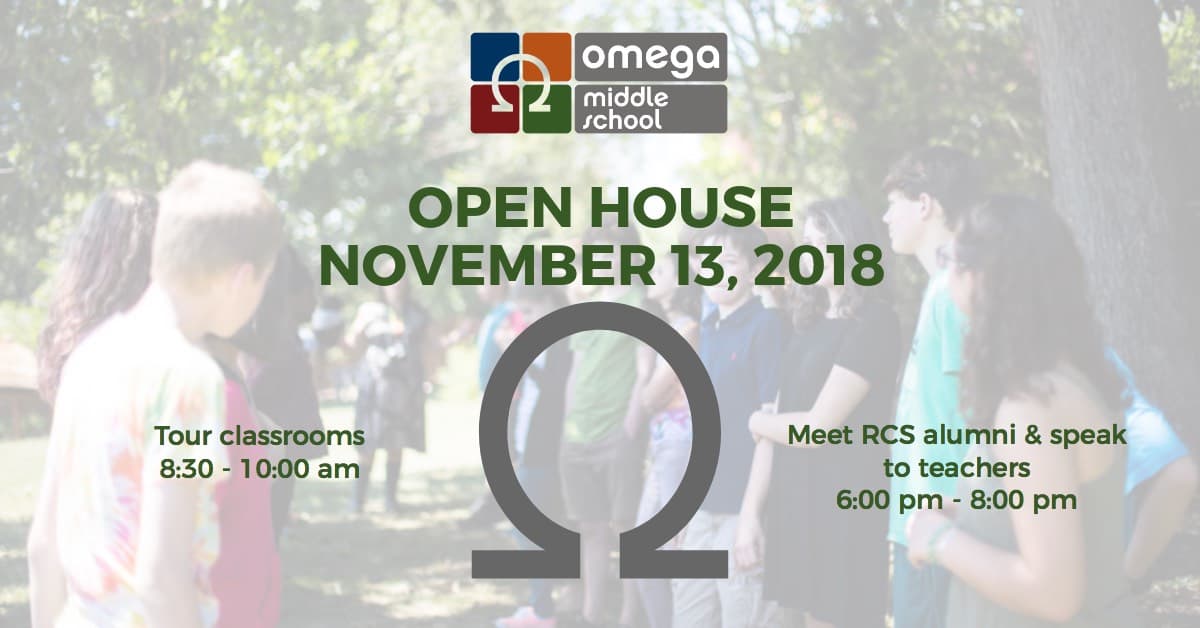
The Omega Open House
The very BEST way to learn about Omega? Attend the Omega Open House and the alumni panel. You can ask alumni any question you want. It’s never too early to start doing your homework. Even if your child is in kindergarten, it will help you understand what is ahead. The panel discussion is November 13, from 7-8pm.
It’s Campaign Time
I felt so good after making my pledge to the annual campaign! I love Rainbow. I love what a Rainbow education did for my kids. They are innovators in a changing world, and thriving. I know my contribution helps our vibrant programs.
I hope you will join me in pledging as soon as possible. The earlier you pledge, the less time we spend fundraising. That gives us more time to focus on what we do best – educating children! Click here to make your pledge. It’s easy to donate now, or you can pledge and RCS can bill you later.
Your financial support also provides moral support! Every time a pledge arrives for the annual campaign, a cheer goes up! Donations are a vote of confidence for our hard-working staff and volunteers.

Voluntary Equitable Tuition
Some people have asked about the difference between the Voluntary Equitable Tuition (VET) program and the Annual Campaign. The V in VET stands for “voluntary” — it is designed for people to voluntarily pay a higher tuition. The E stands for Equitable — parents who feel they can afford to pay a higher tuition do so out of the generosity of their hearts in an effort to make tuition more equitably distributed in our community (meaning those who can pay more do to help those who cannot). The VET specifically provides funding for those who cannot afford tuition, and it helps with teacher salaries.
Donating to the annual campaign
The annual campaign, on the other hand, is much wider. The hope is that everyone will donate to the annual campaign. The funds go broadly into operations. (If you want your annual campaign funds designated to a specific area or program, you can check that on your pledge envelope.)
We hope that people paying into VET truly think of VET as part of their tuition payment (albeit a tax-deductible portion), and still make their regular annual campaign donation.
While we wish fundraising were optional, as a non-profit, it is a necessity. Thanks for making it as fun and easy as possible. In this way, we build a stronger community.
What happened to the Parent Education Program (PEP)?
Last year, we asked parents to come to three required PEP meetings/trainings. The program is now different. This year, instead, we ask that parents attend at least two out of three of their class parent meetings. These meetings are the best way for parents to be engaged, to understand their teacher’s methods, to learn about their child’s developmental stage, and more. An administrator attends these meetings to answer questions and provide information.
Class meetings
By now, every class has had at least one meeting. Thank you for participating in this most important aspect of parenting at Rainbow.
The biggest complaint about Rainbow?
One person just told me their biggest grumble is the amount of email and communication they get. Indeed, it’s A LOT! Like, a crazy-beans amount of communication! In general, as a community school, parents have many things to focus on, give of their time and talent, and participate in many activities.
Some people are fortunate enough to be able keep up with most of it, while others are overworked and overwhelmed. But it’s a community. We just ask that each person does their best to support one another, even though we all have different circumstances.
Sometimes Rainbow can seem magical – and it is! But behind all that magic is a lot of work and cooperation. The real magic is community, support, and collaboration.

Reach out and thank a board member
The new Rainbow Community School Board has been diligently working. Over the summer they attended trainings and began the process of revising a number of board policies.
This is a monumental undertaking that involves carefully analyzing each policy, discussing what it means, its ramifications, and making any needed revisions. These meetings are rich and thought-provoking. The board is truly committed to what is most important: the students! You will be able to identify board members at various campus events. They will have a button that lets you know who they are. If you see them, please thank them for their wisdom and hard work.
As a friendly reminder, don’t forget to VOTE! Early voting goes until November 3.
The world may seem pretty wobbly and often disturbing these days. But when all of us just do the simple things within our control, it makes a difference.
There is so much hope. Everything can change in an instant! I leave you with an excerpt from a poem my husband recently shared with me. (My favorite line is in bold.)

Someone is dreaming of adoring you
Someone is writing a book that you will read in the next two years that will change how you look at life.
Nuns in the Alps are in endless vigil, praying for the Holy Spirit to alight the hearts of all of God’s children.
There are Tibetan Buddhist monks in a temple in the Himalayas endlessly reciting mantras for the cessation of your suffering and for the flourishing of your happiness.
A farmer is looking at his organic crops and whispering, “nourish them.”
Someone wants to kiss you, to hold you, to make tea for you.
Someone in your orbit has something immensely valuable to give you — for free.
Something is being invented this year that will change how your generation lives, communicates, heals and passes on.
The next great song is being rehearsed.
Thousands of people are in yoga classes right now intentionally sending light out from their heart chakras and wrapping it around the earth.
Millions of children are assuming that everything is amazing and will always be that way.
Someone just this second wished for world peace, in earnest.
Someone is fighting the fight so that you don’t have to.
Some civil servant is making sure that you get your mail, and your garbage is picked up, that the trains are running on time, and that you are generally safe.
Someone is dedicating their days to protecting your civil liberties and clean drinking water.
Someone is regaining their sanity.
Someone is coming back from the dead.
Someone is genuinely forgiving the seemingly unforgivable.
Someone is curing the incurable.
Someone loves you more than you can ever know.
Me. You. Some. One. Now.
~author unknown

by Cynthia Calhoun | Dec 27, 2017 | Blogs
We have some pretty amazing staff here at Rainbow Community School.
We have so many folks with myriad talents.
This month’s team highlight is Katie Wilson, our 5th grade teaching assistant. You’ll never guess what Katie was able to do last summer.
It all starts with a story about how she found Rainbow in the first place.

How did Katie become a part of the staff at Rainbow?
Katie’s life has been serendipitous! She temporarily relocated to Boone, NC after living abroad. She’d been teaching English in Mexico and returned to the US to continue her teaching career here.
While up in Boone, she found out about an opening in the after school program at Rainbow and decided to take it. Right then, she was working as a nanny part-time.
She loved Rainbow so much, that when the opportunity came to be able to work with Susie in fourth grade as a full-time employee, she jumped at the chance.
Later, she was able to move up with the same students to fifth grade this year.
Earlier in the year, the director from a summer camp where Katie used to work contacted her.
He was leaving his company to focus on retirement and asked if she would be willing to take on directing the summer camp for international students who wanted to learn English.
Katie’s former director worked the business side of the camp while she worked the educational and development side, including overseeing staff.
Knowing that she always wanted to develop her own educational programs, it was a great opportunity.
This past summer, she developed the entire ESL curriculum for the summer camp, as well as all the programming. She also had the pleasure of locating it at Rainbow!
The Summer Camp: Visions USA
The camp operated by recruiting students from Germany, Spain, and Italy who were interested in learning English. It provided an authentic setting in which to learn English as a Second or Other Language, as well as give students an incredible international cultural experience.
Students stayed with local host families and attended English classes in the morning at Rainbow for four days per week, and then engaged in more fun activities in the afternoons.
They spent time volunteering one day per week as part of the program. Volunteer work is an important component of camp programming.
This gave international students a chance to see what the Asheville community was all about, the struggles people faced and provided visiting students with opportunities to give back to the community in which they were living and learning.
Similar to what Rainbow students do during the school year, campers went to Manna, Black Mountain Home for Kids to help with events, volunteered at local high schools, helped to paint a mural, and more.
Fridays were reserved as field days where they would go rafting, to Carrowinds, go on an overnight to see the Atlanta Braves, or other similar activities.
The camp also offered language courses for the host families’ siblings, as well.
What were some things Katie learned about running a summer camp?
The summer camp session of 2017 was incredibly successful.
Students from different countries experienced US culture, and experienced each others’ culture in a supportive environment.
In only three weeks, they became best friends and formed deep friendships that will last well beyond their time at camp.
Katie loved the fact that she was affiliated with Rainbow and how she was able to share the attitudes that Rainbow cultivates, including its teaching styles, with all the international students.
Activities included centering, teaching to the domains, and incorporating positive discipline techniques to students who hadn’t experienced that before.
[bctt tweet=”Students can tell that Rainbow Community School is different: they value the whole child.” username=”@rainbowcomsch”]
The international students could really tell that life at Rainbow was different.
They were accustomed to a more regimented school setting and often remarked about the freedom and support they had.
Were there any challenges you faced as you ran the camp?
Katie reported how it’s interesting that every country and municipality has stereotypes and attitudes that they form about other cultures and people.
She found it necessary to look for ways to get past those preconceived ideas and really reach students to show them that we humans are more alike than we are different.
Overall, however, she had a successful first year as the director of a summer camp right here at Rainbow! She’s already gearing up for the 2018 session.
If you’d like more information about summer camp and even possibly hosting students, check out Visions USA.