Kaleidoscope – July 2020

Kaleidoscope – July 2020
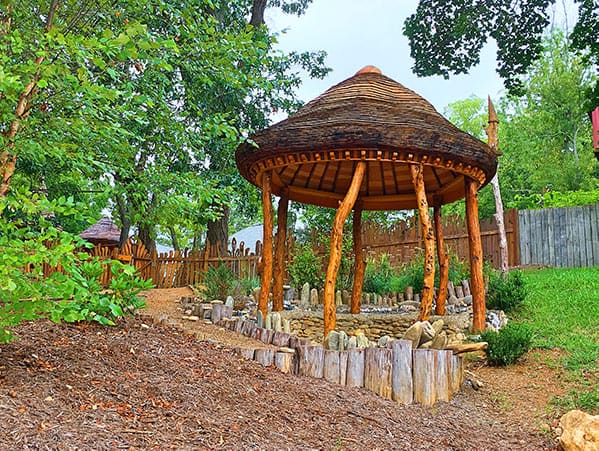
campus sophias garden

The Many Wonderful Things Happening at Rainbow

The Kaleidoscope Communication

As I sit to write my very first Kaleidoscope to you all, I can’t help but pause to reflect on the very nature and context evoked by the name of this publication. The etymology of the word Kaleidoscope comes from the Greek kalos, meaning beauty; eidos, meaning that which is seen in form or shape; and skepeo meaning to examine. So through my words today and into the future, I hope this communication will serve to explore the evolutionary shape of Rainbow. May it surface the potential and realized beauty that exists within, between, and beyond us all.

Our Reopening Plan

Our Reopening Plan has been shared widely and your feedback has been greatly appreciated. We intend to revise the hybrid model proposed for remote learning. Several families shared that this model would create a burden on transportation, and thus become significantly less viable for them. We are working on a revision and will share this with families soon, along with any additional details to the plan. Of course, it was disappointing that the Governor was not yet able to share more specific direction for schools; however, we are feeling confident that we will respond accordingly when guidance is released.

What will school and campus look like?

In the observance of transparency, many families have been wondering about Rainbow’s decision making process as we define what school and campus will look like in 20-21. Specifically, there is curiosity regarding our obligation to follow governmental guidance. While we do have some liberties as a private institution, all of our decisions are being weighed against best practices, health and safety (both physical and emotional), and the ability to achieve our mission. For example, we contextualize how these recommendations will be experienced by Rainbow’s students, families, and staff.  Furthermore, we are a small institution with over 5 acres on our campus. This affords us opportunities to realize physical distancing protocols that can be implemented with developmentally appropriate expectations still intact. In fact, we are building covered outdoor classrooms and by creating these spaces we are advancing the health benefits of being outdoors. In addition, we are supporting our teacher’s capacity to engage inquiry-based discovery and experiential learning.  This is a point of grace that we are grateful for as we continue to develop creative and student-centered approaches to our return.

Spiritual Grounding

Calling in our spiritual grounding and resilience, is possibly our most important work right now. We are being required to process radical shifts in societal “norms” as conversations are centered around public health and racial trauma, and in response to both, the transformation of community systems and agencies. At the root of it all is the question: What does it mean to be in community?  The depth and breadth of processing necessary to reimagine our world is visceral, powerful, and personal. Rainbow has been criticized in the past for being political in the ways we interpret our mission, and yet as a school we are a central element in offering expertise, safety, and leadership to our children and families who deserve support in unpacking these complexities. Our world continues to offer polarizing narratives that our children need to be able to analyze and think critically about. Rainbow seeks to offer this guidance to our students so that they can engage in healthy identity development and citizenship that embraces their family values, personal perspectives, and empathy for others. As a school, we cannot ignore these realities, but rather we must teach them through developmentally appropriate means.

In Partnership

In order for this type of education to thrive, we must be in partnership with you, and each other, to ensure that every family system is honored and valued. A community education takes into account the fact that we will not all agree, but that we will be able to communicate with compassion, listen with intent to understand, and work together in harmony.  I can not overstate the value of being in authentic relationships with one another, that allow us to be vulnerable without fear, so that we may truly realize the power of a united community. Please let this stand as an open invitation to speak with me at any time should you feel tension about Rainbow’s plans moving forward.

May we begin this year, with building connections among us that will realize the beauty that comes from each turn of the Kaleidoscope, adapting and reshaping to find the magic in every moment. 

In Love,
Susie Fahrer

The Co-Creation of Centering Altars

The Co-Creation of Centering Altars

An altar is commonly associated with a religious purpose. It is often a structure or space, considered sacred, on which offerings are placed and used in a rite or ritual. However, we often create altars to honor various things that aren’t necessarily associated with a religious purpose.

We make altars all the time, some intentionally, some unintentionally and others out of habit. Consider how you may arrange your collectibles, how you may display your family photos or art, or how you may plan your garden. Think about the forts or fairy homes that your kids make in the backyard or how they arrange their special artifacts or favorite toys. With these “altars” we aim to elevate, focus energy and/or bring special attention to something.

Altar creation can be a very powerful process. It provides a space to slow down and reconnect to something very personal or meaningful to you. Creating a spiritual altar can also be a physical and visible representation of an intention you may have. It may also serve as a sacred way to invite spiritual energies and questions into your life . Ultimately, altars become focal points or reminders of our inner spirit and our connection to the divine.

Altars are very much a part of the culture of Rainbow

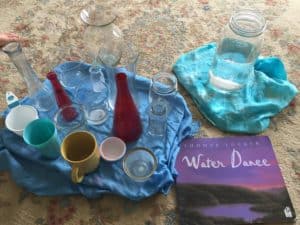
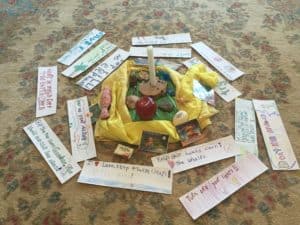
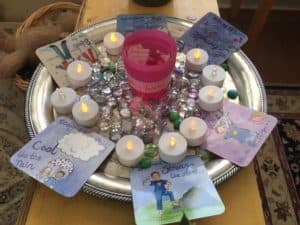
They are found in every classroom, used each day in centering practices and are often created by the students. The elements used in each altar vary but are often reflective of the season, the theme that the class may be studying, or the message the centering practice intends to convey. Below are some classroom altars.


Co-creating altars

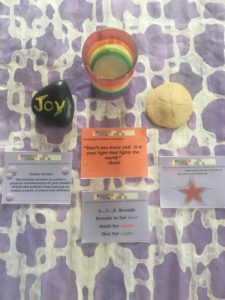
In an effort to raise money for their end of year trip, some of our students recently designed, created and sold traveling altars. Each altar provides various resources and tools that may help others to bring a centering practice into the home.

  • The tablecloth serves a way to transport the altar as well as an aesthetically pleasing foundation to set up the altar.
  • The candle, when lit, sets the tone for the practice and invites spirit into the room. It is also a visible reminder to celebrate the light in ourselves, others and the world around us.
  • The shell demonstrates our connection to the natural world. Displaying nature artifacts bring forth the wonder and magic of the natural world and reminds us that time in nature can yield deep connection and contemplation.
  • The painted rock displays a word of intention and reminds us to aim to bring positive emotions into our lives.

The blue cards share three different breathing techniques that help the mind and body achieve awareness, presence and peace. The orange quote card is intended to engage the reader’s mental domain by encouraging them to reflect on words of wisdom. The yellow cards highlight social conversation questions posed by the students. These cards encourage the readers to ponder big questions such as, “When and how was the universe born?” and “What happens after death?” or ask the reader to personally reflect on things like, “What type of personal do you hope/aim to be?” or What helps you to feel calm and grounded?”

How might these inform your practice?

The creators of these traveling altars were hoping that the altars would prompt centering practices within the home. The elements of each altar are simply starting points out of which family ritual, contemplative practice and spiritual development can grow.

Consider what your family or classroom altar could look like. Where might it live? What elements would you include? What question cards or breathing techniques could be added to this package? What inspirational quotes might serve your family or classroom?


The Three Questions

The Three Questions

Daily centering practice is a part of every Rainbow classroom. These practices, although all anchored in the Rainbow Spiritual Domain Learning Outcomes, take on many shapes and forms and evolve based on the learning needs of the children and the passions of the teacher. From journaling, meditation, dance, yoga, creating art, team building, time in nature to mindfulness practices… regardless of their format, this is a special time where children are encouraged to find their center and their source of personal power and wisdom before undertaking the lessons and explorations of the day.

Oral myth or story often set the stage for a centering or in many cases a children’s book can serve as inspiration for a particular theme. In each RCS classroom you will certainly find a bookshelf designated for those special “centering books.” One that touches the heart of many is Jon. J. Muth’s The Three Questions. This book is an illustrated adaptation of a story by Leo Tolstoy in which a young boy Nikolai, goes on a quest to find the answers to these three questions.

What is the best time to do things?
Who is the most important?
What is the right thing to do?

Nikolai’s interaction with various characters inadvertently lead him into the answers to those three questions.

If the purpose of a holistic education is to nurture the whole child, we do this by aiding them in uncovering their inner wisdom and truest, most authentic self…

As holistic and spiritual educators we explore existential questioning, meaning making, developing connection, leaning into discomfort, encouraging a questing for purpose and embracing awe and wonder.This special book is a gift that has the capacity to do all that for its reader. Happy reading and happy sharing.

Finally, as you gear up for a new school year, new chapter, new job, or just simply a new day. Consider your own three questions. What questions can guide you as you strive to be your best, most authentic self, most divine self?

Maybe these:
What is the best time to do things?
Who is the most important one?
What is the right thing to do?

Or:
What am I doing? Why am I doing it?
Does it bring me joy or purpose?
Is it allowing me to be the best me I can be?