by Renee Owen | May 7, 2019 | Blogs, CEO's Kaleidoscope, Home Page News, Publications
Kaleidoscope – May 2019
I am the earth and the earth is me. Each blade of grass, each honey bee / each bit of mud, and stick and stone / is blood and muscle, skin and bone. I am the earth and the earth is me!
~One of Rainbow’s May Day songs
The song “I Am the Earth and the Earth is Me” captures the heart of Rainbow’s underlying philosophy: We are all interconnected. I recently heard about a satellite video where one can “see” the earth breathing. We are all a part of one giant organism, and that is the underlying message we hope to convey to every child. It’s a very different message from an educational paradigm that assumes that we are all competing with each other.

The hidden curriculum
The term “hidden” curriculum refers to everything children are learning outside of the stated curriculum. The hidden curriculum includes how the classroom and campus look and feel, how people treat one another, how the teachers speak to the children and so on. Some experts believe that children learn far more from the hidden curriculum than anything else. Our beliefs and values are shaped by the hidden curriculum. In short, we become our environment.
Traditional education
Personally, I grew up in a traditional educational space where we were told to “treat one another as you would want to be treated,” but the hidden curriculum had a different message. The hidden curriculum taught us to primarily “watch out for number one,” which may seem like a simple self-preservation technique; but ironically, when humans try to out-compete one another we end up putting the whole world, including ourselves, in jeopardy. Thus we have racism, global warming, extreme economic injustice, and a host of other human-caused maladies.
Interconnectedness
How does this understanding of interconnection affect our educational model on a day-to-day basis? One simple example is the three breaths every class takes together at the beginning of morning centering. Many schools that are still operating in the “competition paradigm” are adopting mindfulness practices, which is great. However, often these practices are intended to make kids behave better, or perform better, which is fine, but so much more is possible. Instead of having a group of 20 children individually close their eyes and meditate, we begin the day with students taking three breaths together, at the same time. In the simple act they become as one organism – like one giant set of lungs. This helps set the tone for the whole day. The hidden curriculum is one of being connected.
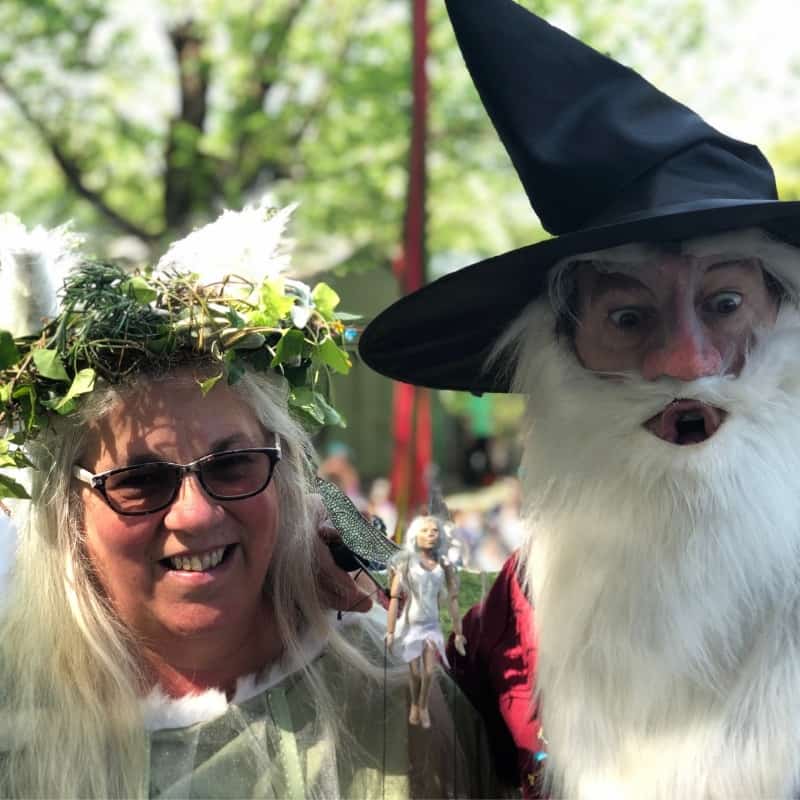
Sue and Hobey Ford on May Day
May Day
Another aspect of the hidden curriculum is the underlying meaning and message in things as simple as the games we play, the songs we sing, and the things we celebrate. May Day is a celebration of Life and all its glory, which includes celebrating glorious you, glorious me, and all of the glorious children. Were you able to attend the May Day celebration? Did you wear wings or a crown of leaves? Sit on the grass? Did you dance to Jai Ma? Eat strawberries and cream? Hug a friend as tightly as possible? I hope you made the most of every minute. May Day also marks the school year coming to an end. We are so grateful for this wonderful year and are looking forward to some new additions for next year.
Staffing Transitions
It’s that time of year when we get ready to say goodbye to friends who are moving on to new adventures and welcome new staff. Over all, we again have very little turn-over, but here are a few of the changes for the 2019-20 school year:
Kurt Campbell
Kurt Campbell is hired to teach fourth grade next year, as Molly Sawyer is leaving that position. Kurt is pretty well known around town as a popular elementary teacher for Asheville City Schools, as well as for the local volunteer work he does. One parent who found out about him coming to Rainbow sent me an email:
“I am so happy for him and for Rainbow, he is such a multi-talented person with so much heart, I’m excited for his future students!…Just wanted to say, great choice. 😀 I know Kurt primarily through Asheville Performing Arts Academy where he does *amazing* work with musical direction and encouragement for the kids, but I’ve also witnessed him as a soccer coach when [my son] played a couple years ago…Whenever we were on the same field, I was so impressed with his ability to really connect with each kid and find both goals and encouragement for them all. So happy to hear this has worked out!”
We look forward to having him on staff next year. He is already busy with our “onboarding” process, which includes trainings, mentoring, meetings, classes to take, and observations. His two boys will also be joining Rainbow.
Justin Pilla
In Omega, we have some shifting around. Omega’s structure is changing slightly, and 6th grade will be more deeply incorporated with 7th and 8th grade, particularly for elective classes in the afternoon. Therefore, Omega will have two assistant teachers who will also lead elective classes. Justin Pilla will still spend some time in 6th grade, where he is currently Assistant Teacher, but he will more often be in 7/8, and he will teach humanities and art electives.
Christa Flores
On a lucky lark we had the opportunity to hire Christa Flores as the other assistant teacher (primarily in 6th grade) and as a STEM educator. Christa has a degree in science education from Columbia University. She is an author and educator who specializes in the “maker movement,” teaching kids how to invent and engineer. Some of you may know her from the “How to Invent Anything” after school club, which she taught here through the Asheville Museum of Science.
Mark Hanf & Kate Folkman
We wish Mark Hanf and Kate Folkman well. Both have held part-time positions in Omega, and both have decided that their position and/or part-time work was no longer a fit for their next phases in life. Mark has been at Rainbow in several different capacities for 11 years. Kate was new to the staff this year, and we hope she will continue here as a parent or in another capacity.
Paris Sigler & Marisa Capablo
Another change is in the preschool after school program. We wish Marisa Capalbo, After School Lead Teacher, many blessings as she moves to Hawaii this summer! Taking her place will be Paris Sigler. Paris is a Rainbow alumnus who first discovered she loved working with preschool children when she was a counselor in training – an Omega Middle School program where students work in the preschool during the summer. Paris is graduating with her early childhood degree this spring, so we finally get to have Paris, the “child whisperer,” full time at Rainbow!
Shawna Grasty
Finally, Shawna Grasty is going to graduate school, and she will not work in after school next year. In addition to being a caring and grounded after school teacher, Shawna has done an incredible job working with Love in Action, particularly with our food bank, which distributes healthy food to over 30 Rainbow families, serving about 100 people weekly. Shawna has a huge heart. I hope you have a chance to wish her well before the end of the school year.
A New Formula for Math
For over a decade Rainbow has instituted “school-wide math,” where all students, 2nd – 8th grade have math at the same time, which allows students who are extremely gifted the opportunity to go to a math class at a higher level. Our “normal” math track has our 8th grade students completing their first year of high school math and receiving high school credit before they leave Rainbow. Advanced students will have already completed two years of high school math by the time they leave Rainbow!
After many months of analysis the faculty and administration have decided to curtail the program back, so that students in 2nd – 5th grade who are advanced in math can stay in their classroom with their peers. (No more missing part of centering while transitioning between classes!) Once students start in Omega (6th grade), they will have many levels of math, including the more advanced classes they can travel to. We decided this adjustment was in the best interest of all students, and the healthiest for the culture of each class.
Got Anxiety?
Our world has become such an anxiety-producing society that almost all of us have more anxiety than we are even aware of. Stress is normal, and according to psychologists, even necessary, but anxiety can be debilitating. If you listen to the news you are probably aware that anxiety in children and young adults has become a national epidemic, a mental health crisis. But there is hope. My recent blog post talks about this and a solution being researched at the Yale Child Study Center.
Screen Free Week
Screen Free week has ended, but feel free to be free! I LOVE this piece of art Mark Hanf did for Screen Free week. The message is clear. There’s a whole world out there.

Dissertation
On a personal note, it feels like I am starting a “new life!” I will still be executive director at Rainbow next year, but I am so excited to have more time. You may know that I have been working on a doctorate degree from Teachers College at Columbia University. Last month I finished my dissertation. The title is, “Learning That Meets Life: The Lived Experience of Teaching with Secular Spiritual Pedagogy.” The dissertation journey was incredibly rewarding, and I learned a lot from the research, which I will be sharing with the faculty. But, as you can imagine, it feels great to be done. However, I will be missing almost a full week of school from May 21-24, to travel to New York with my family and participate in graduation and the 250 year old “hooding ceremony” at St. John’s Cathedral. I promise to share pictures.
Stand Against Racism
For Stand Against Racism Month, Rainbow participated in two events. We hosted the “How to Talk to Children about Race” workshop for parents and educators. The event was so well-attended; we had to slightly adjust our plans for the evening. Participants were divided into the age group they were interested in, age 2 to 13. Each circle learned about stages in children’s development and racial identity, and we discussed how they play out on a day-to-day basis. Rainbow faculty has been using these stages to do a racial equity curriculum audit all year, and it was rewarding to expand the discussion to parents and other educators.
The other event was the Westside Walk for Peace with Hall Fletcher, Asheville Primary, Vance Elementary, and Francine Delaney. Children made signs, marched along Haywood Road; and they gave speeches on the lawn of Trinity Methodist. Several Rainbow students, including children as young as first grade, spoke to the crowd. My husband attended (as a reporter for Asheville FM) and he said, with tears in his eyes, it was “The best thing I’d ever seen!” I was so proud of all the kids who spoke. As always, children are so heartfelt. Their simple wisdom and truthful words cut through any confusion, declaring things like, “Sometimes people are treated different because of the color of their skin. And that’s just not fair!”
The Green New Deal
Also inspired by young people, I attended the Sunrise Movement’s event about the Green New Deal, which was hosted at Rainbow last weekend. The young people and adults at this event helped me understand what the Green New Deal is, and I felt so much hope. I highly recommend you watch this very short animated video to really understand the vision. It’s brilliant.
“A miracle worker is not geared toward fighting the world that is, but creating the world that could be.”
~Marianne Williamson (A Return to Love.)
I chose to be an educator so I could help create “the world that could be.” Just as every child is a miracle – the potential for the world that could be, so is every teacher a miracle worker. We only have a few precious weeks left in the 2018-2019 school year. I hope your family makes the most of it; and I hope you have the opportunity to share you appreciation for all the miracle workers in your life.
by Renee Owen | Feb 26, 2019 | Blogs, Director's Blog, Heart of the Matter, Home Page News
Rainbow Community School is a resource for students, families, and Asheville community members that provides a safe, educational, and social environment. RCS stimulates compassion and empathy between and among these stakeholders.
Ends Policy #3: Community Resource
This the third in a series for Heart of the Matter based on our board Ends Policies. Ends Policies are written by the Board as the guiding light for our school. They point the way toward who we want to be and where we want to go. Ends Policies may seem lofty because they are meant to be grand goals that we may never fully reach but we are always working toward.
As Executive Director, I am responsible for implementing systems and programming at Rainbow Community School that work toward our Ends. For this series of Heart of the Matter, I am sharing my interpretation of each Board Ends Policy so we all know what our intentions are as a community.
This issue focuses on Ends Policy 3, which addresses the Board’s intention that Rainbow Community School serves as a community resource.
Education is for improving the lives of others and for leaving your community and world better than you found it. –Marian Wright Edelman
What is community and what does it mean to be a community resource for our school?
“Community” is the middle name of our school. Why did we choose this as part of our name?
An individual or a community can each exist as a discrete entity. They can also exist along a continuum, with individualism and communalism at opposite ends, and with a range of merged characteristics along that line.
At Rainbow Community School we seek a balance between the two. We live in a Western nation founded on individualism, which our culture promotes over communal values. Embracing both of these elements is quite unconventional. What’s more, RCS doesn’t seek a balance between individualism and communalism through compromise, but with a both/and approach. The result is a school that lovingly embraces and nurtures a strong communal culture, while also courageously promoting the identity development of each individual. Each student receives individualized attention that, in turn, strengthens the community as a whole.
Empathy is the starting point for creating a community and taking action. It is the impetus for creating change. –Max Carver
How is a community strengthened by individuals?
At RCS, when a student takes a stand on an issue, or achieves a goal, these actions do not take away from the community. Rather, they enrich it. In addition, by bringing in different lived experiences and perspectives, we also know that diverse individuals make us stronger. This is in contrast to traditional communalism where homogeneity is the norm. Still, the community is strengthened when an individual may have exceptional needs or accommodations, and the community rallies to support that need.
How are individuals strengthened by our communal values and by our culture of community support?
First, students know they have the backing of their peers. Because of the emotional safety at Rainbow, students can use their failures to learn, and ultimately triumph. Students can take risks and perhaps not succeed the first time because they know they have the support of teachers, as well. In addition, when bad luck befalls an individual, our loving community can act supportively to help that person. Our students can dare to be unique, because they will be recognized and appreciated for their distinctive efforts and contributions.
Students who have grown up in the RCS model become accustomed to taking risks and can accomplish many things. They do this within the positive framework of our holistic system, and support of our community. Therefore, they develop strong personal identities, while also having a communal consciousness. This awareness extends beyond their immediate community to concern for the city in which they live, as well as the state, nation, and world. The outcome is that Rainbow sends out students who apply their individual strengths and talents toward the greater good.
Curriculum
Our students participate in a curriculum that integrates learning about communal cultures and values. Students create and agree to adhere to classroom rules, work on group projects, and engage in group play and planning time. They develop a sound understanding of what it means to collaborate with each other, care about one another, as well as develop their sense of morals and ethics. This occurs all within our holistic curriculum. In addition, students learn effective communication skills, including “compassionate communication.” Rainbow teachers instruct students on using practical common skills as well as help them develop empathetic ways to communicate and to contribute to the community.
A true community is not just about being geographically close to someone or part of the same social web network. It’s about feeling conncted and responsible for what happens. Humanity is our ultimate community, and everyone plays a crucial role. –Yehuda Berg
Culture
With the above-named beliefs, social norms, and the method of education, the culture at Rainbow Community School is one where students feel loved and supported by their peers and the larger school community.
It’s not just students who benefit from this culture, however. Faculty, parents, and other adult members of our community also value their membership. They experience enjoyable community interaction, they learn about the world and themselves through participation in the community. Because of support and encouragement they feel, adult community members feel comfortable to seek advice or assistance when they are enduring tragedy or hard times. This sense of community means that families don’t feel they need to compete with one another, or that they must “keep up with the Joneses.” Instead, they can be vulnerable with one another in a community of mutual support, with acceptance for their weaknesses and flaws, as well as their strengths.
The goal is for all community members feel a sense of inclusion, belonging, and purpose. In other words, every community member feels recognized and also recognizes their role in the community. Everyone feels like they have something to contribute. When community members feel a sense of commitment to their community, they naturally give of themselves through doing their best work, providing a service, or contributing through donations.
A strong culture has symbols, rituals, and routines that create an identifying culture. Informal and formal interactions (such as celebrations) help make up the fiber of community. These occasions allow our community to celebrate together, as well as grow closer through shared experiences.
Systems and policy
At the classroom level, behavior policies reflect community values in several ways:
- By creating class rules and decisions collectively as a group.
- By encouraging students to consider their impact on their classroom community when they are not abiding by the agreed-upon behaviors, rather than simply being rule-oriented.
- Using restorative practices for students who may need redirection.
At the larger level, policies and decisions are made with community values in mind. (Some of this overlaps with the Social Justice Ends interpretation, See Ends Policy 7.) Our style of governance includes the voices of all individuals (who are willing to participate), and uses a flattened hierarchy – a sociocratic system – for consent decisions designed to include multiple perspectives.
Rainbow Community School Ends Policies
E-1 School Mission
E-2 Beauty, Truth, and Goodness
E-3 Community Resource
E-4 Influencing Education
E-5 Spiritual Growth
E-6 Environmental Sustainability
E-7 Social Justice and Equity
In general, the need, strength, or power of an individual does not supersede the consideration of the community and vice versa. Individual needs are seen and met because our sense of empathy. Our community has systems and facilities to foster community interaction and health, rather than individual efficiency. For example, we ask that parents walk their child to class. These systems ensure that bureaucracy does not weigh down communal values. Still, we can honor the individual as they go through their unique life circumstances and provide support as needed.
RCS will be viewed as a model community-oriented organization
Rainbow is a private school with a public purpose. These means that while we take care of ourselves as an organization, we strive to do so with the larger community in mind. We do this because it is the right thing to do. Equally important, we understand that when we take care of the community, it reciprocates.
We care for the larger community in several ways:
We directly serve the larger Asheville Community in as many ways as feasible and appropriate. (Providing financial aid and loaning out our facilities are two examples.)
We are a model school that can be emulated by other schools and educators, and/or we directly provide training and education to other organizations and for the field of education at large.
We promote integrity and ethical actions in order to be a model organization with a positive reputation.
In general, we seek to model the ideals for a world in which we wish to live – both for the sake of the world and as a teaching mechanism for our students.
by Renee Owen | Oct 17, 2018 | Blogs, Director's Blog, Heart of the Matter
What’s in a mission?
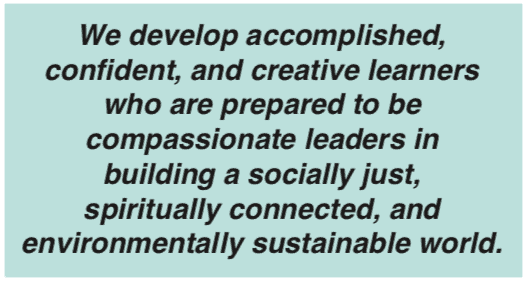
This school year I will be writing a series for Heart of the Matter based on our board Ends Policies. Ends Policies are written by the board as the guiding light for our school.
They point the way toward who we want to be and where we want to go. Ends Policies may seem lofty because they are meant to be grand goals that we may never fully reach but we are always working toward.
Ends Policies
The Executive Director is responsible for implementing systems and programming at Rainbow Community School that work toward our Ends. For this series of Heart of the Matter, I will be sharing my interpretation of each Board Ends Policy so we all know what our intentions are as a community.
The first and most important Ends Policy is our mission. What follows is an interpretation of our mission that is broken down, phrase by phrase. I hope that this feels as alive in you as it feels alive in me.

Reneé Owen, Executive Director
We develop:
This first verb in our mission is very important. As we often state, an education at RCS is more about development than mere achievement. Learning is the core of education. However, if learning is only instrumental, technical, or social conditioning, it is not sufficient to create humans who will become their highest selves — humans who will help society to evolve to reach its highest potential.
Stages of Development
Human development is a complex matter that, according to science, comes in stages. Children will remain at one stage for many years, but while they are in that stage, we are preparing them to successfully and beautifully transition into the next stage of development when they are developmentally ready.
Additionally, we are helping them lay a foundation for successful development throughout adulthood by teaching them how to think critically, have strong character with positive values, and be integrated “whole” human beings. Achievement comes naturally when humans have been educated to understand and utilize their whole selves.
Developmentally Appropriate
Note that the term “developmentally appropriate” is often heard at Rainbow. As pedagogical scientists, we understand the appropriate abilities of learners at various ages.
We know, for example, that you can teach a child to mimic advanced academic behavior at an age that is premature for them to truly understand it deeply, therefore stunting their ability to be more advanced at older ages. Likewise, we know that when only one aspect of development is overemphasized at stages of development, it stunts holistic development in other domains.
False Development
The most common example in our society is the advanced “false” development many schools try to force onto children before they are ready. Because the children are not ready, forcing such advanced academic work on them requires cutting out other activities that would develop their whole selves such as play, creative activities, and unstructured social time.
When one area of the brain is overemphasized, developmental “windows” of opportunity are missed in other areas. These missed developmental opportunities can never be fully recovered, and can result in a host of maladies, notably mental health issues.
Accomplished, confident, and creative:
Beauty, Truth, and Goodness
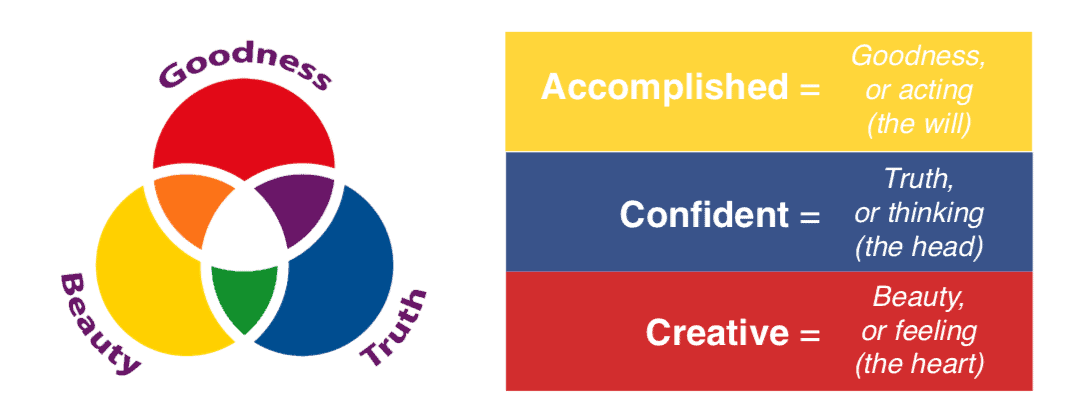
In general, this triad is meant to evoke the triad of beauty, truth, and goodness. Although accomplished, confident, and creative don’t match up one-to-one with beauty, truth, and goodness, the concept of health and wholeness coming in triads is important.
Triads create balance that a duality can never achieve. Triads create a dialectic where two aspects of a triad may be working together or in tension with one another, and then the third element is a catalyst for change or evolution/development to a higher level.
Although it is not exact, or one-to-one, as I say above, this triad of accomplished, confident, and creative loosely relates to beauty, truth, and goodness as such:
Accomplished:
RCS is not just a learning lab where students will devour knowledge provided by a teacher; it is real life. We want students to have authentic experiences in the world including opportunities to see problems in the world, and to act out of goodness to alleviate them, either through service, service- learning, or creating inventions and design plans that have the potential to help.
“Accomplished” also means that students need to be productive. They need to leave RCS having literal, material accomplishments such as awards and achievements; and they also (or more so) have to establish productive and positive work habits and manners of being, so they are set up for success for the rest of their lives.
Confident:
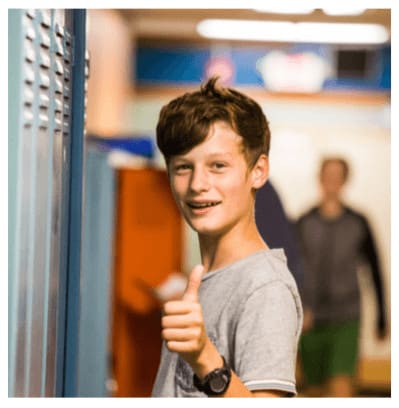 “Confident” has to do with the way learners approach the world. We want learners to see themselves confidently as forces of good in the world.
To have this sense of confidence, they need to have worked to find their own personal truth, including understanding that truth is a flowing concept and they will forever be changing and adapting their truth as they confront new realities in life and in their being.
This means they have to be robust critical thinkers who don’t merely consume information, but evaluate and apply it. This means they need to have developed an epistemological stance in life where they can understand complexity, think in systems, and later in life visualize and mentally manipulate systems within systems.
Creative:
The creative learner has developed their heart. In the triad of head, heart, and hands, they have learned that the heart – not the head – is truly the best “boss;” and when the triad is in balance, the head and the hands are in service to the heart.
Creative learners have had the immense privilege of being allowed to “follow their heart” and have discovered those results experientially. Through taking such risks they have learned wisdom through mistakes, including the wisdom to know that mistakes are necessary, forgivable, and often lead to brilliance. Partly, through their own experience with mistakes, they have developed true compassion for the human-ness of others.
Creative learners are in touch with their intuition. They are inspired by ideas that come from beyond… beyond somewhere anyone can explain. They have access to such inspiration because their conduit to creativity has not been criticized or cut off, but nurtured and encouraged. They have rich experiences of working on the right side of their brain and getting into “the zone.”
Prepared:
“Prepared” looks different for every student, for
every learner has different gifts and challenges.
Therefore, prepared means making sure each student has developed essential learning skills that have prepared them to continue learning throughout life.
Part of this preparedness means being able
to meet the world with one’s authentic self – so by the end of eighth grade students will have prepared themselves through deep personal analysis and inner reflection.
Compassionate:
In part, “compassionate” is in contrast to “competitive.” Although there is solid scientific evidence that some humans have the competition gene and need healthy opportunities to compete for proper development, the idea of having competition as the bedrock of society is, according to anthropological evidence, completely misguided.
Humans would not have survived thus far if they were not naturally collaborative – working together and pooling the greater mind of the group to overcome nature. Unfortunately, we became so good at overcoming nature that we have completely dominated it to the point that our very survival now depends on us collaborating in ways that span vast and complex systems.
Now, instead of overcoming nature, we need to overcome greed, misguided individuality, and paradigms of injustice. In short, we need to overcome our compulsion and deep-seated cultural habits to exploit the earth and one another.
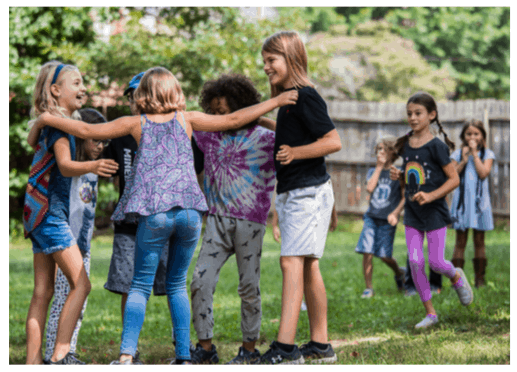 Learners who are compassionate have learned from a very early age to sit still and go inward to reflect on their emotions and notice how emotions affect their thoughts and actions (and more emotions).
They have learned how to articulate these emotions, and therefore, recognize emotions in others. They have learned empathy – the ability to relate to the feelings of others and to be connected human beings. This helps learners communicate in a manner that breaks barriers and frees the mind and heart to learn and to learn even more by collaborating and working with others. Compassionate learners don’t just feel, they act out of this compassion.
Leaders:
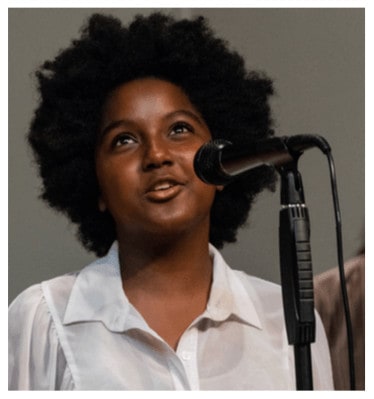 Note that compassion does not stand alone in the mission, but as a descriptor of the word “leaders.” Compassionate leaders have learned, as mentioned above, that the heart is actually the most appropriate personal “leader.”
They are considerate of others in their decisions. After all, that is what leaders do – they consider others.
The word “leaders” – like all words in our mission – was considered carefully. In this case, the concern was whether or not the term implies forced leadership, or the expectation that every student be a dominant person, when the world has enough dominate people. In the end, it was decided that anyone who is a good role model is a leader, and good role models are what we expect a Rainbow graduate to be.
Building:
Whether we are still designing, excavating, or have moved onto laying the foundation or even construction, the point is that Rainbow graduates will be helping the world make positive progress toward becoming a socially just, spiritually connected, and environmentally sustainable world.
They will not take, they will give. They will not rest (except to the degree resting is healthy), they will work. They will not give up because it’s hard, or it’s painfully slow, or because sometimes it seems like we are moving backwards. They will not give up because they cannot do it all by themselves. They will wake each morning with a purpose in life.
Socially Just:
This phrase is expounded upon in the interpretation of Ends-4. Here it is enough to say that the world a Rainbow graduate is working toward is one where every human has the opportunity to have not only their basic needs met, but also to become a self-actualized person, to use Maslow’s language.
Every person, no matter what their circumstances or how rare (or common) their perceived differences may be, deserves to be included and cared for by a loving, communal, societal force.
Spiritually Connected:
The interpretation for Ends-5 provides an exploration of Rainbow’s spiritual end. We envision a world where human spirituality is recognized as a core aspect of being human, if not the very thing that makes us human – that breathes life into our souls.
In such a world, spiritual development would be understood as an important aspect of education, work life, and family life. It would not be relegated to those who choose to be a part of an organized religion, but instead it would flow through the veins of our civil life.
Rainbow graduates will help create a world where we recognize, honor, enrich, and utilize our spirituality to create greater well-being for all people.
Environmentally Sustainable:
This is expounded upon in the Ends-6 report. Fritz Capra defines a sustainable society as one that “satisfies its needs without diminishing the prospects of future generations” (From the Web of Life, page 4.)
To accomplish this means shifting out of the paradigm that became firmly established during the industrial revolution of linear thinking to one that thinks and operates in systems, cycles, and webbed networks.
This also means shifting out of the current American paradigm where the economic sphere is the most important, or dominating, social sphere — where virtually everything is “commoditized” and economic growth (typically for the few) and competition is the underlying mandate from whence most political and social (and individual) decisions and actions are made.
The new, sustainable paradigm would move us out of our current anthropocentric attitude (where humans are viewed as the center of the world), and put humans in relation to all of nature and as stewards of the natural world. Harmony.

Bringing it to Life
In general, as practitioners of holistic education, we know that the whole is always much greater than the parts added together. For the sake of analysis and greater understanding I have broken our mission statement into parts and pieces, but our mission comes to life when it is whole.
Our mission comes to life every day when we live it — every morning when our teachers arise in thought and meditation for their students; every moment a child expresses wonderment and is embraced in love; every year when we, as a community, come together with awe and appreciation for our human qualities – including (and perhaps especially) our faults; in order to lift one another up so that our children can be better than us.
by Cynthia Calhoun | Sep 12, 2018 | Blogs, Home Page News
First Grade Studies Beautiful Trees
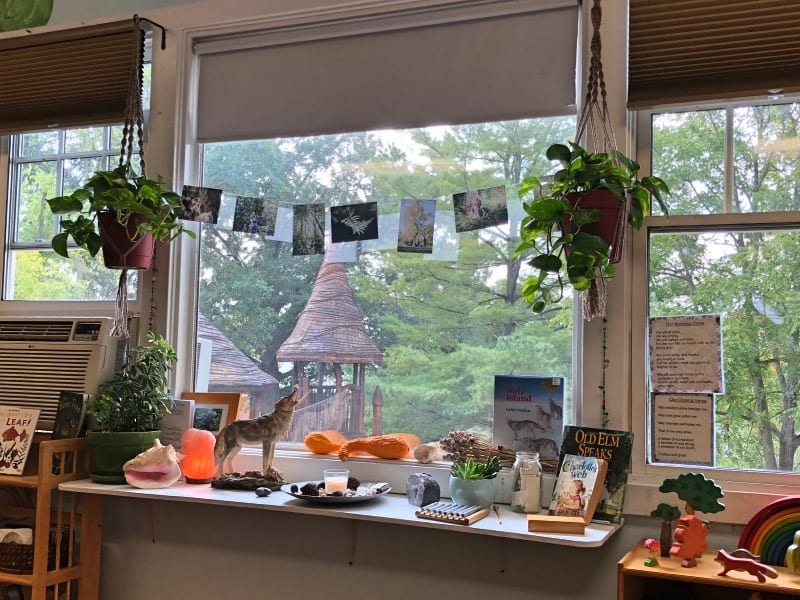
We stepped into first grade recently, into a veritable classroom forest. There were displays of books about trees, nature artifacts that reminded us of our natural roots, and artwork that featured patched trees and their individual parts. First grade is studying beautiful trees in all their splendor.
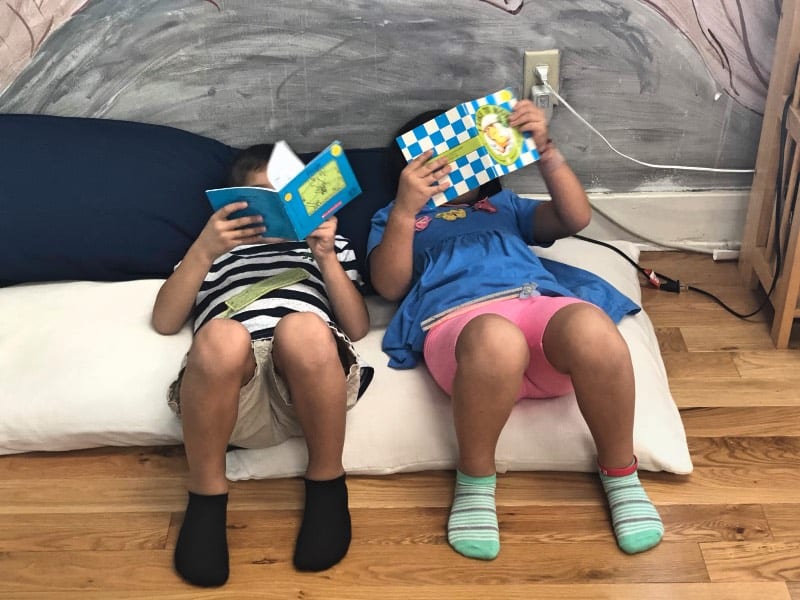
The first grade “wolves,” as they call themselves, were contentedly reading to each other. They quietly tried out new words and soaked up fun ideas from illustrated books.

The Story of Trees
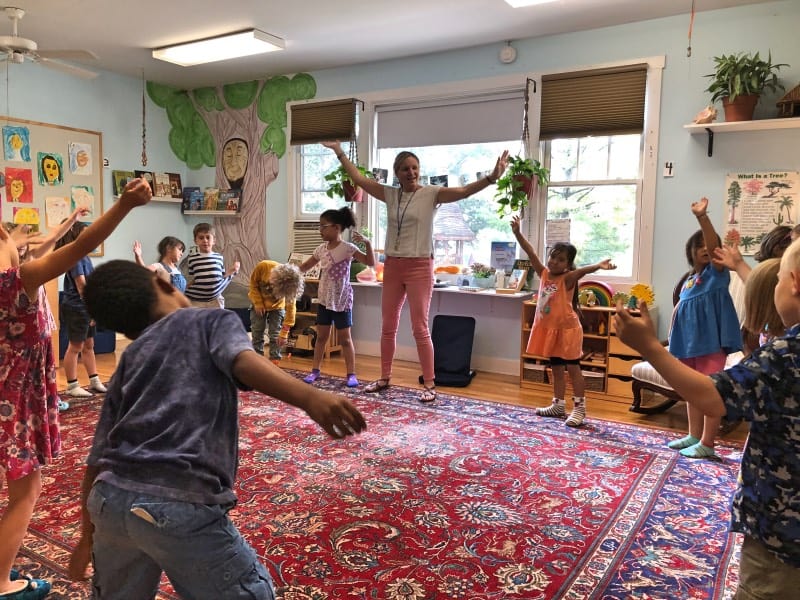
Their teacher, Rachel, guided them into a circle where they recited a poem about trees. They swayed like leaves, or dropped to the floor like apples. They sang and recited verses from the song, “I’m a Tall, Tall Tree.” At the conclusion, students huddled together to hear a story.
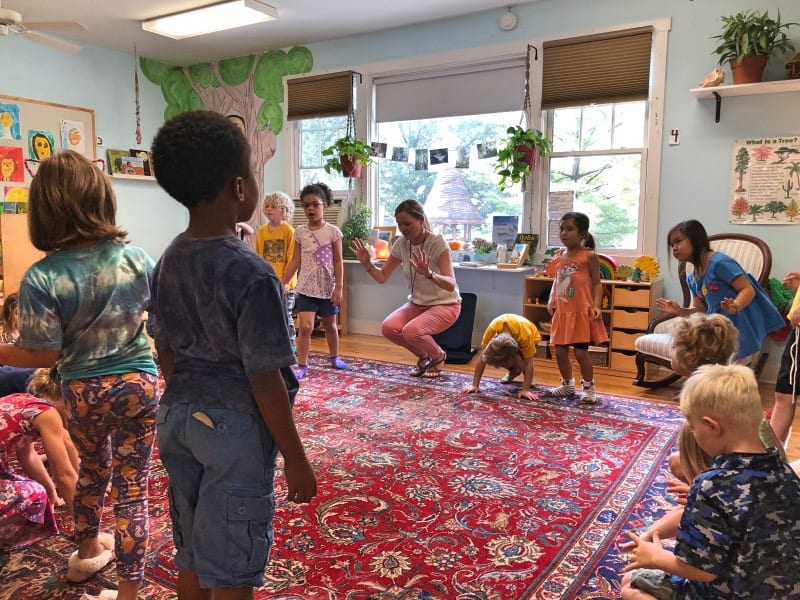
Ms. Rachel read about many different trees that grow. She asked her students about all the different varieties they might have already known: “Apple tree!” one said. “Maple! Peach! Magnolia!” chimed others. First graders are about the same age as it takes for an apple tree to mature: 6-10 years, depending on the species.
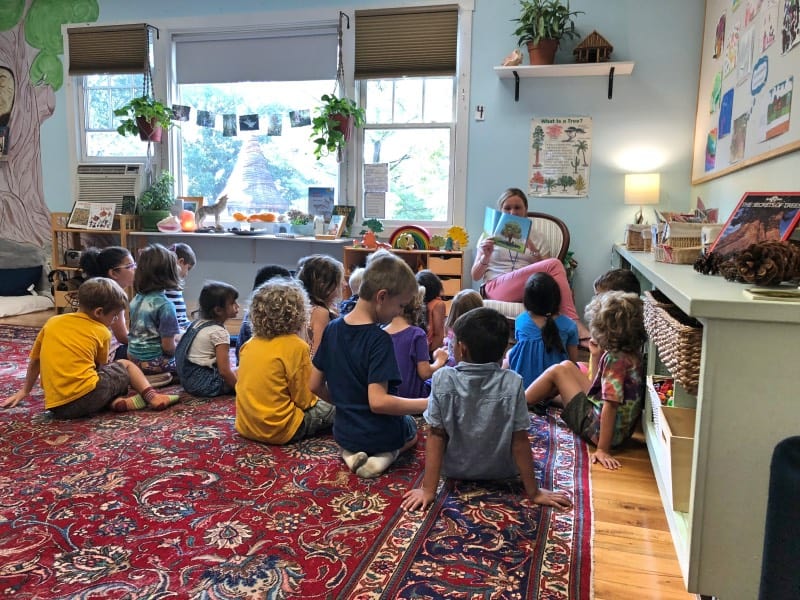
The Four Elements to Make a Tree Grow
They arrived to a part in the book that detailed the four elements of what trees need to grow big and strong.
These first graders already knew:
Air. Water. Soil. Sunlight.
A Little Space
But there was just one more thing that trees needed to grow. What was it?
Rachel called up one student. Then another and another until there were four, standing so close together they could hardly breathe….
All these students were “trees that hadn’t fully grown” and they quickly figured out what that last thing was. Trees need space.
These four students spread out and demonstrated how having a little space made it much easier to spread and grow.
So many life lessons in that statement: having a little space makes it much easier to spread and grow.
The Natural and Physical Domains
There was more. Each student became an “element.” Rachel handed out cards of either air, soil, water, or the sun. Students wore them as badges of honor as they imagined they were air, water, soil, or sunlight. They lined up to head toward the outdoor classroom to incorporate two different modalities of learning: the natural and physical domains.
Rachel’s instructions were to run around the outdoor classroom, but when they heard, “1-2-3-GROW!” each person had to find the other elements that would make a tree. When all four students – elements – were joined, they’d make a circle, giving themselves some space. As they successfully “grew into a tree,” they’d exclaim, “I’m a tree! I’m a tree! I’m a tree!”
After several rounds of finding the different elements, students returned to their classroom. This space is a peaceful oasis that peers out to the Gnome Village below, giving the impression that they are, in fact, in a tree house. We knew they were secure in the knowledge that they wouldn’t soon forget what makes a tree grow from a seedling into a sprawling giant.
by Cynthia Calhoun | Jul 24, 2018 | Blogs, Home Page News
As we gear up for the school year, we thought it would be fun to highlight one of the first faces you’ll see on campus: Kate Chassner! She is Rainbow’s Office Manager.
She seemingly knows the answers to everything. Need keys? She’s got ’em. Need to know the schedule? She can tell you. Need to find someone on campus? Kate will know. Need to locate a form? Kate’s got you covered.
We gave her a set of questions to answer, interview style. It’s so fun to read the answers of these team highlights.
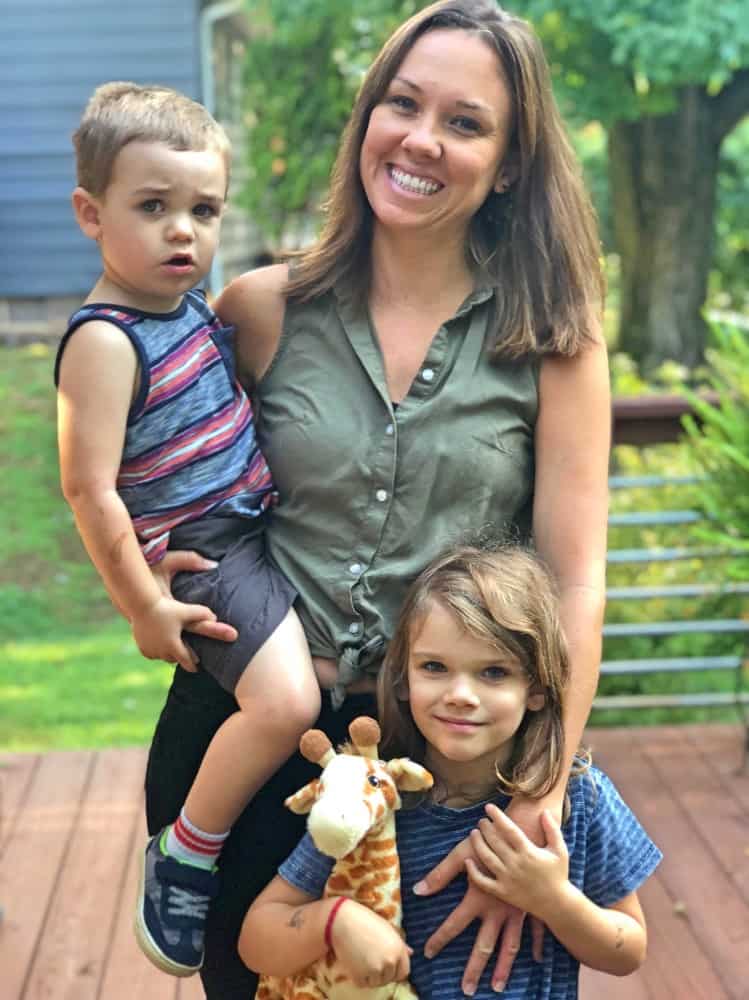
You’re originally from Florida, right? How did you end up at Rainbow?
After I graduated from Florida State University, I moved to New Orleans with my sister. On a trip back home to Florida one Thanksgiving I ran into a friend from college and we started dating soon after. He lived in Asheville. I then decided that I should move here, too. We have been together for 10 years and have two kids. I’m glad I moved.
How long have you been in Asheville? At Rainbow?
I have been in Asheville since January 2010, and I have been at Rainbow since August 2011.
Why did you decide to do the work you’re doing now?
I was teaching preschool when I first started at Rainbow (and I taught preschool for years before coming to RCS). After I had my first child, coming back as a full-time preschool teacher was very challenging. I knew I did not want to leave Rainbow but I needed a change. At that time, the current Office Manager was transitioning out and I was able to begin helping part-time in the office. I was thrilled to train for the position.
What is the favorite part of your job?
I love getting to know everyone in the school and make connections with teachers, staff, parents and students.
What do you like to do when you’re not at Rainbow?
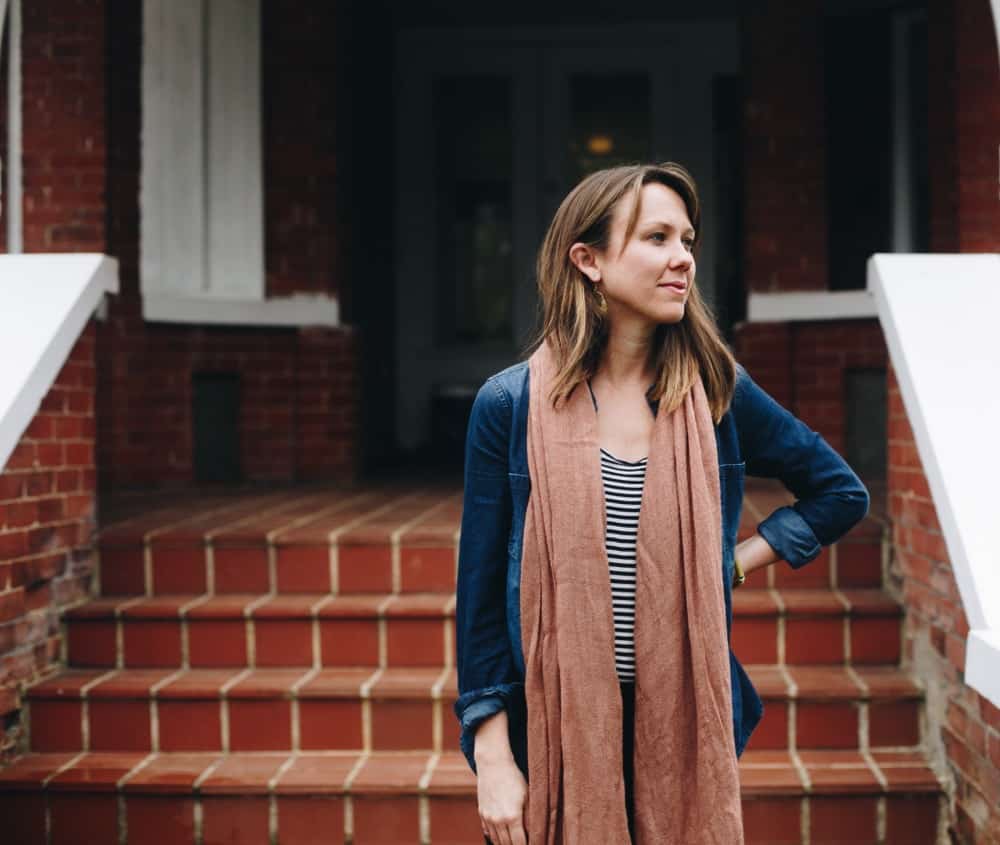
I love my family time! Going on hikes, bike rides, swimming, making forts, dance parties, cooking, painting and really anything with my family is what I look forward to most.
I am making more time for art lately, too. In addition, I have been taking marimba with Sue Ford.
I also try to run a few times a week and get into a good book.
You’re taking an art class on campus. What sorts of art do you like to create?
I am currently taking a drawing class, and I every time I take an art class I find out a new style or medium I love. Currently I create a lot of mixed media pieces (collage with my drawings layered in). Most of my art has a message about something I am passionate about. (You can see my art on my Instagram page @k8couture.)
What’s the best way to start the day?
My 2 year old wakes me up most mornings, earlier than I would like. But ideally I would like to wake up (after the sun has come up) and sit on the porch with a cup of coffee or go for an early run. Still, I know I will miss my sweet early mornings with my kiddos as they get older.
What irrational fear do you have?
As a parent I have all sorts of irrational fears for my kids. To that end, I have to find a balance between letting them be adventurous and keeping them safe.
What book(s) are you reading?
Right now I am reading, The Muralist by B.A. Shapiro and Conversations Worth Having by Jackie Stavros and Cheri Torres.
I read Americanah by Chimamanda Ngozi Adiche earlier in the year. I loved it and really enjoy anything by her.
What’s the farthest you’ve traveled from home?
I lived in Tokyo, Japan for 2 years when I was young (6 years old).
My family lived in Geneva, Switzerland when I was in college, so I visited there often. I also studied Art History in Paris, France. All were super interesting and wonderful. Traveling is such an amazing experience and I can’t wait to travel more as my kids get older.
What is something that everyone should do at least once in their lives?
Travel to another country.
What is an item on your bucket list?
A long overdue honeymoon with my husband
If you could talk to any person, living or deceased, for half an hour, who would it be?
Martin Luther King, Jr.
Pablo Picasso
What advice would you give to your younger self?
Take risks. Stay true to yourself. Tell the people you love how wonderful they are… as often as possible.
You have been granted one wish that WILL come true. What do you wish for?
I would wish for a greater understanding throughout the human race to treat people with respect and to celebrate our differences.